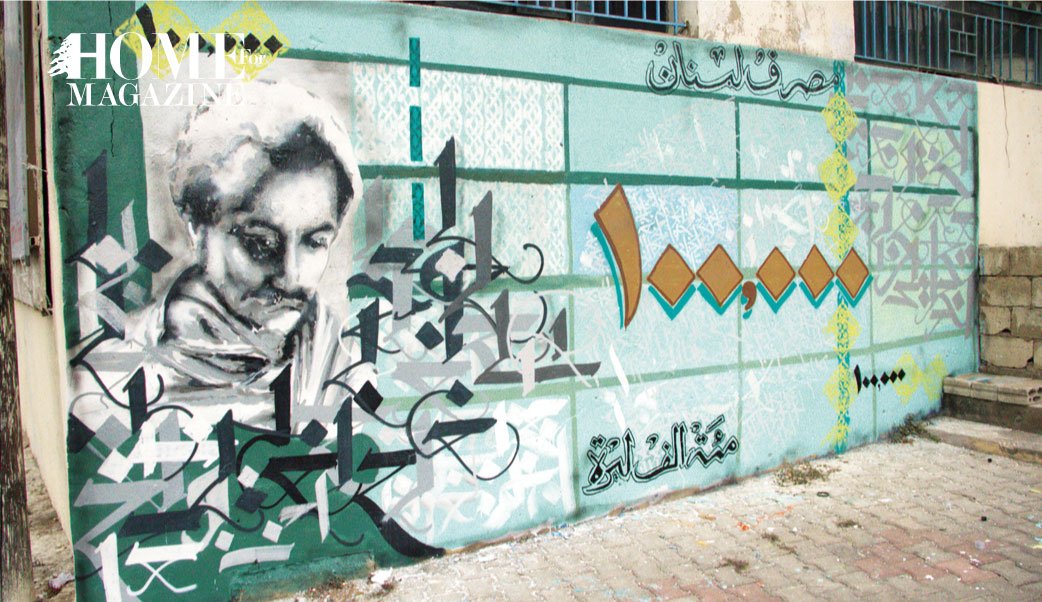
Yazan Halwani is not your average street artist. His style combines elements of Arabic calligraphy and arabesques, mixed with urban Western graffiti styles. His murals depicting famous Arabic personalities such as Fairuz can be found on the walls of buildings around Beirut.
Born in Beirut in 1993, he became interested in graffiti at a very young age and started producing the largest graffiti murals on the walls of Beirut. Halwani has taken the local urban art world by storm as one of the youngest graffiti artists in the Middle East. His work not only covers walls all over Lebanon, but he also produces original pieces for HOMEs, TV shows and shops.
What inspired you to start doing graffiti?
Graffiti is the easiest of art forms to start with if you have no idea about art. You just need a bit of paint, a bit of time, and the canvas is offered by the city. When I was around 14, I had a seen graffiti in movies and heard about it a lot. I decided to try it myself. Bit by bit my style developed and became my own.
What kind of message do you convey with your art?
When I first started, I didn’t have a particular message, but as I progressed, I wanted my art to be more culturally inspired, to exhibit it to the Lebanese people and to the world. In Lebanon, culture is summarized by politicians, not by poets or artists. I wanted to show people a more positive aspect of Lebanon. This is why at one point instead of making graffiti, I removed posters and painted portraits of cultural figures.
What was your inspiration to create your works of art?
When I started in 2009, the European and American graffiti movement inspired me. In 2012, I decided to change that and to move to a style that is more contextually and culturally relevant. I taught myself calligraphy from an old book, and was fascinated by Oriental geometry and art forms – these are the current building blocks of my work.
What do you love about street art?
I think the nice thing about graffiti is that it changes the perspective people have of simple things. The owner of the building next to my Fairuz mural once told me, “It’s fascinating how ever since you painted this wall, it has become the most photographed wall in the city. I see people taking photos of it every single time I go down or up the stairs.” I find this interesting because it creates a sense of interest for simple things, like walls. Talking to people that live near the mural, I think this is a very important aspect of the mural making process – making sure the mural talks to the people around it – otherwise it will not become a landmark for them.
How do you go about choosing a location to graffiti? Is there something you look for?
Some walls have character, others have less. It is like your thought process when choosing friends, you don’t really know how it happens, but some walls are more interesting than others.

How do you think Lebanese see graffiti?
People see it as an entertainment more than art. Unlike in the West, we don’t have a history of graffiti being seen as vandalism, so it has a much better image here. Taking out money from your own pocket and painting and decorating the city’s walls is very interesting to them. They don’t want to stop you, but it’s a bit weird. They kind of like it.
What do you want people to get from your work?
That you can do something good for the public even if it does not benefit you. I get a lot of times people asking me why I spend time and money on painting a wall in the street when I could use the resources for more “personally beneficial” purposes. I usually tell them that this is the exact thought process that creates most of the problems we complain about everyday: traffic, bad infrastructure and even selfishness.
What is your favorite piece from your graffiti collections?
I sometimes ask my mom who is her favorite between her three kids, she tells me a mother loves all her kids equally.
What do you see for the future of art in Lebanon?
I think we have a long way to go. I think art in Lebanon is comprised of a very sophisticated community of artists, known in the world and Arab world, but we don’t have the cultural infrastructure to promote the artists in our own country. Local artists may be known internationally but not locally.
What do you see for your future in the arts?
I never had an objective to become an artist who sells paintings in galleries. I just wanted to put things on walls – and this is still the case. I want my work to be part of the city, embedded in the culture and history. In my perspective, a mural in the street is not the artist’s it’s the city’s. It’s for Beirut, not for Yazan Halwani.
![]()

HOMEland Magazine
We firmly believe that the internet should be available and accessible to anyone, and are committed to providing a website that is accessible to the widest possible audience, regardless of circumstance and ability.
To fulfill this, we aim to adhere as strictly as possible to the World Wide Web Consortium’s (W3C) Web Content Accessibility Guidelines 2.1 (WCAG 2.1) at the AA level. These guidelines explain how to make web content accessible to people with a wide array of disabilities. Complying with those guidelines helps us ensure that the website is accessible to all people: blind people, people with motor impairments, visual impairment, cognitive disabilities, and more.
This website utilizes various technologies that are meant to make it as accessible as possible at all times. We utilize an accessibility interface that allows persons with specific disabilities to adjust the website’s UI (user interface) and design it to their personal needs.
Additionally, the website utilizes an AI-based application that runs in the background and optimizes its accessibility level constantly. This application remediates the website’s HTML, adapts Its functionality and behavior for screen-readers used by the blind users, and for keyboard functions used by individuals with motor impairments.
If you’ve found a malfunction or have ideas for improvement, we’ll be happy to hear from you. You can reach out to the website’s operators by using the following email
Our website implements the ARIA attributes (Accessible Rich Internet Applications) technique, alongside various different behavioral changes, to ensure blind users visiting with screen-readers are able to read, comprehend, and enjoy the website’s functions. As soon as a user with a screen-reader enters your site, they immediately receive a prompt to enter the Screen-Reader Profile so they can browse and operate your site effectively. Here’s how our website covers some of the most important screen-reader requirements, alongside console screenshots of code examples:
Screen-reader optimization: we run a background process that learns the website’s components from top to bottom, to ensure ongoing compliance even when updating the website. In this process, we provide screen-readers with meaningful data using the ARIA set of attributes. For example, we provide accurate form labels; descriptions for actionable icons (social media icons, search icons, cart icons, etc.); validation guidance for form inputs; element roles such as buttons, menus, modal dialogues (popups), and others. Additionally, the background process scans all the website’s images and provides an accurate and meaningful image-object-recognition-based description as an ALT (alternate text) tag for images that are not described. It will also extract texts that are embedded within the image, using an OCR (optical character recognition) technology. To turn on screen-reader adjustments at any time, users need only to press the Alt+1 keyboard combination. Screen-reader users also get automatic announcements to turn the Screen-reader mode on as soon as they enter the website.
These adjustments are compatible with all popular screen readers, including JAWS and NVDA.
Keyboard navigation optimization: The background process also adjusts the website’s HTML, and adds various behaviors using JavaScript code to make the website operable by the keyboard. This includes the ability to navigate the website using the Tab and Shift+Tab keys, operate dropdowns with the arrow keys, close them with Esc, trigger buttons and links using the Enter key, navigate between radio and checkbox elements using the arrow keys, and fill them in with the Spacebar or Enter key.Additionally, keyboard users will find quick-navigation and content-skip menus, available at any time by clicking Alt+1, or as the first elements of the site while navigating with the keyboard. The background process also handles triggered popups by moving the keyboard focus towards them as soon as they appear, and not allow the focus drift outside it.
Users can also use shortcuts such as “M” (menus), “H” (headings), “F” (forms), “B” (buttons), and “G” (graphics) to jump to specific elements.
We aim to support the widest array of browsers and assistive technologies as possible, so our users can choose the best fitting tools for them, with as few limitations as possible. Therefore, we have worked very hard to be able to support all major systems that comprise over 95% of the user market share including Google Chrome, Mozilla Firefox, Apple Safari, Opera and Microsoft Edge, JAWS and NVDA (screen readers).
Despite our very best efforts to allow anybody to adjust the website to their needs. There may still be pages or sections that are not fully accessible, are in the process of becoming accessible, or are lacking an adequate technological solution to make them accessible. Still, we are continually improving our accessibility, adding, updating and improving its options and features, and developing and adopting new technologies. All this is meant to reach the optimal level of accessibility, following technological advancements. For any assistance, please reach out to