

HOMEland THEMES
Coming Soon
HOMEland Events & Collaborations
Coming Soon
 Signature Boutique

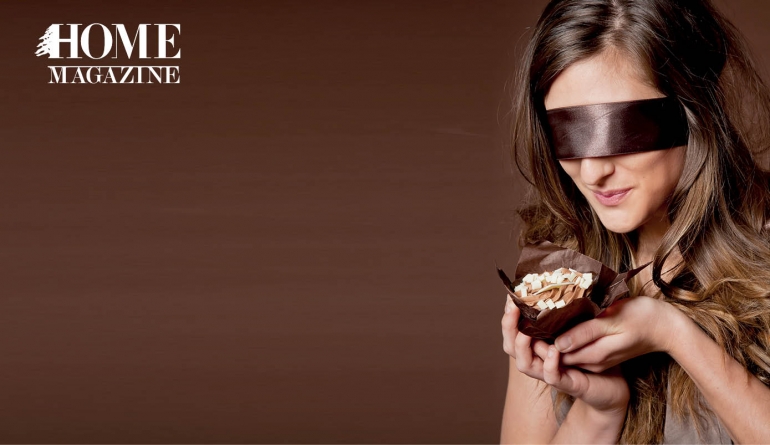
Accepting an invitation to dine in the dark gives the writer new insight.
Article by: Yara Zgheib
Where is the salt?
First question of many that catapults through my mind. I reach my hands forward, slowly, hesitant, feeling the tablecloth in front of me. My fingers touch something tubular. Two. Glass. The top feels like metal. Bingo. Ah, but which is the salt, which the pepper? I set that dilemma aside for now.
Where is my glass of water? Do I have one? Are these my forks and knives? How many are there? This feels like a butter knife; there must be bread somewhere.
But where?
I am hungry, very hungry. The person to my right must be, too. His stomach grumbles loudly; its voice all I know of my table companion so far. I want to keep searching the table with my hands for that hopeful basket of bread, but what if I touch him by mistake? What if someone sees me do it?
No one can see me.
I remember. Just as I cannot see anyone. Every person in this hall is blindfolded or blind, except for the waiters and ushers. Those help four other individuals into their seats at our table. We wait. No more arrive. It seems our party is complete, whoever, however many we are.
“I wish I knew who “they” were, and what version of myself to present.”
We are six. We use our voices to determine that. To my right, the grumbling stomach, I learn, belongs to an older man. To my left, a woman who speaks very softly. Do I hear an accent?
“Should we introduce ourselves?”
Yes, but remember the rules: no mention of names, professions or where we come from. And of course, blindfold on at all times. No exceptions, no peeking, no matter what.
I realize the gentleman who suggested introductions received no response.
I had nodded in agreement the rest probably had, too, but he could not see that. So I speak up:
“Good idea.” My voice sounds odd.
“Would you like to start?”
Oh dear. I should have stayed quiet, safe in the silence where no one can see me.
I feel extremely uncomfortable, confined in that blindfold; I have never liked the dark. My hands want to remove the black mask on my eyes. My instincts want me to leave.
How had “Dining in the Dark” sounded like fun? Too late now, I am here. Deep breath and again, remember, they cannot see me.
I wish I knew who “they” were, and what version of myself to present. We all tailor our personas to the different audiences we face: Ethnic backgrounds present?
Religious, political, philosophical views?
All I know is that there are six humans at this table and no guiding labels I can use.
“All right. My name is … “
First obstacle: first rule.
“Well, for tonight, let’s say, Strawberry.
I am …
Wow, this is difficult.
“I do … “
No.
“I like to read, write, travel, learn. I seek new adventures constantly. I am usually cheerful in the morning. My family is everything to me.”
I direct my voice at the lady to my left.
“Would you like to go next?”
Round the table, the voices take on names like Blueberry, Superman, Michael Jackson. They also take on interests and personalities.
“So you like to read, too?”
A gust of air to my right and a clank. Multiple clanks. First course. Suddenly this table of six blind strangers is catapulted into a team. Twelve hands reaching, I imagine comically, around for their cutlery.
“I think it is a salad.”
“There is no dressing on mine.”
“I have no dressing either. It must be on the table.”
“Careful! I just poured coffee creamer on mine!”
Laughter and silverware clashing clumsily against the porcelain plates. I stab what I hope is a piece of lettuce and aim for my mouth. I miss. I find my lips on my second try, except now there is nothing on my fork. The lettuce must have fallen. On the plate? On my lap? I wish I could eat with my hands.
“I found the dressing! Who would like some?”
“And I found the bread basket!”
We can do this. We can do this. As a team, we identify croutons, lettuce and radish.
The first course is taken away without warning. The stomach to my right is still grumbling. As is mine; I had been slow with the fork propriety had insisted I use. Funny, I reflect. I could have used my hands. Perhaps the others had. No one would have seen. I doubt anyone would have judged. I had set that barrier for myself.
Air and a clank announce the second course is served. And the smell wafts up to my nose. How heightened my senses are, how alert. Every sensation is magnified.
I panic. I am vegetarian, part vegan, and the pickiest eater alive. I cannot eat this mystery dish. I want my eyes back!
I hear my own voice a few minutes ago say, “I seek new adventures constantly.”
Yes, but not this. I want to see again please.
I raise my hand like a schoolgirl.
A few minutes later a waiter taps my shoulder.
“Is everything all right, Miss?” No, no it is not.
“Please, I am vegetarian … “
“Yes, do not worry. It is written on your name card. You have a vegetarian meal, trust me.”
Trust him? I cannot see him! But the hand has already left my shoulder. I am in the dark again, with my fears and my dinner plate. My male dinner companion speaks.
“It will be all right. Just do what I am doing: start with finding your fork and knife.”
I do find that second set.
“Now feel the edge of the plate with your fingers and put the fork in the center.”
I can smell roasted garlic, tomato, herbs and perhaps some white wine? The hot steam flushes my cheeks. My fork sinks into something.
I hesitate.
“Just try a bite. You can always spit it out. And there is always bread.”
That is true. I seek new adventures constantly.
My first bite is a piece of broccoli. I get sauce on my chin and — Where is my napkin? I hope this is a napkin — wipe it off sheepishly. Around me, I hear conversations interspersed with curses and laughs.
” Ableism is a mindset. You decide whether you can or not.”
“I think I am eating chicken.”
“Chicken? I thought it was turkey!”
“How were you able to cut it?”
“Oh, I didn’t! I am using my hands!”
We laugh. Other voices: “So am I!”
And so, six blindfolded strangers become friends and have a lovely dinner.
For the length of three courses, there is a mask on my eyes and no labels on me or anyone. For the length of three courses, I am not what I do, what I look like or where I come from. This is what it is like to be blind. To be blind to stereotypes, too. There is having a disability, and there is being disabled. The latter is a choice.
After dessert and coffee, we take the blindfolds off our eyes. We see one another and the silly, useless labels we, as a society, slap on.
One in every seven people is born with a disability. Many, many more are disabled. Potential is always there, and ableism is a mindset. You decide whether you can or not.
For more info: Empowerment Through Integration: http://www.etivision.org/
Empowerment Through Integration is an organization that offers life skills training programs to children and young adults who are blind or visually impaired. It raises funds and awareness with dinners, like this one, “In the Dark.”
Yara Zgheib’s Essays: https:/www.aristotleatafternoontea.com
Signature Boutique 

HOMEland Magazine
We firmly believe that the internet should be available and accessible to anyone, and are committed to providing a website that is accessible to the widest possible audience, regardless of circumstance and ability.
To fulfill this, we aim to adhere as strictly as possible to the World Wide Web Consortium’s (W3C) Web Content Accessibility Guidelines 2.1 (WCAG 2.1) at the AA level. These guidelines explain how to make web content accessible to people with a wide array of disabilities. Complying with those guidelines helps us ensure that the website is accessible to all people: blind people, people with motor impairments, visual impairment, cognitive disabilities, and more.
This website utilizes various technologies that are meant to make it as accessible as possible at all times. We utilize an accessibility interface that allows persons with specific disabilities to adjust the website’s UI (user interface) and design it to their personal needs.
Additionally, the website utilizes an AI-based application that runs in the background and optimizes its accessibility level constantly. This application remediates the website’s HTML, adapts Its functionality and behavior for screen-readers used by the blind users, and for keyboard functions used by individuals with motor impairments.
If you’ve found a malfunction or have ideas for improvement, we’ll be happy to hear from you. You can reach out to the website’s operators by using the following email
Our website implements the ARIA attributes (Accessible Rich Internet Applications) technique, alongside various different behavioral changes, to ensure blind users visiting with screen-readers are able to read, comprehend, and enjoy the website’s functions. As soon as a user with a screen-reader enters your site, they immediately receive a prompt to enter the Screen-Reader Profile so they can browse and operate your site effectively. Here’s how our website covers some of the most important screen-reader requirements, alongside console screenshots of code examples:
Screen-reader optimization: we run a background process that learns the website’s components from top to bottom, to ensure ongoing compliance even when updating the website. In this process, we provide screen-readers with meaningful data using the ARIA set of attributes. For example, we provide accurate form labels; descriptions for actionable icons (social media icons, search icons, cart icons, etc.); validation guidance for form inputs; element roles such as buttons, menus, modal dialogues (popups), and others. Additionally, the background process scans all the website’s images and provides an accurate and meaningful image-object-recognition-based description as an ALT (alternate text) tag for images that are not described. It will also extract texts that are embedded within the image, using an OCR (optical character recognition) technology. To turn on screen-reader adjustments at any time, users need only to press the Alt+1 keyboard combination. Screen-reader users also get automatic announcements to turn the Screen-reader mode on as soon as they enter the website.
These adjustments are compatible with all popular screen readers, including JAWS and NVDA.
Keyboard navigation optimization: The background process also adjusts the website’s HTML, and adds various behaviors using JavaScript code to make the website operable by the keyboard. This includes the ability to navigate the website using the Tab and Shift+Tab keys, operate dropdowns with the arrow keys, close them with Esc, trigger buttons and links using the Enter key, navigate between radio and checkbox elements using the arrow keys, and fill them in with the Spacebar or Enter key.Additionally, keyboard users will find quick-navigation and content-skip menus, available at any time by clicking Alt+1, or as the first elements of the site while navigating with the keyboard. The background process also handles triggered popups by moving the keyboard focus towards them as soon as they appear, and not allow the focus drift outside it.
Users can also use shortcuts such as “M” (menus), “H” (headings), “F” (forms), “B” (buttons), and “G” (graphics) to jump to specific elements.
We aim to support the widest array of browsers and assistive technologies as possible, so our users can choose the best fitting tools for them, with as few limitations as possible. Therefore, we have worked very hard to be able to support all major systems that comprise over 95% of the user market share including Google Chrome, Mozilla Firefox, Apple Safari, Opera and Microsoft Edge, JAWS and NVDA (screen readers).
Despite our very best efforts to allow anybody to adjust the website to their needs. There may still be pages or sections that are not fully accessible, are in the process of becoming accessible, or are lacking an adequate technological solution to make them accessible. Still, we are continually improving our accessibility, adding, updating and improving its options and features, and developing and adopting new technologies. All this is meant to reach the optimal level of accessibility, following technological advancements. For any assistance, please reach out to