

HOMEland THEMES
Coming Soon
HOMEland Events & Collaborations
Coming Soon
 Signature Boutique

There is something new in Montreal. It is a mesmerizing Lebanese talent that sprinkles oriental magic dust in front of the Consulate General of Lebanon in Montreal. It makes pedestrians open their eyes wide with bewilderment and vehicles abruptly slow down.
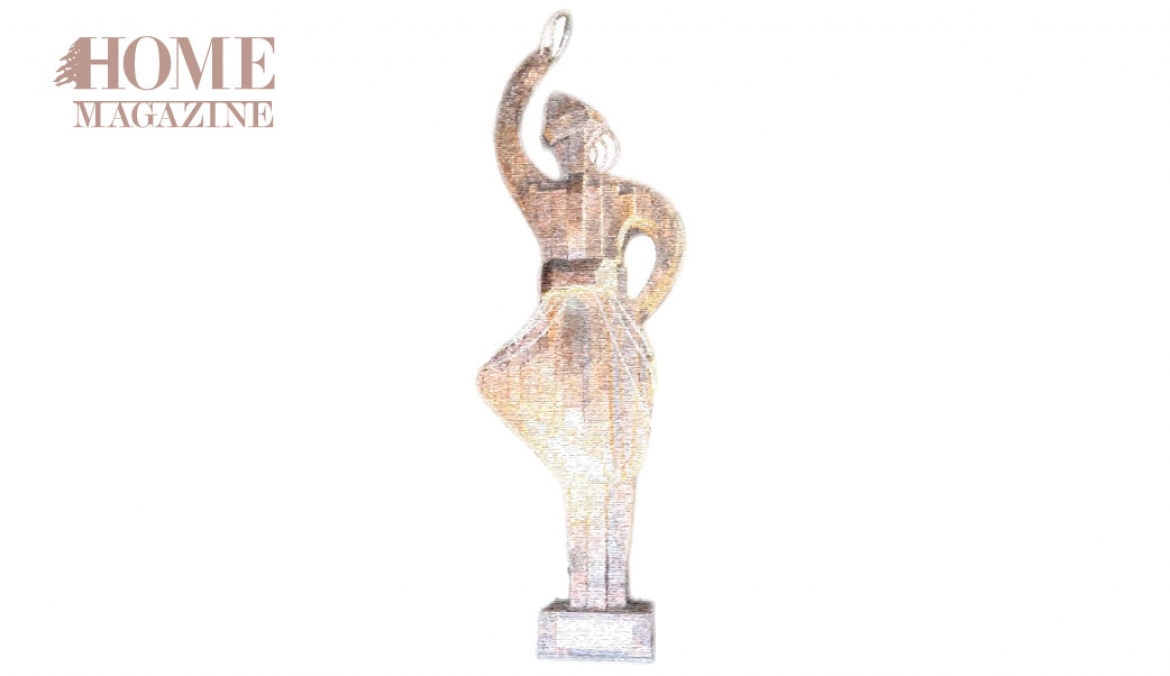
Indeed, since November 4th, 2016, an impressive and majestic five meter sculpture, designed and realized by the Lebanese-born artist Joe Jbeily, has been on display.
The Consul General of Lebanon in Montreal, his Excellency Fadi Ziadeh, organized the event and unveiled the piece of art. It brought together prestigious guests and allowed the artist to present a range of artworks, in different sizes and colors at the Consulate General of Lebanon.
The impressive sculpture, donated by the artist, was conceived to mark the 50th anniversary of the Lebanese consular presence in Quebec. It represents a Lebanese folk dancer holding his head high with pride and captured in a beautiful movement. Monumental and majestic, made from fiberglass and covered with copper and bronze, it invites visitors to enter the eastern magic and get carried away by the joyous steps of the traditional dance of Lebanon. It is also intended to be rooted in the city’s heritage.
While working on this piece, Jbeily admits digging back into his memories for the rhythms that have cradled his childhood. Addabic is indeed an heir to Lebanese traditions. It is also an artwork that reconciles the one who left his native country with the one who chose another HOMEland.
Born in Lebanon, Joe Jbeily has called Canada HOME for over 40 years. His love affair with art began while studying art and sociology. However, despite his numerous business projects and diverse interests, sculpture remained an unwavering passion. In the past ten years, Jbeily has become dedicated to it in a very active way, sparking a fertile talent that expresses itself through a wide number of sculptures in a variety of styles and processes. Allying a personal technique which consists of intertwined steel cables in a variety of woods, his purpose is to create vibrant art whose message transcends the material.
Joe Jbeily reveals: “My challenge is to transcend the emotion which lives in the human soul.” Undoubtedly, the figurative representation is beautiful and the illusion is stunning: Addabic is dancing the Dabke in Montreal! The artist also confides: “After more than ten hours of sculpting, my fingers are often stiff with pain and my limbs are aching. However finding Addabic looking at me, my weariness and pain vanish as if by magic.”
Beyond the magnificently cut piece, the strength of the artist lies in his capacity to surprise us. His Addabic is vibrating with the vital force of his native Levantine country and deeply rooted in the soil of his adopted country.
Joe Jbeily has already produced hundreds of works in exotic wood, bronze and stone that rival in beauty and harmony. Besides having exhibited in several cities in Europe and America, Joe Jbeily is a recipient of various awards:
If you ever pass by the Consulate General of Lebanon in Montreal, be careful, you might discern the beautiful rhythm of a Dal Ouna song as the Addabic is rhythmically and cheerfully hopping. It might take you along a joyous and typically Lebanese dance in the heart of Canada.
“Donating this sculpture to the Lebanese Consulate General in Montreal has a double value for me. It allows me to honor my Lebanese roots and to pay tribute to my adopted city, Montreal.” Joe Jbeily, sculptor
Signature Boutique 

HOMEland Magazine
We firmly believe that the internet should be available and accessible to anyone, and are committed to providing a website that is accessible to the widest possible audience, regardless of circumstance and ability.
To fulfill this, we aim to adhere as strictly as possible to the World Wide Web Consortium’s (W3C) Web Content Accessibility Guidelines 2.1 (WCAG 2.1) at the AA level. These guidelines explain how to make web content accessible to people with a wide array of disabilities. Complying with those guidelines helps us ensure that the website is accessible to all people: blind people, people with motor impairments, visual impairment, cognitive disabilities, and more.
This website utilizes various technologies that are meant to make it as accessible as possible at all times. We utilize an accessibility interface that allows persons with specific disabilities to adjust the website’s UI (user interface) and design it to their personal needs.
Additionally, the website utilizes an AI-based application that runs in the background and optimizes its accessibility level constantly. This application remediates the website’s HTML, adapts Its functionality and behavior for screen-readers used by the blind users, and for keyboard functions used by individuals with motor impairments.
If you’ve found a malfunction or have ideas for improvement, we’ll be happy to hear from you. You can reach out to the website’s operators by using the following email
Our website implements the ARIA attributes (Accessible Rich Internet Applications) technique, alongside various different behavioral changes, to ensure blind users visiting with screen-readers are able to read, comprehend, and enjoy the website’s functions. As soon as a user with a screen-reader enters your site, they immediately receive a prompt to enter the Screen-Reader Profile so they can browse and operate your site effectively. Here’s how our website covers some of the most important screen-reader requirements, alongside console screenshots of code examples:
Screen-reader optimization: we run a background process that learns the website’s components from top to bottom, to ensure ongoing compliance even when updating the website. In this process, we provide screen-readers with meaningful data using the ARIA set of attributes. For example, we provide accurate form labels; descriptions for actionable icons (social media icons, search icons, cart icons, etc.); validation guidance for form inputs; element roles such as buttons, menus, modal dialogues (popups), and others. Additionally, the background process scans all the website’s images and provides an accurate and meaningful image-object-recognition-based description as an ALT (alternate text) tag for images that are not described. It will also extract texts that are embedded within the image, using an OCR (optical character recognition) technology. To turn on screen-reader adjustments at any time, users need only to press the Alt+1 keyboard combination. Screen-reader users also get automatic announcements to turn the Screen-reader mode on as soon as they enter the website.
These adjustments are compatible with all popular screen readers, including JAWS and NVDA.
Keyboard navigation optimization: The background process also adjusts the website’s HTML, and adds various behaviors using JavaScript code to make the website operable by the keyboard. This includes the ability to navigate the website using the Tab and Shift+Tab keys, operate dropdowns with the arrow keys, close them with Esc, trigger buttons and links using the Enter key, navigate between radio and checkbox elements using the arrow keys, and fill them in with the Spacebar or Enter key.Additionally, keyboard users will find quick-navigation and content-skip menus, available at any time by clicking Alt+1, or as the first elements of the site while navigating with the keyboard. The background process also handles triggered popups by moving the keyboard focus towards them as soon as they appear, and not allow the focus drift outside it.
Users can also use shortcuts such as “M” (menus), “H” (headings), “F” (forms), “B” (buttons), and “G” (graphics) to jump to specific elements.
We aim to support the widest array of browsers and assistive technologies as possible, so our users can choose the best fitting tools for them, with as few limitations as possible. Therefore, we have worked very hard to be able to support all major systems that comprise over 95% of the user market share including Google Chrome, Mozilla Firefox, Apple Safari, Opera and Microsoft Edge, JAWS and NVDA (screen readers).
Despite our very best efforts to allow anybody to adjust the website to their needs. There may still be pages or sections that are not fully accessible, are in the process of becoming accessible, or are lacking an adequate technological solution to make them accessible. Still, we are continually improving our accessibility, adding, updating and improving its options and features, and developing and adopting new technologies. All this is meant to reach the optimal level of accessibility, following technological advancements. For any assistance, please reach out to