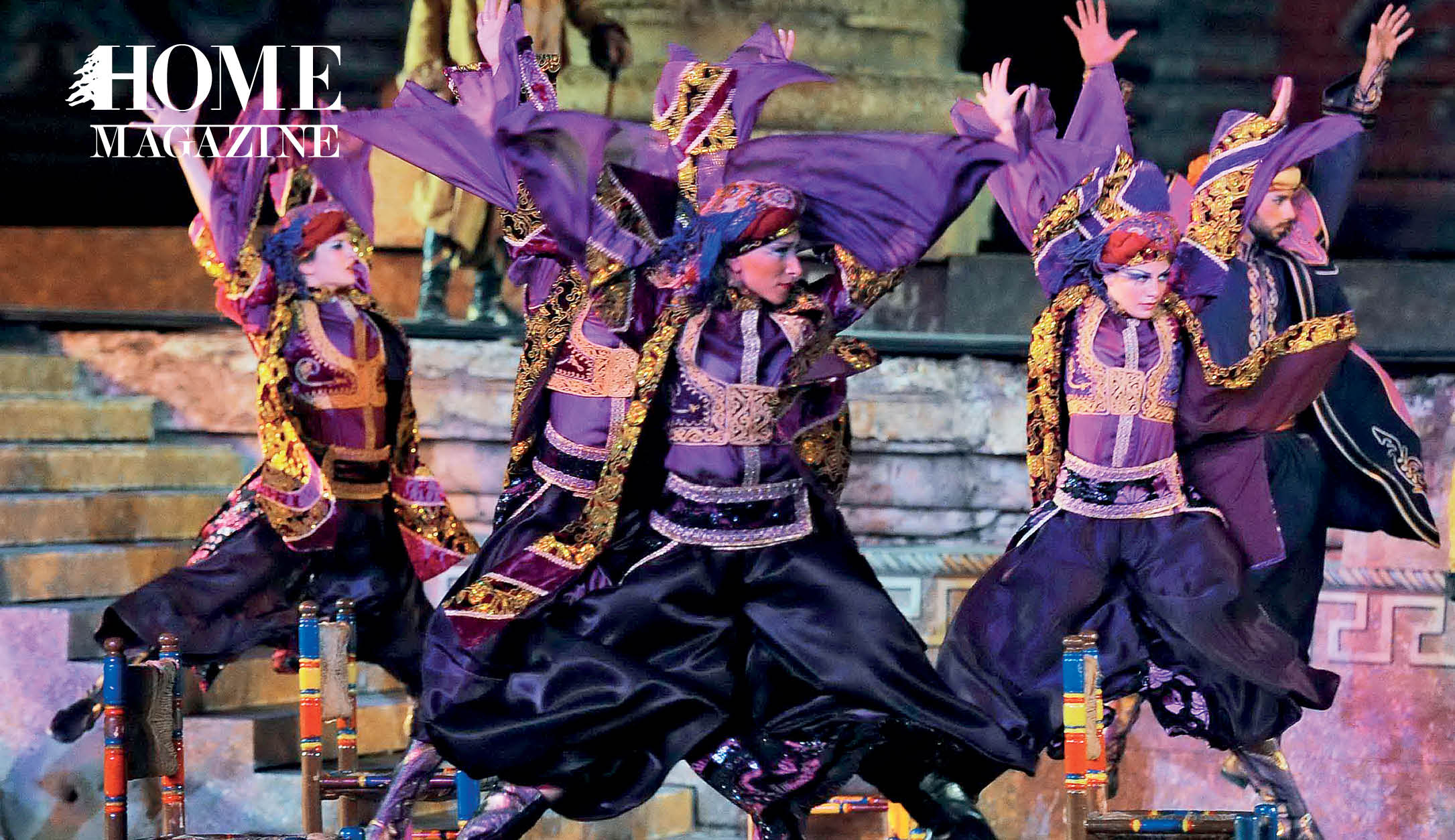

For Alissar Caracalla, artistry is in her genes. Following in her father’s footsteps, she has become a powerhouse of creativity and an unstoppable force in the Caracalla dance community.
Caracalla is the daughter of Abdel-Halim Caracalla, founder and artistic director of the world-famous Caracalla Dance Theater. From birth, Alissar was immersed into the world of theater and dance.
“Some of my earliest memories are of the stage, lights, music, poetry, my father working at night with artists at HOME – sometimes the company would rehearse at the house. My family encouraged me and my brother to be involved in the arts, and being surrounded by all of this definitely had a strong impact on our upbringing,” she says.
Forty-five years ago, her father, a Muslim from Baalbek, married her mother, a Christian from Zahle, in a church. “That takes a crazy artist to do that. We believe in humanity, beauty, peace and a higher power, but we don’t follow terrestrial guidelines.”
During the Lebanese Civil War, Caracalla lived in London.
“I really struggled in my relationship with Lebanon. For the longest time, Lebanon meant my family. My father, my mother, my brother, my company, the Caracalla Dance Theater. I was growing up in London in the 1980s, and all you heard about was war in Lebanon, so I could never really connect to it.”
At the age of 18, she moved to the United States and received a bachelor’s degree in dance choreography and double major in international communications. She then returned to Lebanon to work with her father. While working at the Caracalla Theater, her passion for choreography flourished.
“You cannot be told to become a choreographer. It has to be something inside you. You can’t be taught to create.”
After gaining extensive experience working at the Caracalla Theater, she returned to the United States and graduated with a master’s degree in choreography from UCLA. At that point, she realized that choreography was exactly what she wanted to do, and credits her father as her biggest motivator.
“The U.S. gave me a foundation, an education, but the real experience that I gained was working with my father.
He’s my hero, the light that guides my way. He has enlightened me in every way. Father knows best, even if I didn’t like it. Sure, I’ve had clashes with him, but there was always this voice of reason in my head that said, ‘He knows what he’s talking about.’”
Dance is non-verbal communication, glorified For Caracalla, dance is the most beautiful form of expression.
“I have two ways of seeing it, as a performer on stage, and as a choreographer. I don’t think there’s a word in vocabulary that describes how it feels to perform in front of an audience. You are using your body to communicate, It’s not just movement.
Dance is a complete fusion of the body, soul and mind,” she says.
“As a choreographer, it’s even more beautiful because dance becomes your instrument and you can send any kind of message you want. The possibilities are limitless. A choreographer is someone who has a wide imagination, quite meticulous, can take anything they envision and express it through the human body. They have to be able to dream, believe that anything is possible.”
Contrary to popular belief, not all dancers become choreographers and not all choreographers have been dancers. Her father is a choreographer but never was a dancer.
The Theater: art as a form of peacemaking
The Caracalla Dance Theater was founded in 1968, and from the beginning her father gave a cultural image to the company that became the language of dance in the Middle East. In the Middle East dance meant Caracalla, and this helped make dance more accepted among Arab cultures.
When Caracalla came into the domain, she immediately gained respect thanks to the efforts her father had made to show the Arab region that dance was a respectable art form.
“Caracalla is culture, tradition, heritage – the ultimate form of art.
This is something my father created and I came under, and I’m continuing on that path. It was easier in a way because I didn’t have to battle the barriers of dance, but it’s also harder, because I have to follow the footsteps of a giant in front of me.”
With her father at the helm as the artistic director, her brother as the director and Alissar as the choreographer, they make one powerful team.
Preparing a new show for the Caracalla Dance Theater takes two years. The company’s dancers sign a contract that runs a minimum of five years and when they open a show, it’s a huge undertaking as well as an investment, as they expect each show to run for nine months.
However, no success comes without struggle. “When the country is struggling due to the situation, we struggle.
Sometimes we have to slow down but we’ve never stopped. The company has never stopped a day, not even while there was a civil war going on.”
When the curtain falls at the end of a show’s opening night, Caracalla admits she gets mixed feelings.
“Whenever I achieve something, I don’t hang out in that success too long. I kind of dwell on what’s going to come next. I have inherited this from my father. On the opening night of a show, I’ll see him so serene and quiet and I’ll ask him, ‘Why aren’t you celebrating?’ and he’ll say, ‘What are we going to do next?’ Every opening night is glorious, though.”
Teaching the new generations
Caracalla has had shining moments dancing center stage for the Dance
Theater, and with all she has learned, she is now in charge of overseeing the next generations of dancers, as the director of the Caracalla Dance School.
“The Caracalla Dance School is HOME to over 2,000 students who are transported to a different world within its walls, a ‘pays des merveilles’ . Dance is taught through discipline, which we lack here in Lebanon,” says Alissar. “I encourage every family to place their children in an artistic activity they will have the passion for, and then they will find their track. Children without passion are lost.”
Caracalla would also like the government to get involved in encouraging involvement in the arts.
“In Lebanon we do not have institutions that fund the dance world. I would like to see the government fund and monetize the art world for the Middle East, create opera houses, artistic degrees and funding young artist to develop their talents, for all forms of art. For example, the United Kingdom gives 3.6 billion pounds [$5.4 billion] to art institutions. How are we funded?”
Dance: a career, a form of existing
Dance is not just a hobby. It’s an education, a career, a talent, a form of expression, a form of existing. The most cultural and beautiful image of how to define a country is through art.
Dance is not fully understood in the Middle East, as it is in Europe and the
U.S. It’s not known as a career, but is becoming more and more accepted with the new generation, with the help of commercial TV shows showing people how much it takes to become a dancer.
“All our achievements – when we open at the Baalbek or Beiteddine festivals, perform abroad, welcomed into the biggest theaters around the world, applauded by people, and when we get to send our message of art and peace, and show the beauty of Lebanon and what we have to offer here – those are defining moments.”
Caracalla’s artistic journey continues and with each step, she is promoting Lebanon and all it has to offer.
“Lebanon is HOME. Wherever you go, you have to remember where you come from. You have to go back to your roots to be able to go ahead in life. I feel that Lebanon needs me here because I’m an example of dance and theater for the country. I think if all the talented Lebanese in the world came back, we’d be a superpower. I’m so proud to say I’m Lebanese.”
HOMEland
Coming Soon
HOMEland Events & Collaborations
Coming Soon
 Signature Boutique
 Signature Boutique