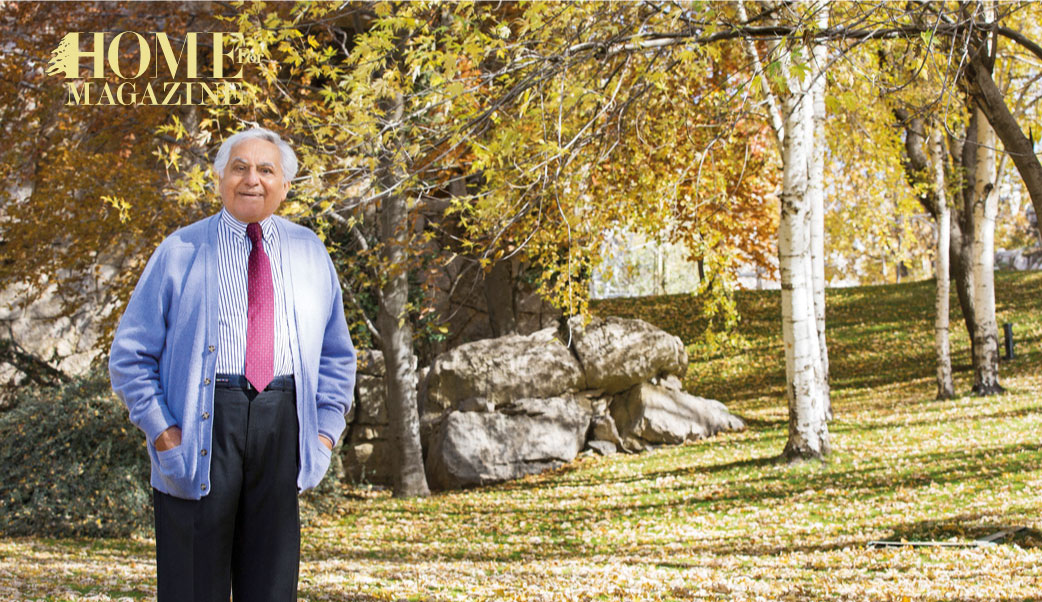
Art and fashion at its most refined, Richard Noura’s fashion items are now coveted around the world. HOME talks to him about his inspirations
Talent has all the powers. It can go beyond borderlines and get to the utmost peak of fame. When creativity is wrapped in innovation, the results reach the farthest lands, beyond one’s expectations. Despite the competiveness of the fashion world, Richard Noura Paris made it to the hall of fame.
Clutches, small leather items, jewels bags, and accessories are all the extension of his creative, yet classy mind. An assortment of luxury and style has reached the most renowned personalities all over the world. From Lebanon to the very heart of Paris, Richard Noura’s creations even outshine international borderlines and fly to the soul of stars. Kate Moss, Beyoncé and many other prominent figures have had a crush on Richard Noura’s sophisticated and well-designed pieces – way to go.
In a way or another, Beirut is most of the time the deepest inspiration of Lebanese artists who tour the world. Richard Noura’s childhood period in Lebanon has definitely nurtured his soul with a taste of thyme and roses. The inspiration behind his creations opened up the way to launching his handbags and accessories line in 2010, after he sculpted his savoir-faire and techniques mastering at Swarovski and Balmain. Colorful statements are Richard Noura’s expertise whereas his personal style distinguishes his luxurious creations all based on a particular composition of ageless aesthetic.

How did you begin your artistic and business journey?
Launched in 2010, my nascent line of handbags and accessories built on my past work experience at Swarovski and Balmain, and offered a variety of show-stopping evening bags, minaudières and accessories made in France, Spain and Italy.
What inspires you?
I have creativity in the genes. I recall a childhood in Beirut that was influenced by my aunt’s notable couture house and my father’s skills as a painter and calligrapher. My parents used to say I was born with a pencil in my hand.
Drawing on my love of ancient art and the natural world, my collection is inspired by Italian gardens of the 16th century.
Who inspires you?
I work with Swarovski crystals and luxurious, exotic skins like crocodile and lizard, and am never one to shy away from making a statement.
Which makes it fitting that my design hero is one of the most revolutionary designers in the world. Someone who deeply marked my childhood was Victoire de Castellane, the current artistic director of fine jewelry at Dior. I’m amazed by her personal style and her sense of exaggeration and color.
What are your favorite colors, materials and textures, and shapes, and how would you define beauty?
The sensual yet timeless shapes of my designs, as well as my use of popular medieval colors and textiles, suggest artifacts taken right out of Boccaccio’s The Decameron. The Charles, the first bag I designed for the collection and also my favorite, comes in a multitude of dark colors like burgundy, dark green and black. Each features his emblematic flower in the center and each reflects my singular luxe-with-a-twist aesthetic.
RICHARD NOURA and DONALD ROBERTSON
On the occasion of his first book launching “Mitford at the Fashion Zoo”, Donald Robertson asked designer Richard Noura to draw a giraffe on coated fun and colorful canvas for a collection of bags and clutches embellished with the iconic motif La Maison Richard Noura, the detail of a plant embroidery in varnish leather.
But the Parisian designer, embodying the French elegance, goes further and displays Mitford on Limoge porcelain storage tray, mugs and cups of tea. So very French.
After an exclusive launch at Colette in Paris in the presence of the illustrator fashion star who had invited the chic Parisians to climb to Mitford neck through one portrait in time, the collection is now present at Etoile Boutique Dubai, Story in New York, Forty Five Ten in Dallas, and Lebelik.com Beirut. Mitford has now two dads that guide the fashion world without losing their heads in the stars!
HOMEland Magazine
We firmly believe that the internet should be available and accessible to anyone, and are committed to providing a website that is accessible to the widest possible audience, regardless of circumstance and ability.
To fulfill this, we aim to adhere as strictly as possible to the World Wide Web Consortium’s (W3C) Web Content Accessibility Guidelines 2.1 (WCAG 2.1) at the AA level. These guidelines explain how to make web content accessible to people with a wide array of disabilities. Complying with those guidelines helps us ensure that the website is accessible to all people: blind people, people with motor impairments, visual impairment, cognitive disabilities, and more.
This website utilizes various technologies that are meant to make it as accessible as possible at all times. We utilize an accessibility interface that allows persons with specific disabilities to adjust the website’s UI (user interface) and design it to their personal needs.
Additionally, the website utilizes an AI-based application that runs in the background and optimizes its accessibility level constantly. This application remediates the website’s HTML, adapts Its functionality and behavior for screen-readers used by the blind users, and for keyboard functions used by individuals with motor impairments.
If you’ve found a malfunction or have ideas for improvement, we’ll be happy to hear from you. You can reach out to the website’s operators by using the following email
Our website implements the ARIA attributes (Accessible Rich Internet Applications) technique, alongside various different behavioral changes, to ensure blind users visiting with screen-readers are able to read, comprehend, and enjoy the website’s functions. As soon as a user with a screen-reader enters your site, they immediately receive a prompt to enter the Screen-Reader Profile so they can browse and operate your site effectively. Here’s how our website covers some of the most important screen-reader requirements, alongside console screenshots of code examples:
Screen-reader optimization: we run a background process that learns the website’s components from top to bottom, to ensure ongoing compliance even when updating the website. In this process, we provide screen-readers with meaningful data using the ARIA set of attributes. For example, we provide accurate form labels; descriptions for actionable icons (social media icons, search icons, cart icons, etc.); validation guidance for form inputs; element roles such as buttons, menus, modal dialogues (popups), and others. Additionally, the background process scans all the website’s images and provides an accurate and meaningful image-object-recognition-based description as an ALT (alternate text) tag for images that are not described. It will also extract texts that are embedded within the image, using an OCR (optical character recognition) technology. To turn on screen-reader adjustments at any time, users need only to press the Alt+1 keyboard combination. Screen-reader users also get automatic announcements to turn the Screen-reader mode on as soon as they enter the website.
These adjustments are compatible with all popular screen readers, including JAWS and NVDA.
Keyboard navigation optimization: The background process also adjusts the website’s HTML, and adds various behaviors using JavaScript code to make the website operable by the keyboard. This includes the ability to navigate the website using the Tab and Shift+Tab keys, operate dropdowns with the arrow keys, close them with Esc, trigger buttons and links using the Enter key, navigate between radio and checkbox elements using the arrow keys, and fill them in with the Spacebar or Enter key.Additionally, keyboard users will find quick-navigation and content-skip menus, available at any time by clicking Alt+1, or as the first elements of the site while navigating with the keyboard. The background process also handles triggered popups by moving the keyboard focus towards them as soon as they appear, and not allow the focus drift outside it.
Users can also use shortcuts such as “M” (menus), “H” (headings), “F” (forms), “B” (buttons), and “G” (graphics) to jump to specific elements.
We aim to support the widest array of browsers and assistive technologies as possible, so our users can choose the best fitting tools for them, with as few limitations as possible. Therefore, we have worked very hard to be able to support all major systems that comprise over 95% of the user market share including Google Chrome, Mozilla Firefox, Apple Safari, Opera and Microsoft Edge, JAWS and NVDA (screen readers).
Despite our very best efforts to allow anybody to adjust the website to their needs. There may still be pages or sections that are not fully accessible, are in the process of becoming accessible, or are lacking an adequate technological solution to make them accessible. Still, we are continually improving our accessibility, adding, updating and improving its options and features, and developing and adopting new technologies. All this is meant to reach the optimal level of accessibility, following technological advancements. For any assistance, please reach out to