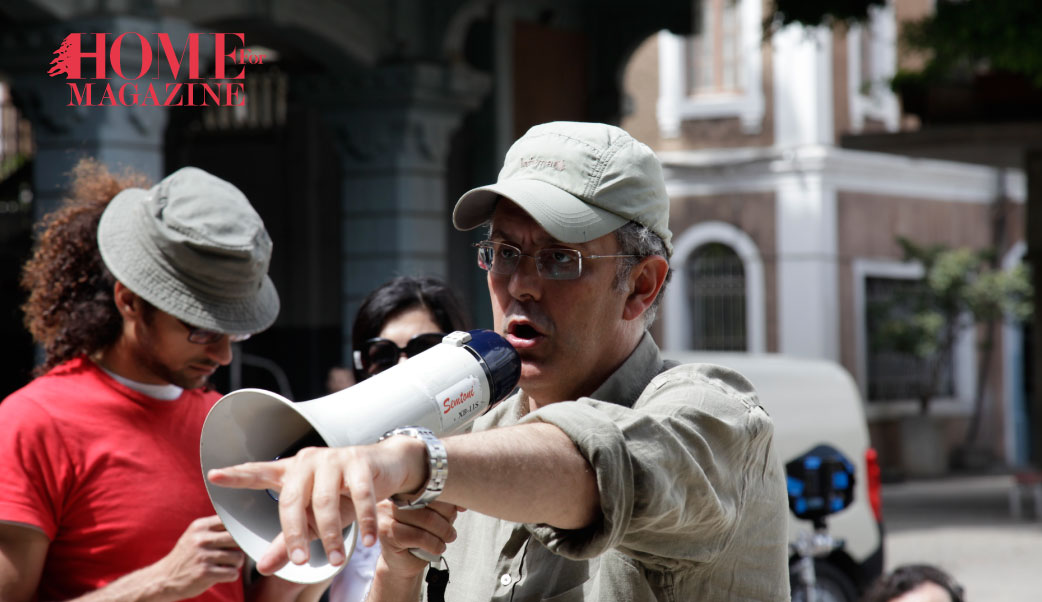
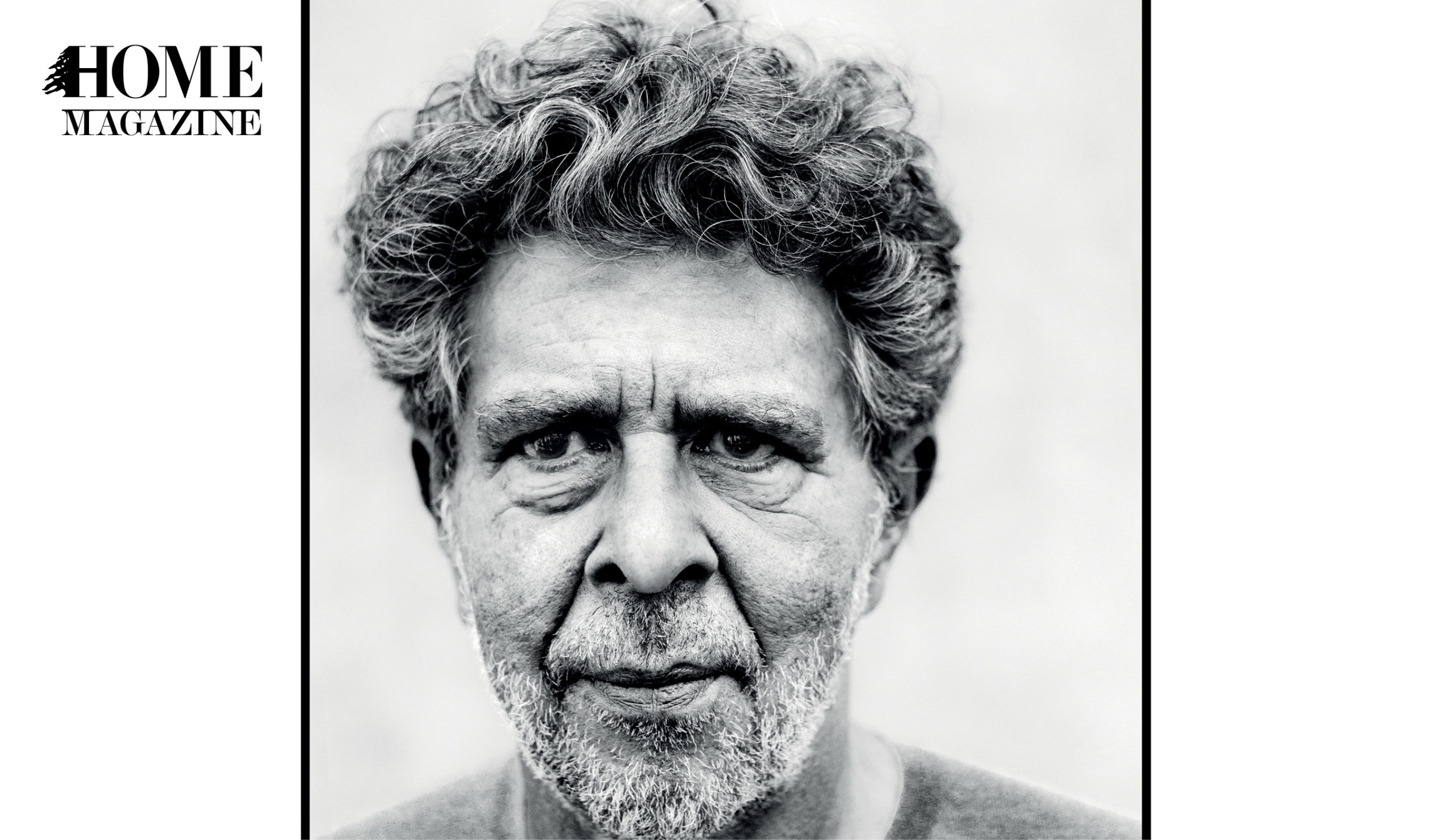
Philippe Aractingi is one of Lebanon’s most prominent filmmakers working today. His films have touched on a wide range of themes and have attempted to shape the way thatLebanese people, both at HOME and abroad view their country and its history. HOME sat down with him to discuss his heritage through the timeless ‘Heritages’ and how he views Lebanon in both his day to day life and in his work.
What component does history play in yourself?
It’s memory more than history. That’s the keyword. Memory is the main way I get the ideas. Fortunately or unfortunately we as Lebanese and myself, have lived through so much. It is very intense what we have been through. I’ve been through 16 years of official war, plus the rest of the nonsense, plus a happy childhood until I was ten years old, plus traveling around the world and being an immigrant three time at least. That’s a lot of stories by itself. That’s only me. What if I listened to people, and I got stories out of their memories? For me we have a wealth of stories in Lebanon and this is why I decided to leave France and come back to Lebanon, and to live here although it is 20 times more difficult for me here than when I used to be in France.
How do you think emigration plays in the heritage of the Lebanese people?
As Lebanese we have emigration in our identity. We have been emigrating for generations. It’s part of our DNA. I realized that when I was on a French military boat leaving Lebanon in 2006. For the fourth time I was leaving Lebanon to settle somewhere else, in another country. This time I realized that I wasn’t by myself, I was with my kids, and I was giving this to them in my inheritance. I also realized that not only me, but five generations of our family have been born and died in different places. We all left at least once, to take refuge somewhere else. Sometimes from Lebanon to Lebanon, sometimes from Syria to Lebanon sometimes from Turkey to Lebanon; all in the Levant. Just for a more peaceful place for our future generations. So we realized that our past history is extremely heavy. We don’t know anything about it, because there are no books of history. In state schools, Levantine history is only taught up to 1945 and up to 1975 in private schools. Kids don’t know their past, and if you don’t know the past, unconsciously you’ll repeat. There are so many studies on that subject. If you don’t know your past, then you’ll want to repeat it, create it again, because you are looking for it. So I thought it was necessary for me to do a story about our history. The Levant’s history. I thought that the best way to tell it, was through my own stories. This is why I started writing ‘Heritages’; for my children, but also for the rest of the children around Lebanon. Now I am proud to say that ‘Heritages’ is shown in 40 schools. We need to understand the past in order not to repeat it.
Therapy
You hoped that your children wouldn’t end up in therapy?
I explained to them that I filmed them a lot, so that instead of remembering their past in front of a therapist they can go back and play the tapes and see how they were raised by their parents.
Haunted by Beirut
Do you have a love/hate relationship or is this a passionate relationship?
I think that I suffer from Stockholm Syndrome with Lebanon. I have fallen in love with my captor.
Betrayal
When talking about nostalgia you said that you felt like you have betrayed your country.
Feeling like a traitor is one of the feelings that you have when you are an emigrant. This is because you haven’t helped your country.
Returning
You say that returning is sometimes more difficult than leaving. Can you expand on this?
Apparently only 18 percent of people that leave their home country return. So if only 18 percent of the Syrians currently outside Syria go back, then that is a lot of Syrians around the world. 18 percent is a very small amount. And then apparently 20 percent of people around the word are first time emigrants, which is enormous when you think about it, and it’s constantly going up. That is another figure that is quite interesting. You need ten times the guts to come back than you needed to leave. Especially since when you leave you’re supposed to be going to something better.
Also you put a lot of idealistic pressure, on what your next life will be like. You leave for France, because you think that it will be better, and it takes you a few years to realize that it’s not, and in those few years, there is a lot of disillusion. Disillusion comes with a lot of ego breaking. You have to face the notion that you were wrong and not only were you wrong but you have to go back to the country that you left. But breaking this egotism is good for you. Also you are afraid to go back, and meet the friends who were jealous because you left in the first place and then tell them that you didn’t succeed or enjoy your time away. So many people thought that I was senseless because I left France to come back to Lebanon. In France I had a job and was making a living.
War
You said in French “il m’a fallu 20 ans pour comprendre que pour eux les méchants c’était moi!” It took me 20 years to understand that for them we were the bad guys.
I was trying to explain the war to my son. He asked me who the bad people were. I wanted him to ask this question, because I wanted to be very frank about the fact that we had a civil war and that we hated each other. I never wanted to say that this was the war of others. It wasn’t. We hated each other. I was a child and at the time I didn’t know who the bad people were. I just inherited this hatred. I told my son that the bad people were the Muslims and the Palestinians, but more importantly, that it took me 20 years to understand that for them, we were the bad guys. There were many Muslims that came to me and asked to host their own screenings of the film. My speech was from a Christian- Francophone person, but they felt the same way. Muslims could say the same sentence, but the other way around. It works both ways around.
“It took me 20 years to understand that for them, we were the bad guys”
But it takes a life time to understand.
It does take a lifetime. This is the reason why we were born here.
Do you still believe in Lebanon?
I’m a very optimistic person. I decided to come to Lebanon and to stay in Lebanon and to fight for Lebanon. When the trash crisis came, it made me sick. I went up to the cedars a couple of week ago, because I was shooting a film. I was at the edge of Mount Lebanon, and the feeling when you are there is so majestic. There is a feeling that it’s not about what’s currently going on, but about thousands of years of history and stories. For me making films is a way of fighting; it’s not just a pleasure, it’s a creative resistance.
“For me making films is a way of fighting; it’s not just a pleasure, it’s a creative resistance”
As well as being a filmmaker, you’re also a photographer?
I’m mainly filmmaker. I have been taking photographs since I was young, and I’m getting back into it now. I’ve had one exhibition in Paris, and I’m preparing others for the near future… I wanted to become an artist. I’m still struggling to be one. I think it is because I have lived so much, and a lot of it has been dark, so it’s like a search. I carry a camera with me wherever I go and it keeps your eyes sharp.
Did you have to fight against superficiality?
There was a suffering at the beginning. I remember my parents taking me to those snobby places, and I would hate it. I would hate it from my heart and soul. I was around 13. I would rather stay home. I come from a bit of a bourgeois society, and what gave me the biggest joy was going to boarding school and meeting normal people. For me it was a rebellious act, not to be part of that superficial way of life. This caused me suffering at the beginning. Now, I am more at ease with my own identity and I have an empathy towards the Lebanese. I have been talking to people a lot. I love to listen to people. My next film is called ‘Listen’. When you listen, you realize that all these superficialities are a huge fight against the fear of death. Making yourself alive is to deny the truth. The compulsion of death is as strong as the compulsion of life. There are studies, about the success of nationalities, throughout time, and the common point that they have found about the most successful nationalities, is the fear of death. They are always in danger. Fear brings a strong desire for life, and a strong desire to live; when it is not intellectual it becomes pseudo-superficial.

You are very exposed when you make something autobiographical. Did you find this too revealing?
Personally, I am fine with it. For ‘Heritage’, at first I didn’t think that anyone would care about my story and then a lot of people told me that this was their story as well. The problem with autobiographical pieces is that you are showing a lot and not only about yourself but about your family. That was quite scary at the beginning.So, I was very careful. First I did the film with my their permission. I showed them the film, and removed scenes that they didn’t like. Then I waited a year before releasing the film, so that the kids where older, from when it was made, and we showed it in Dubai and many other festivals, before we showed it in Lebanon. When people started enjoying it, this gave us the courage to release it in Lebanon. So it was a very long process.
What is HOME and nostalgia for you?
I’ve done a lot of study into the wounds of what it is to become nostalgic or an emigrant. An emigrant suffers many things at the same time. An emigrant suffers from guilt, because he feels that he has a better life than those who stayed, and I mentioned that. You also have problems between couples, and I do speak about the problems that I had with my wife. Fortunately, we are still together and very happy. But in a way we have made a metaphor out of it and created a film, and maybe that made us a better couple. This is like therapy. You speak out loud. Nostalgia is also an interesting word. Some would say that the word derives from suffering from being away from the nest. What is the nest? The nest is where you grow up from zero to nine months. It’s all the surroundings. When I was in France I would eat some labneh, and you think that it tastes different; but it’s not that it tastes different, it’s the environment that comes with it that is different. Your brain and how you perceive the nest is different. Nostalgia, is the wound of the nest. Looking back to find that nest. If you feel uncomfortable, then go back to where you grew up, you’ll feel better. I have a friend who says that when they feel bad, they go back to their childhood neighborhood and they feel much better. When I go to my mother’s house I feel better; it’s not necessarily because of my mother, its because of the vibes in the house.
I am a communicator. I am a filmmaker. My aim is to make my people enjoy my art; but not just enjoy it. I am sure that the films that I make move people. I once showed ‘Heritages’ in Dubai, and we had a Q & A afterwards, and then showed it again, two days later, and there was one guy who had returned for a second time to watch the film and ask more questions. He said “I’ve been longing to tell my story about my past tomy kids for years, but I have never know how. And here comes your film which gives me a pretext to open up the door of my past.” And this was a recurring theme. There were kids that brought their parents to the film to try and get them to open up about their past. So the film became a useful object, a useful therapeutical object, and not just a film. When I was in France I was making films for the French, and it’s less useful to make films that are just for entertainment, rather than an instrumental film that moves people.
HOMEland
Coming Soon
HOMEland Events & Collaborations
Coming Soon
 Signature Boutique