
HOMEland THEMES
Coming Soon
HOMEland Events & Collaborations
Coming Soon
 Signature Boutique

The Olea europaea, the olive tree as we know today, is one of the oldest cultivated trees in the world. It was just a humble evergreen until a clever farmer grafted it with a fruit-producing tree and created the olive. The olive’s exact origin is still a matter of debate, however, but the fact remains that the first trees were cultivated in the Levant thousands of years ago. For centuries olive production has been an essential part of society and culture. The olive has a place on our table year after year as it thrives through happier times.
Grown for thousands of years in Lebanon, it would be hard to imagine the country without olive trees. A country where almost every road leads to an olive grove, Lebanon remains true to its tradition.
Lebanon, known as La Route des Oliviers or the Land of the Olive, dates back ever to Phoenician ancestors and Canaanites. Its hills and valleys, mild winters and temperate summers are perfectly suited to growing olives, the reason why they flourish in this country like nowhere else.
In the countryside, the carpet of olive trees not only enhances the beauty of the country, but serves as a way for people to make a living.
A handful of olives is as precious as a handful of gold.The olive season in Lebanon begins in February or March. As the summer fades and autumn sets in, the olives ripen and the right day for the harvest begins.
All parts of the olive are useful. During the blossoming season the branches are covered in bunches of lightly scented ivory pearls which burst into flower. During the harvest season, the farmer prunes his trees and throws the trimmings into a pile that he uses for fires. The olive wood gives off a good deal of heat. The trimmings are also used to make charcoal and tobacco water pipes. The farmer then uses the ashes from his fire as fertilizers for his olive trees. An olive tree needs to be 8 years old before it bears fruit, the olive, which can be eaten and pressed to produce oil. Olive oil is used as well for dietary purposes and as a cure to heal stubborn areas in the body.
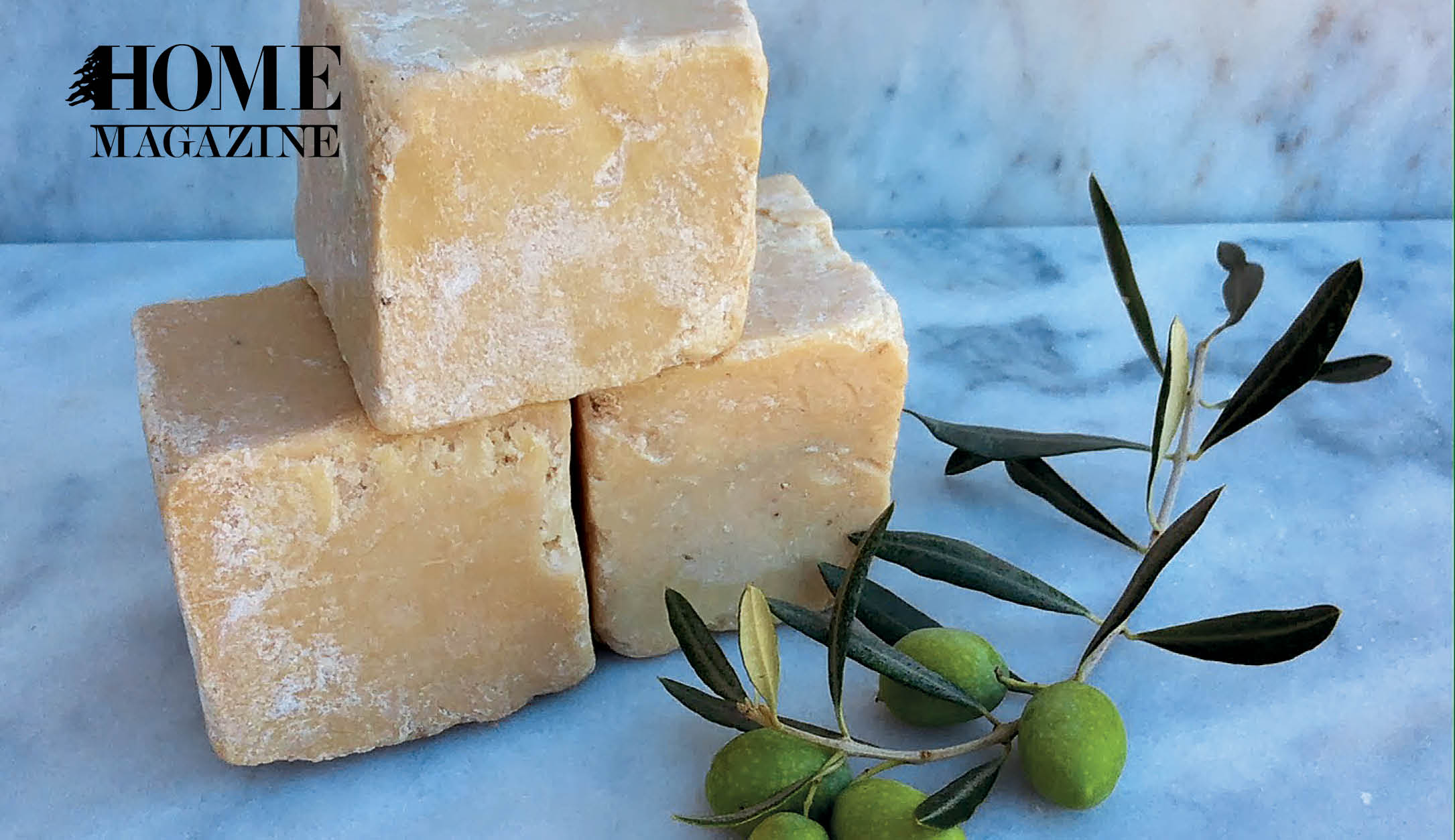
One of the greatest treasures of olive oil is the traditional olive soap.
Olive oil has been used in soap making for thousands of years. The clay tablet of natural and ancient olive oil-based soap is perhaps the oldest and purest soap in the world. It originated in 2400 B.C. from the eastern Mediterranean cities of Tripoli in Lebanon, Aleppo in Syria and Nablus in the West Bank.
Renowned for its high-quality raw ingredients without chemicals, the pure olive oil-based soaps are the most natural cleansing products for the skin.
The first olive oil soap factory was established in Marseilles in the sixth century. This is when the soap industry began to flourish. However, the quality of such soaps was not consistent until 1792 where the government of France ordered that all soap should conform to the manufacturing process of Marseilles soap. Only soap made in this manner would earn a certification of purity. During the 15th century soaps made from olive oil were on the rise, spreading across Europe. French merchants came to Crete seeking olive oil to supply the soap factories of Marseilles.
Over the centuries, the process of making soap from olive oil was improved as different oils were mixed with olive oil and additives. Lebanon’s Saboun Baladi is the country’s signature soap.
Lebanon still follows the traditional way, making the olive oil soap based on natural ingredients – a relatively simple process where the recipe is a mixture of oil, salt, lye, water and glycerin. The mixture is heated in large vats resulting in a soap white in color. Crushed olive pits are sometimes added to the mix to turn it green. Beauty soaps are often perfumed with natural fragrances such as rose and lavender. Once cooked, the mixture is poured onto huge molds on the floor and left to cool. Finally it is cut into cubes, stacked and left to harden.
The soap is usually stamped with the name of the soap maker. Many work with jealousy – keeping guarded recipes handed down from generation to generation.
Signature Boutique 

HOMEland Magazine
We firmly believe that the internet should be available and accessible to anyone, and are committed to providing a website that is accessible to the widest possible audience, regardless of circumstance and ability.
To fulfill this, we aim to adhere as strictly as possible to the World Wide Web Consortium’s (W3C) Web Content Accessibility Guidelines 2.1 (WCAG 2.1) at the AA level. These guidelines explain how to make web content accessible to people with a wide array of disabilities. Complying with those guidelines helps us ensure that the website is accessible to all people: blind people, people with motor impairments, visual impairment, cognitive disabilities, and more.
This website utilizes various technologies that are meant to make it as accessible as possible at all times. We utilize an accessibility interface that allows persons with specific disabilities to adjust the website’s UI (user interface) and design it to their personal needs.
Additionally, the website utilizes an AI-based application that runs in the background and optimizes its accessibility level constantly. This application remediates the website’s HTML, adapts Its functionality and behavior for screen-readers used by the blind users, and for keyboard functions used by individuals with motor impairments.
If you’ve found a malfunction or have ideas for improvement, we’ll be happy to hear from you. You can reach out to the website’s operators by using the following email
Our website implements the ARIA attributes (Accessible Rich Internet Applications) technique, alongside various different behavioral changes, to ensure blind users visiting with screen-readers are able to read, comprehend, and enjoy the website’s functions. As soon as a user with a screen-reader enters your site, they immediately receive a prompt to enter the Screen-Reader Profile so they can browse and operate your site effectively. Here’s how our website covers some of the most important screen-reader requirements, alongside console screenshots of code examples:
Screen-reader optimization: we run a background process that learns the website’s components from top to bottom, to ensure ongoing compliance even when updating the website. In this process, we provide screen-readers with meaningful data using the ARIA set of attributes. For example, we provide accurate form labels; descriptions for actionable icons (social media icons, search icons, cart icons, etc.); validation guidance for form inputs; element roles such as buttons, menus, modal dialogues (popups), and others. Additionally, the background process scans all the website’s images and provides an accurate and meaningful image-object-recognition-based description as an ALT (alternate text) tag for images that are not described. It will also extract texts that are embedded within the image, using an OCR (optical character recognition) technology. To turn on screen-reader adjustments at any time, users need only to press the Alt+1 keyboard combination. Screen-reader users also get automatic announcements to turn the Screen-reader mode on as soon as they enter the website.
These adjustments are compatible with all popular screen readers, including JAWS and NVDA.
Keyboard navigation optimization: The background process also adjusts the website’s HTML, and adds various behaviors using JavaScript code to make the website operable by the keyboard. This includes the ability to navigate the website using the Tab and Shift+Tab keys, operate dropdowns with the arrow keys, close them with Esc, trigger buttons and links using the Enter key, navigate between radio and checkbox elements using the arrow keys, and fill them in with the Spacebar or Enter key.Additionally, keyboard users will find quick-navigation and content-skip menus, available at any time by clicking Alt+1, or as the first elements of the site while navigating with the keyboard. The background process also handles triggered popups by moving the keyboard focus towards them as soon as they appear, and not allow the focus drift outside it.
Users can also use shortcuts such as “M” (menus), “H” (headings), “F” (forms), “B” (buttons), and “G” (graphics) to jump to specific elements.
We aim to support the widest array of browsers and assistive technologies as possible, so our users can choose the best fitting tools for them, with as few limitations as possible. Therefore, we have worked very hard to be able to support all major systems that comprise over 95% of the user market share including Google Chrome, Mozilla Firefox, Apple Safari, Opera and Microsoft Edge, JAWS and NVDA (screen readers).
Despite our very best efforts to allow anybody to adjust the website to their needs. There may still be pages or sections that are not fully accessible, are in the process of becoming accessible, or are lacking an adequate technological solution to make them accessible. Still, we are continually improving our accessibility, adding, updating and improving its options and features, and developing and adopting new technologies. All this is meant to reach the optimal level of accessibility, following technological advancements. For any assistance, please reach out to