
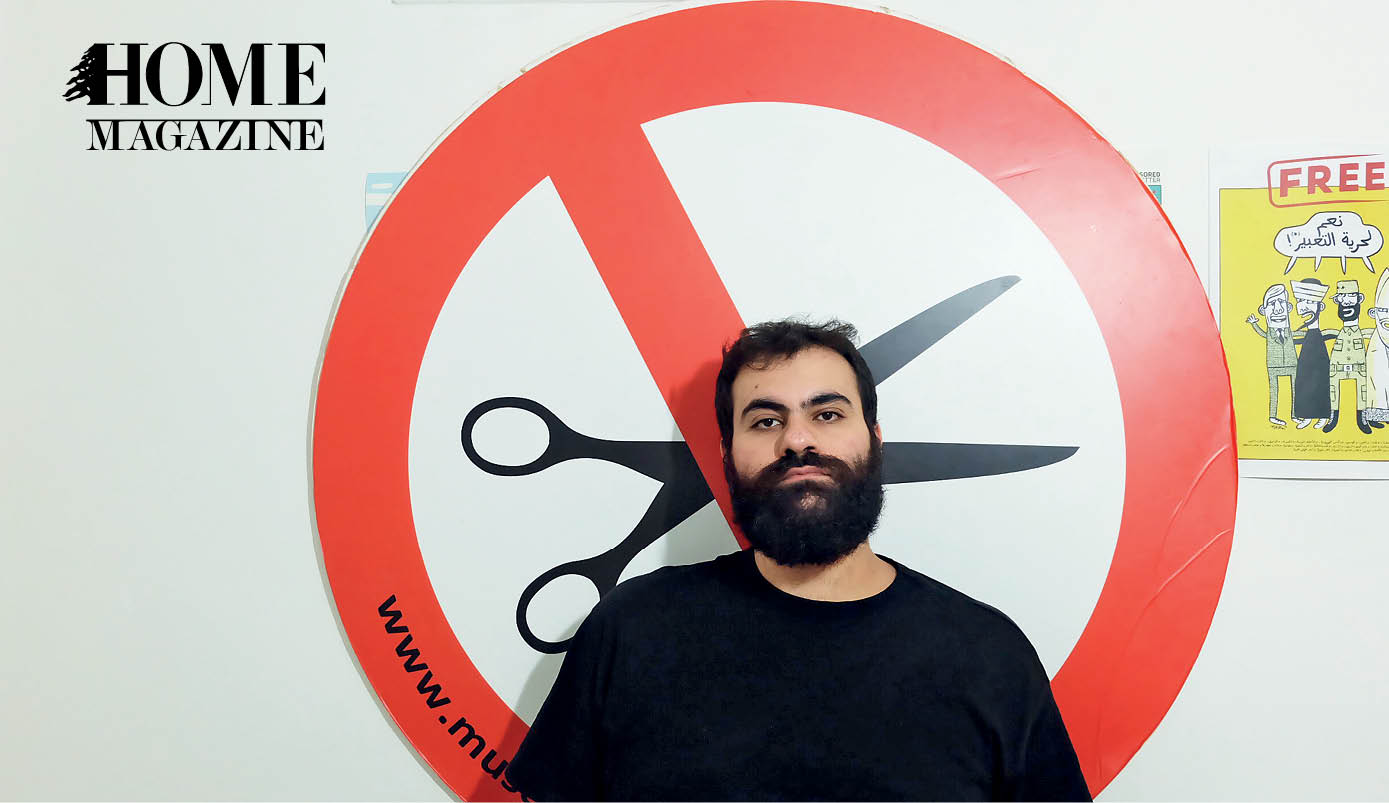
Popular Lebanese blogger Gino Raidy talks civil society, liberal ideals and initiating change, walking us through his journey from blogging and journalism into impactful activism.
Between Gino’s Blog and MARCH
Gino Raidy started a blog in 2010 as an extra-credit project while studying biology at the American University of Beirut. Little did he know he would one day become one of Lebanon’s most widely recognized bloggers.
“I was happy people were reading the blog,” he told HOME. “There was no particular focus back then, mainly just such topics as things to do and places to go out. Gradually, the blog evolved into discussions on social and political issues.”
Upon finishing his studies, Raidy moved to New York for a couple of years, where he worked as a public relations consultant. He came back to Lebanon and dabbled in marketing for a while before turning to freelance journalism, covering human stories in conflict zones, among other topics.
Yet, following a number of investigations and lawsuits against him due to certain blog posts, he established contact with the Lebanese NGO MARCH, whose mission is to educate, motivate and empower the Lebanese society to recognize its right to freedom of expression.
“Instead of applying the law, authorities often overcome it and entrap people by scaring them, but MARCH was there to direct me on what to do and provided me with the necessary anti-censorship info,” he explained.
“The new generation is reading more than any time before; it might not be books but just think about how many tweets a person reads per day!”
MARCH was established in 2011. Raidy joined a year later as a board member and then became vice president in 2016. “The organization pushes towards liberal ideals in Lebanon, from civil rights and human rights to gender equality and LGBT (lesbian, gay, bisexual and transgender) rights. We do political activism on a policy level. We want policy to be implemented and are not seeking political office.”
As a member of MARCH, Raidy shifted from covering someone else’s story as a journalist to becoming the story as an activist. “I was covering stories without being emotionally invested in them, always trying to be impartial in my coverage. Moving from that journalistic field to activism, we (MARCH) have become the story that journalists cover.”
The organization has expanded its activity over the years to cover conflict areas in Lebanon, such as Bab al- Tabbaneh and Jabal Mohsen in Tripoli, utilizing performing arts as an outlet for acceptance, change and freedom.
“Freedom of speech is the most important thing to us. If we don’t talk about something, it will never change. The problem here is that everyone is with freedom of speech until you touch one of their idols,” he said.
“Now there is a need for moving from the streets into elected office. We can’t wait for change forever, especially in the absence of accountability. Change is coming, it may be slow but it is coming.”

Between trend and tradition
Even after years of blogging, Raidy’s main challenge remains to deliver better every time, hence relying on social media interaction to infer people’s thoughts and opinions.
“A lot more can be said on social media than an actual blog. It allows such an interesting interaction,” he told HOME. “But now that marketing companies realized the potential of social media, it has become a little too crowded.”
He said he always embraces new technologies and has recently moved the blog entirely to the online publishing platform Medium. “I love it. It’s simple and has no ads. Its editor is also extremely nice and easy to use, which makes you waste a lot less time fixing the layout. You just copy-paste the link and it’s automatically embedded in a legible way. What I also like about it is that it’s a self-contained community,” he said.
As a person who has experienced both blogging and journalism, Raidy said he believes there will always be a place for journalism in the internet age, notably for fact-checking and in-depth reporting purposes. “There should be an added value to reporting, not just relying on clickbait or curating content from the internet like websites and TV channels do today,” he noted.
“The new generation is reading more than any time before; it might not be books, but just think about how many tweets a person reads per day! Twitter will not replace the news bulletin. It is the journalist’s responsibility to verify what’s on Twitter and not simply to showcase tweets in the news like many are doing today.”
When it comes to print media, Raidy thinks print is there to stay, but within certain limitations, and goes on to compare it to coal. Many people still use it and will continue to, but the number of users will not grow beyond that.
“Convenience trumps romanticism,” he observed. “Journalism cannot just rely on the romantic side of print; it needs to adapt and create in-depth reporting that is important enough for people to want to read it.”
Moving on to his notion of HOME, Raidy does not view HOME as physical place but rather attaches it to individual ideals. On the patriotic level, he paints Lebanon as a fortress where anything can come in (arms, drugs, etc.), while it is very hard for people to leave due to visa restrictions and the difficult socioeconomic situation. Yet Raidy said he still feels genuinely at HOME when surrounded by family in his beloved village Zgharta. “I would like to see religion and sex have a lot less power in Lebanon, and this will only happen when we move toward laws that will allow for more gender equality,” he noted.
“Journalism cannot just rely on the romantic side of print; it needs to adapt and create in-depth reporting that is important enough for people to want to read it.”
“Lebanese youth today are living an identity crisis: we’re not sure who we are. We are living under the rule of a war generation who only views both Lebanese youth and the diaspora as money-making tools and does not give them a chance. But I am optimistic that there is a secular shift taking place, whether with Beirut Madinati winning 40 percent of the vote in the last municipal election against an alliance of all political parties or in university elections, like AUB’s, where the Secular Club secured a large number of seats.”
On the personal level, Raidy’s plans take him back to his academic biologist background. “I would like to venture into neuroscience research on human behavior by looking at the brain and exploring memory. It’s exciting to explore why people think the way they do, or why one becomes part of Daesh, for instance.” He intends to undertake this project in Beirut with the help of a few friends, and they already have a couple investors lined up to fund part of it, he said.
For more info: https://ginosblog.com/


HOMEland
Coming Soon
HOMEland Events & Collaborations
Coming Soon
 Signature Boutique




Speaking Truth to Power: Pierre Sadek Foundation