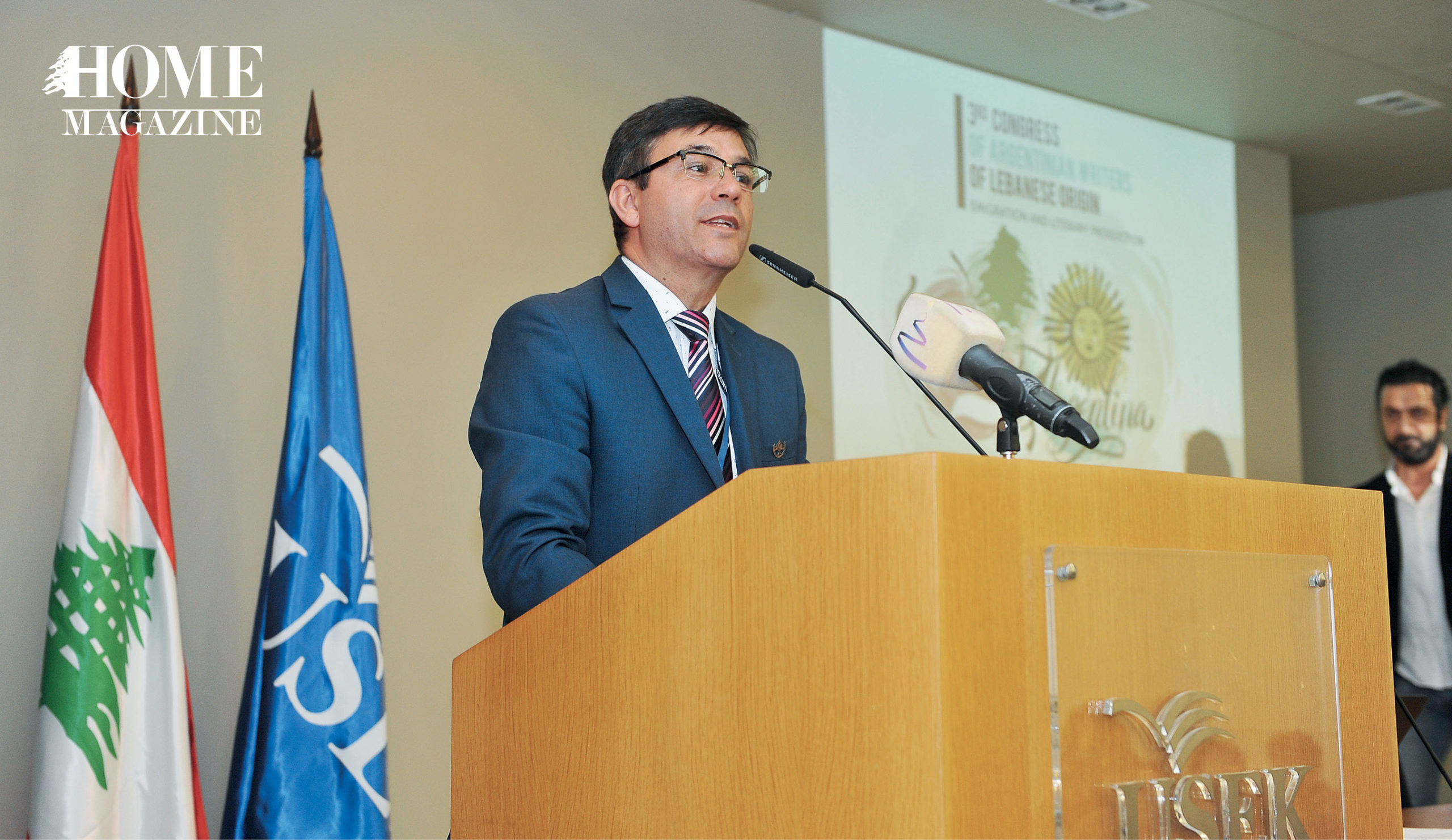
Should I stay or should I go? Raja Abdallah explains his tricky relationship with his country of origin.
Can’t live with, can’t live without; damned if you do, damned if you don’t: this is the love-hate relationship most Lebanese, inside and abroad, have with their native Lebanon. And I’m no exception. Brought up in Lebanon, twice expatriated, twice returned willingly to settle “back HOME.”
So what is it that brought me back … and is it HOME forever this time?
I left Lebanon “for good” at 18 to study in Montreal, Quebec, where I started a career and a family. Life could not have been better. Canada offered superb quality of life and endless opportunity. Ten years later however, I was poached by a Lebanese industrial group and chose to return to Lebanon and work on rebuilding a war-torn country. I was also starting to realize Canada had its downsides: unbearably cold in winter, huge taxes and a weak sense of social and cultural belonging – in spite of the large Lebanese diaspora.
So I embraced Lebanon with an open heart and never looked back. Yet something was still not right. After 10 years abroad, I did not identify with the post-war society – it was too material and superficial for my liking. Most of all, I did not find it a suitable place to bring up two young children, due to a lack of basic playgrounds and green spaces, among other things.
And so I emigrated again in 1999, this time to Switzerland, a country that I swore I would never leave “except in a horizontal position.” This was the perfect country, with picture-perfect scenery, mild winters and low taxes. I hated the idea of turning my back on Lebanon but this time I had my children’s future at heart. But yet again, 10 years later, then in my 40s, my perspective of life changed again and I decided once more to head back to Lebanon. With Europe and the banking sector deep in financial crisis, I longed for the entrepreneurial and dynamic spirit of the Lebanese economy. I felt the country deserved more from its expats. After all, who would care for it if not its native sons?
There is a responsibility on those who lived and learned abroad, to bring precious skills and good habits back HOME. And so Lebanon has been our HOME again, ever since the start of the decade. We have gone through Lebanon’s ups and downs from the real-estate bonanza and economic boom to political deadlock and a garbage crisis. Will it be HOME forever this time? In spite of a dreadful 2015, probably yes. My years abroad have taught me that every country has a dark side, its share of problems, crises and curses. But while Lebanon’s biggest asset is its people – its resilience, business ingenuity and love of life, my fear is that Lebanon’s biggest threat resides in its very own people too: a weak if non-existent sense of national identity, with feudalism, tribalism, religion, disunity and special interests running deep even among the most educated and sophisticated. In fact, the “enemy within” is the worst of all enemies.
As the late Ghassan Tueini once said: ”Lebanon is not a hotel where you can check in and out at your leisure”. So until further notice, this is indeed HOME… and not a hotel anymore.
For more information visit theunep.org

HOMEland Magazine
We firmly believe that the internet should be available and accessible to anyone, and are committed to providing a website that is accessible to the widest possible audience, regardless of circumstance and ability.
To fulfill this, we aim to adhere as strictly as possible to the World Wide Web Consortium’s (W3C) Web Content Accessibility Guidelines 2.1 (WCAG 2.1) at the AA level. These guidelines explain how to make web content accessible to people with a wide array of disabilities. Complying with those guidelines helps us ensure that the website is accessible to all people: blind people, people with motor impairments, visual impairment, cognitive disabilities, and more.
This website utilizes various technologies that are meant to make it as accessible as possible at all times. We utilize an accessibility interface that allows persons with specific disabilities to adjust the website’s UI (user interface) and design it to their personal needs.
Additionally, the website utilizes an AI-based application that runs in the background and optimizes its accessibility level constantly. This application remediates the website’s HTML, adapts Its functionality and behavior for screen-readers used by the blind users, and for keyboard functions used by individuals with motor impairments.
If you’ve found a malfunction or have ideas for improvement, we’ll be happy to hear from you. You can reach out to the website’s operators by using the following email
Our website implements the ARIA attributes (Accessible Rich Internet Applications) technique, alongside various different behavioral changes, to ensure blind users visiting with screen-readers are able to read, comprehend, and enjoy the website’s functions. As soon as a user with a screen-reader enters your site, they immediately receive a prompt to enter the Screen-Reader Profile so they can browse and operate your site effectively. Here’s how our website covers some of the most important screen-reader requirements, alongside console screenshots of code examples:
Screen-reader optimization: we run a background process that learns the website’s components from top to bottom, to ensure ongoing compliance even when updating the website. In this process, we provide screen-readers with meaningful data using the ARIA set of attributes. For example, we provide accurate form labels; descriptions for actionable icons (social media icons, search icons, cart icons, etc.); validation guidance for form inputs; element roles such as buttons, menus, modal dialogues (popups), and others. Additionally, the background process scans all the website’s images and provides an accurate and meaningful image-object-recognition-based description as an ALT (alternate text) tag for images that are not described. It will also extract texts that are embedded within the image, using an OCR (optical character recognition) technology. To turn on screen-reader adjustments at any time, users need only to press the Alt+1 keyboard combination. Screen-reader users also get automatic announcements to turn the Screen-reader mode on as soon as they enter the website.
These adjustments are compatible with all popular screen readers, including JAWS and NVDA.
Keyboard navigation optimization: The background process also adjusts the website’s HTML, and adds various behaviors using JavaScript code to make the website operable by the keyboard. This includes the ability to navigate the website using the Tab and Shift+Tab keys, operate dropdowns with the arrow keys, close them with Esc, trigger buttons and links using the Enter key, navigate between radio and checkbox elements using the arrow keys, and fill them in with the Spacebar or Enter key.Additionally, keyboard users will find quick-navigation and content-skip menus, available at any time by clicking Alt+1, or as the first elements of the site while navigating with the keyboard. The background process also handles triggered popups by moving the keyboard focus towards them as soon as they appear, and not allow the focus drift outside it.
Users can also use shortcuts such as “M” (menus), “H” (headings), “F” (forms), “B” (buttons), and “G” (graphics) to jump to specific elements.
We aim to support the widest array of browsers and assistive technologies as possible, so our users can choose the best fitting tools for them, with as few limitations as possible. Therefore, we have worked very hard to be able to support all major systems that comprise over 95% of the user market share including Google Chrome, Mozilla Firefox, Apple Safari, Opera and Microsoft Edge, JAWS and NVDA (screen readers).
Despite our very best efforts to allow anybody to adjust the website to their needs. There may still be pages or sections that are not fully accessible, are in the process of becoming accessible, or are lacking an adequate technological solution to make them accessible. Still, we are continually improving our accessibility, adding, updating and improving its options and features, and developing and adopting new technologies. All this is meant to reach the optimal level of accessibility, following technological advancements. For any assistance, please reach out to