
Creativity is sometimes hard to define. As Iyad Naja gives insight into his life, it’s clear that his speech and mind go any direction that takes him. Naja’s artistic nature was nurtured from a young age, he has an interesting relationship with Lebanon having lived abroad intermittently at different stages of his life, but he expresses nothing but love for the country. He also expresses nothing but love for his grandmother who was everything to him – his guardian, artistic mentor and inspiration. After a stint in the advertising world, Naja now pursues his own artistic endeavors in a wide variety of design projects.
Born in Nigeria, Naja then moved back to Lebanon. He spent the first eight years of his life largely in the company of his grandmother – a beautiful, strong, self-taught woman, a teacher and a poet. “She was progressive and so focused on creativity that she didn’t even know how to cook,” Naja says. “This was unusual for a woman living at that time.” She also wrote and spoke Arabic beautifully, Naja remembers, “she told me I should always remember my Arabic roots and my heritage.”
At aged 8, Naja returned to Nigeria to live with his father. By the age of 12 his parents decided that the best thing for him would be to go to England for his education. Of his time at SABIS International, a boarding school in Bath, he remembers, “it was exactly like Harry Potter. Our school was in an old castle, there were endless green gardens and house teams called things like ‘the Hawks’ and ‘the Falcons.’”
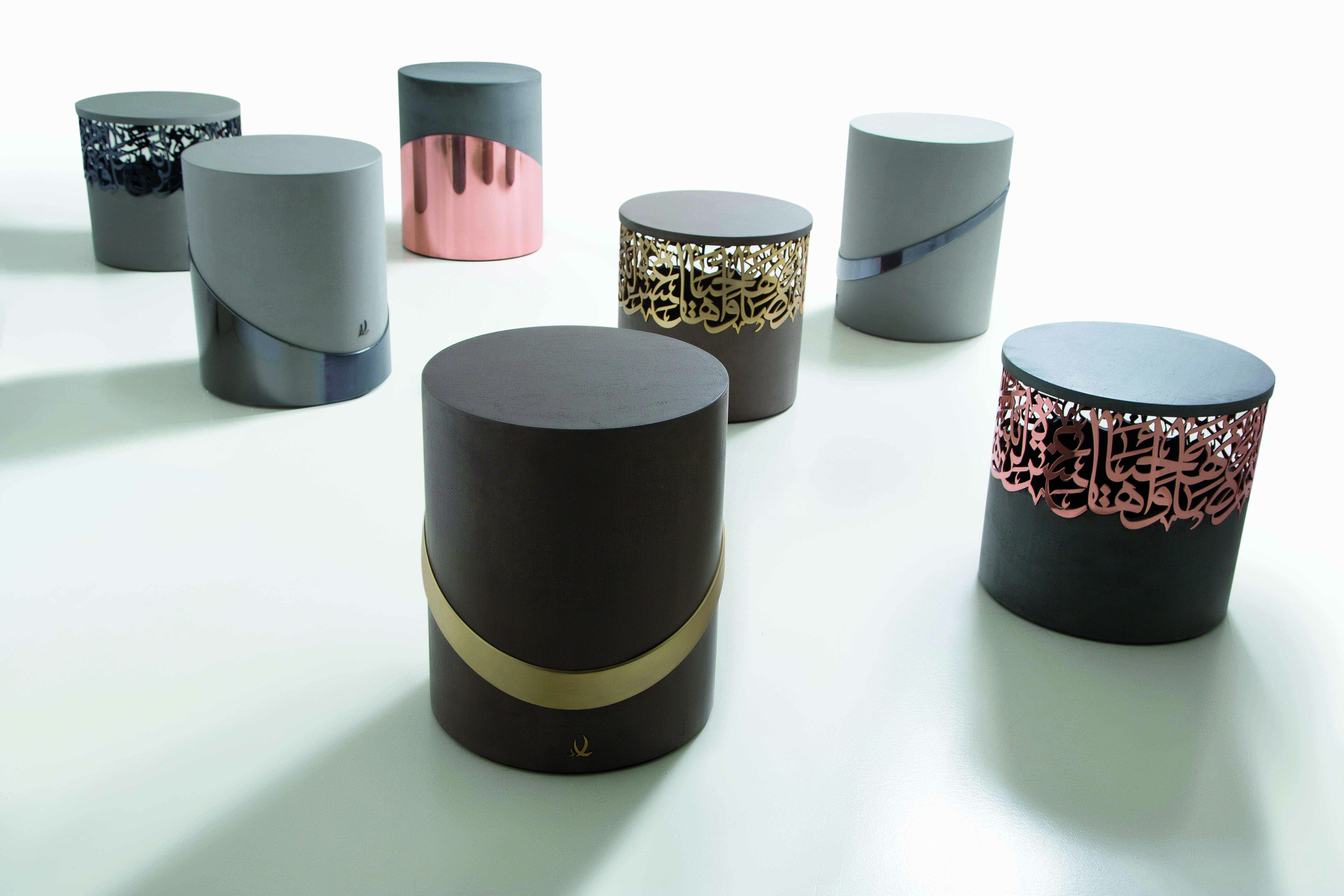
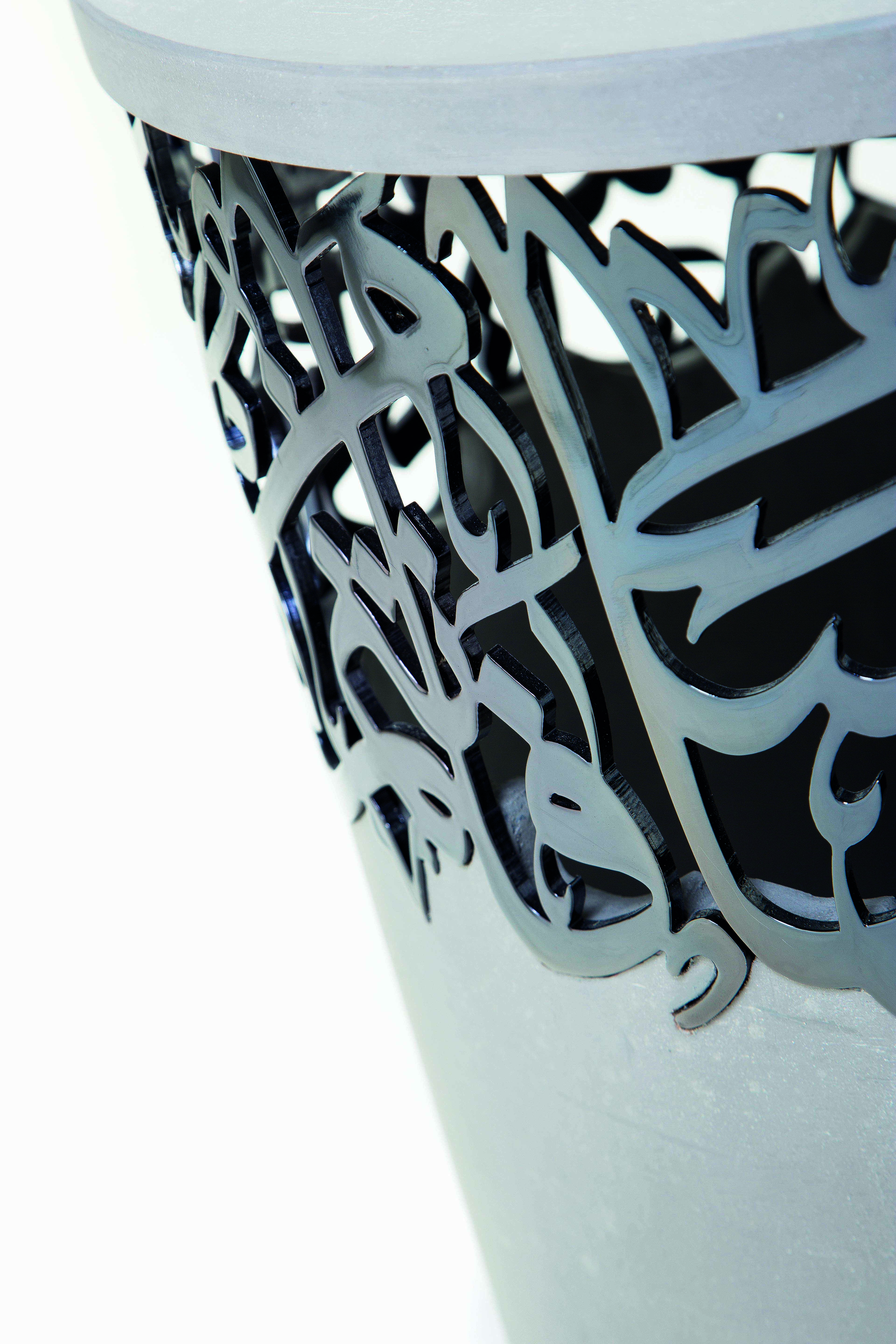
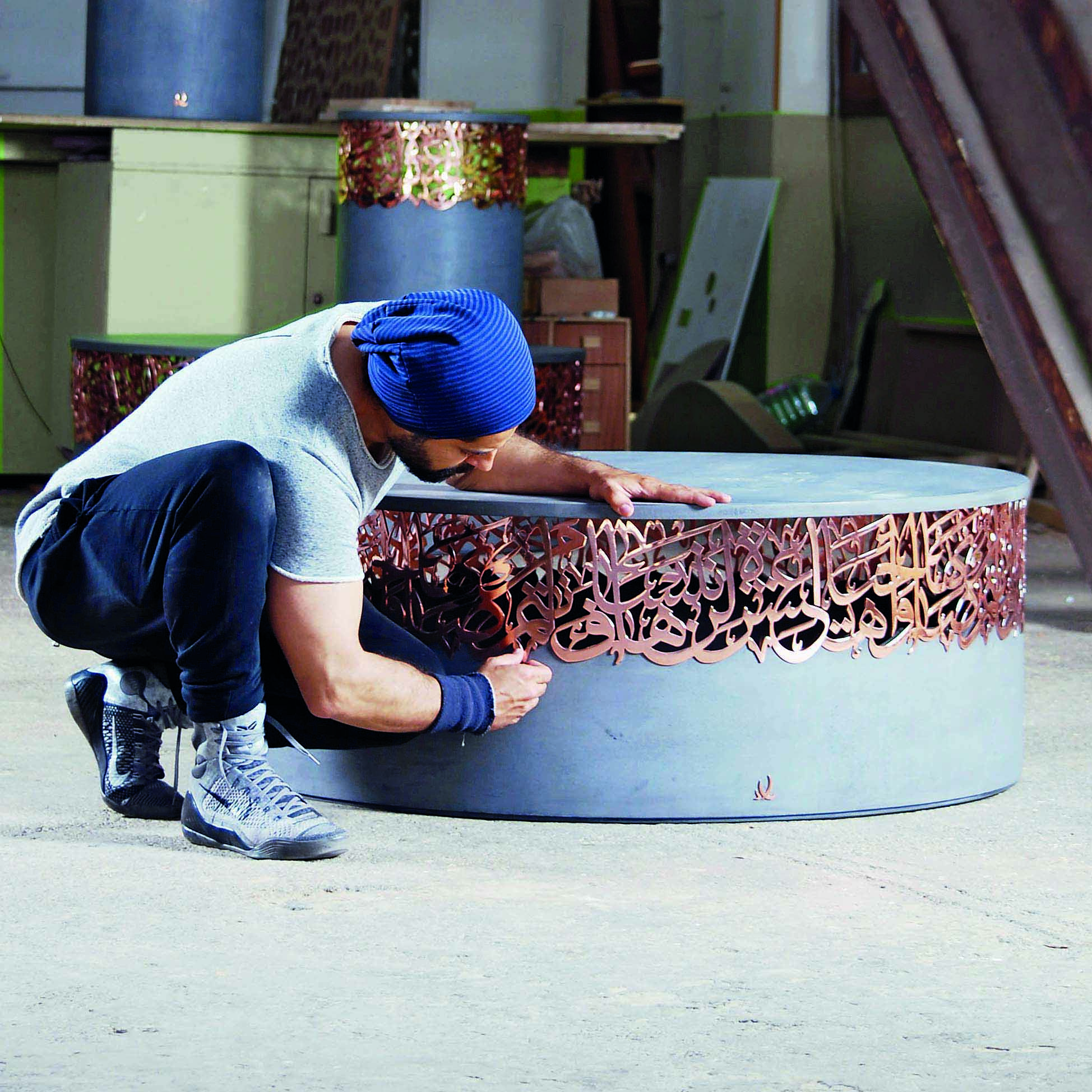
Like many of us growing up Naja took everything for granted. All of his senses and experiences seemed infinite and his loved ones eternal. However as he matured he found that things faded, family gatherings became less frequent over time. The need to capture memory in a visual context, and inspiration from his grandmother led Naja to explore calligraphy as something that appeals to eye and is flattering to the soul. It takes an interesting journey from the page of hand-written calligraphy to a digital design program and then on to a blacksmith who forges it in metal. Finally Naja gives it color treatment and sometimes installs a light, just to give the impression of something distinctive and finely made.
Naja says that much of his influence is drawn from the rich well of Arab history, and his goal is to show this to the rest of the world by making it relevant in a modern context. His art reflects his surroundings, for example some of his calligraphy and his collection of stools are made from concrete and steel, inspired by the construction industry and the ever-changing face of a city. “You do not have to use beautiful materials to produce a beautiful object,” notes the artist, “there’s something about using metal that I find so rewarding. That this hard, rough substance can be melted down and turned into something beautiful and tough is amazing.”
He cites his real challenge as expressing the history of the Arab region, but in a modern context. “We invented algebra, astronomy, musical instruments and so many things,” he says. “The rest of the world, and even most Arabs, have no idea about this, and so I want to bring it to light.” He was commissioned to build a brass lift doors in a private residence in Lebanon. While in Milan at the Da Vinci museum shop he discovered a book on Abass ibn Firnas, a ninthcentury Arabian polymath who invented a flying machine hundreds of years before Da Vinci. Ibn Firnas’ notes resemble Da Vinci’s with geometric patters and mathematic equations. In fact in many of Da Vinci’s sketches the notes were written backwards, almost in a code, a direct result of his exposure to the work of Ibn Firnas who, as an Arabic speaker, wrote from right to left. Naja’s doors are a triumph, beautifully constructed pieces with the Arabic phrase.
“We have lived moments in life that are abundant with blessings” written across them when closed.
One might ask, seeing as Naja is so accomplished and had such an international upbringing, why he chose to live in Lebanon. “This is my HOME,” he responds, “this is a beautiful HOME for me, despite the chaos. You can either run away from it or embrace it. It’s not the place it’s how you relate to it.”
Instagram: @iyadnaja
Facebook: facebook.com/iyadnajaofficial
theurbanfusion.com
designboom.com/design/ dubai-design-week-iyad-najastools- ode-rose-10-21-2015/
HOMEland Magazine
We firmly believe that the internet should be available and accessible to anyone, and are committed to providing a website that is accessible to the widest possible audience, regardless of circumstance and ability.
To fulfill this, we aim to adhere as strictly as possible to the World Wide Web Consortium’s (W3C) Web Content Accessibility Guidelines 2.1 (WCAG 2.1) at the AA level. These guidelines explain how to make web content accessible to people with a wide array of disabilities. Complying with those guidelines helps us ensure that the website is accessible to all people: blind people, people with motor impairments, visual impairment, cognitive disabilities, and more.
This website utilizes various technologies that are meant to make it as accessible as possible at all times. We utilize an accessibility interface that allows persons with specific disabilities to adjust the website’s UI (user interface) and design it to their personal needs.
Additionally, the website utilizes an AI-based application that runs in the background and optimizes its accessibility level constantly. This application remediates the website’s HTML, adapts Its functionality and behavior for screen-readers used by the blind users, and for keyboard functions used by individuals with motor impairments.
If you’ve found a malfunction or have ideas for improvement, we’ll be happy to hear from you. You can reach out to the website’s operators by using the following email
Our website implements the ARIA attributes (Accessible Rich Internet Applications) technique, alongside various different behavioral changes, to ensure blind users visiting with screen-readers are able to read, comprehend, and enjoy the website’s functions. As soon as a user with a screen-reader enters your site, they immediately receive a prompt to enter the Screen-Reader Profile so they can browse and operate your site effectively. Here’s how our website covers some of the most important screen-reader requirements, alongside console screenshots of code examples:
Screen-reader optimization: we run a background process that learns the website’s components from top to bottom, to ensure ongoing compliance even when updating the website. In this process, we provide screen-readers with meaningful data using the ARIA set of attributes. For example, we provide accurate form labels; descriptions for actionable icons (social media icons, search icons, cart icons, etc.); validation guidance for form inputs; element roles such as buttons, menus, modal dialogues (popups), and others. Additionally, the background process scans all the website’s images and provides an accurate and meaningful image-object-recognition-based description as an ALT (alternate text) tag for images that are not described. It will also extract texts that are embedded within the image, using an OCR (optical character recognition) technology. To turn on screen-reader adjustments at any time, users need only to press the Alt+1 keyboard combination. Screen-reader users also get automatic announcements to turn the Screen-reader mode on as soon as they enter the website.
These adjustments are compatible with all popular screen readers, including JAWS and NVDA.
Keyboard navigation optimization: The background process also adjusts the website’s HTML, and adds various behaviors using JavaScript code to make the website operable by the keyboard. This includes the ability to navigate the website using the Tab and Shift+Tab keys, operate dropdowns with the arrow keys, close them with Esc, trigger buttons and links using the Enter key, navigate between radio and checkbox elements using the arrow keys, and fill them in with the Spacebar or Enter key.Additionally, keyboard users will find quick-navigation and content-skip menus, available at any time by clicking Alt+1, or as the first elements of the site while navigating with the keyboard. The background process also handles triggered popups by moving the keyboard focus towards them as soon as they appear, and not allow the focus drift outside it.
Users can also use shortcuts such as “M” (menus), “H” (headings), “F” (forms), “B” (buttons), and “G” (graphics) to jump to specific elements.
We aim to support the widest array of browsers and assistive technologies as possible, so our users can choose the best fitting tools for them, with as few limitations as possible. Therefore, we have worked very hard to be able to support all major systems that comprise over 95% of the user market share including Google Chrome, Mozilla Firefox, Apple Safari, Opera and Microsoft Edge, JAWS and NVDA (screen readers).
Despite our very best efforts to allow anybody to adjust the website to their needs. There may still be pages or sections that are not fully accessible, are in the process of becoming accessible, or are lacking an adequate technological solution to make them accessible. Still, we are continually improving our accessibility, adding, updating and improving its options and features, and developing and adopting new technologies. All this is meant to reach the optimal level of accessibility, following technological advancements. For any assistance, please reach out to