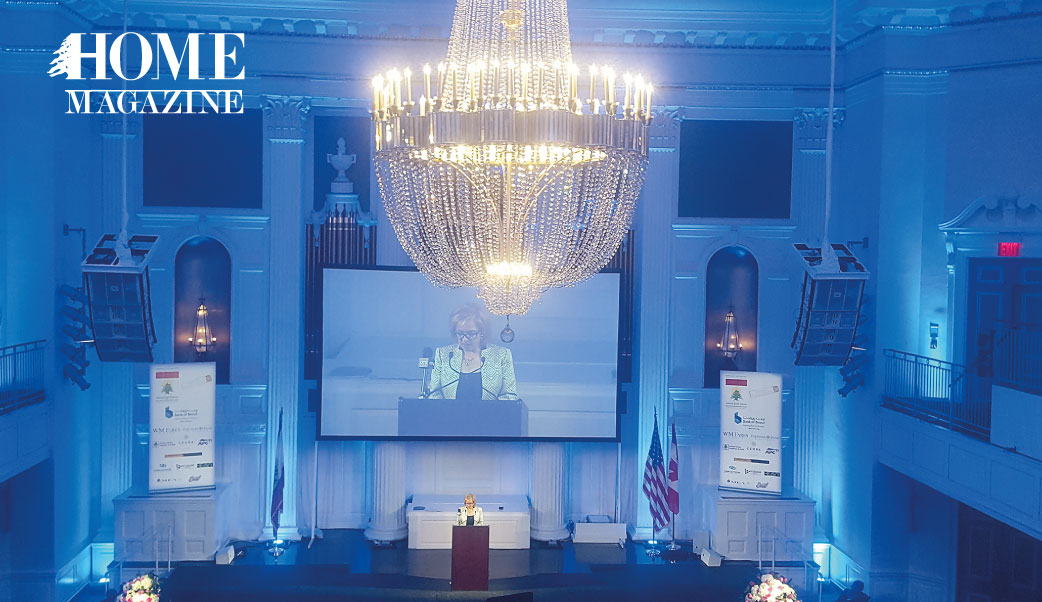
The Ministry of Foreign Affairs and Emigrants organized the Lebanese Diaspora Energy Conference (LDE), for the first time in 2014. It was a great occasion bringing many Lebanese descendants to Lebanon to participate in this event. Based on the huge success of the very first LDE, two other events were organized in 2015 and then in 2016. It was time to get closer to the diaspora and to where the Lebanese descendants live. The ministry has a determination to reach out to the Lebanese of the world, explore people’s needs, and find possible cooperation opportunities. This is how the idea of LDE – New York, LDE – Sao Paulo, and LDE – Johannesburg came up.
The North America Lebanese Diaspora Energy Conference in New York was held on the 16th and 17th of September 2016, with the participation of many organizations founded and operated by successful Lebanese leaders: Lebanese International Finance Executives (LIFE), the Network of Lebanese-American Professionals (LebNet), the American TaskForce for Lebanon (ATFL), and
ABANA. (founded as Arab Bankers Association of North America). Leaders from different fields of expertise came specially to attend this event. The main objective of this conference organized in the region of the North-East America was to put together experts from different fields of: business, IT, economics, finance, science, medicine, renewable energy, engineering, fashion, public relations, advertising, education, research, food and wine industry and law. This conference represents a chance for the Lebanese Diaspora to offer Lebanon potential policy recommendations for reform and economic development in diverse fields of expertise by: helping in creating a suitable environment for start-ups, diversifying economic sectors, creating educational partnerships.
On the first day, the Minister of Foreign Affairs, Gebran Bassil, invited all Lebanese descendants to apply for regaining their Lebanese nationality. The project of nationality restoration is one of the objectives that the ministry of foreign affairs is trying to accomplish and to promote in each and every event in Lebanon or abroad due to its major importance and impact on Lebanon.
A major panel revolved around Investment, Diversification, and Economic Branding in Lebanon. After two consecutive days of brainstorming, open discussions, too many questions and answers, it was time to close the ceremony. Successively Hashim Sarkism, Dean of the school of architecture and planning at MIT, Joumana Kayrouz, lawyer and Founder of Joumana Kayrouz PLLC, Attorney General and Minister of Justice, Minister of Immigration at the Executive Council of Nova Scotia, Lena Diab, in addition to Consul General, Mr. Majdi Ramada, presented the summary of the conference report centred around start-ups and entrepreneurship:
Opportunities and Challenges, with a focus on creating successful start-ups. Lebanon needs to increase the volume of start-up ideas and number of entrepreneurs.
Diversification and energy resources were also discussed, namely renewable technologies that are
expensive and need governmental support with decentralization and privatization of electricity as efficient long-term solutions. Investments, diversification, and economic growth (banking and finance/services) were also suggested through creating diaspora bonds with good returns for the investors that should be targeted towards projects appealing to the diaspora. The conference additionally tackled branding Lebanon: Buy Lebanese & Lebanese Cuisine. It has become clear that public perception of Lebanese products is changing. Cities like Montreal have decided to produce major Lebanese products on their own and branding them to North American markets. There was also a proposal for online portals where people can buy online Lebanese wine and identify local points of sale.

Finally, ideas about developing a market like Eataly in NYC, a mixture of market-style shopping, counter dining, and traditional restaurants, were proposed, which would be partially subsidised by the Lebanese government. Eataly has opened in NY and Chicago and was inspired by the original famous food mecca of the same name in Turin, Italy. Educational partnerships and healthcare cooperation: exchange of knowledge and capacity building also had its share. Potential opportunities to help Lebanese higher education institutions technically, logistically, and financially are a must to further empower both faculty and students. Students will therefore show more professionalism in their fields of expertise since they would be better prepared to deal with real-life job markets. Panellists expressed their willingness to help Lebanese Institutions thrive in a very vulnerable and challenging environment. This specific panel was particularly interesting because it was the only one featuring two ladies among panellists. This feminine presence was very unique and remarkable; Nada Anid, Dean at the New York Institute of Technology, as well as Mona Nemer, Vice-President
of Research at the University of Ottawa have both shown and proved to all the attendees and participants that the world cannot be ruled without the key role women could play. It was mentioned many times during the conference that the lack of participation of women at the LDE is a shame to Lebanese diaspora that has witnessed the clear success of many women, in different fields and sectors.
This educational panel with two very successful ladies was the best example to show the world that a Lebanese woman has the ability to prove herself. The Lebanese Diaspora Energy cannot function well without the feminine component. We might go further and say that the Lebanese Diaspora Energy will not exist without Lebanese women working hard in all four corners of the world.
LDE- NY 2016 was indubitably a fruitful event. Moderators, speakers, panellists, and attendees went back to their businesses inspired by the countless Lebanese success stories, by the Lebanese environment they enjoyed, and most of all, by the strength of the ties attaching them to their land. The next LDE will be taking place in Lebanon on 4, 5, and 6 May 2017.
For further information about the past and future events, check the following link: www.lde-leb.com

HOMEland
Coming Soon
HOMEland Events & Collaborations
Coming Soon
 Signature Boutique