When it comes to success stories of the Lebanese diaspora, Berlin-based news host and video journalist Jaafar Abdul Karim fits the bill perfectly.
Arriving in Dresden, Germany, in 2002 to study media computer science, Jaafar Abdul Karim never thought he would stay in Europe longer than his degree.
Instead he has surprised even himself, having spent the past three years rising through the ranks at Deutche Welle, Germany’s leading international broadcasting service. He began as an intern, then earned himself a video journalist position separating his time between Berlin and Cairo.

He now presents his own talk show, “Shabab Talk,” where he invites a variety of young Arab and European guests to discuss current, socio-political affairs.
The show is a colossal hit, reaching a weekly audience of 4 million people in Egypt alone, and won the “Best Talk Show” award at the ASBU Festival in Tunisia.
Of all his successes, Abdul Karim is as humble about these as he is about his own national and cultural identity. He has great pride in his parents and his Lebanese origins, but his views on nationality are refreshingly unique. He believes that identity is based not on heritage, but rather a diverse mix of cultural immersion and experience. Born in Monrovia, Liberia, he spent his childhood there before moving to Switzerland and then on to Beirut for his education at a German school, before going on to study as an undergraduate in Germany. In 2015 he earned a master’s degree in Leadership and Communication at Quadriga University in Berlin.
He values his multinational experiences greatly as a chief reason for his successful career so far. “An international upbringing has taught me the importance of accepting every kind of person and I feel it has taught me valuable lessons in tolerance to different beliefs, personalities and topics”
Abdul Karim is a passionate journalist and his ability to accommodate very different identities and beliefs seems to be the reason “Shabab Talk” is so successful. The purpose of the show, he says, is to create an environment in which direct and open dialogue flows freely between the sharpest young minds of Europe and the Arab world. It is the perfect platform for young activists and politically minded individuals to have the voice that they wouldn’t usually receive in mainstream media.
Abdul Karim is the perfect host, guiding conversation just enough so that all sides of the discussion are given ample air time. “To me, people and their opinions and individualism is important, regardless of their origin” he says. He is certainly not afraid to tackle the biggest and often most controversial topics of the day, such as journalistic freedom of speech, terrorism, racism and many more.
Often the debates between guests on “Shabab Talk” are followed closely on social media, where fans and followers add their own voices and perspectives to the discussion.
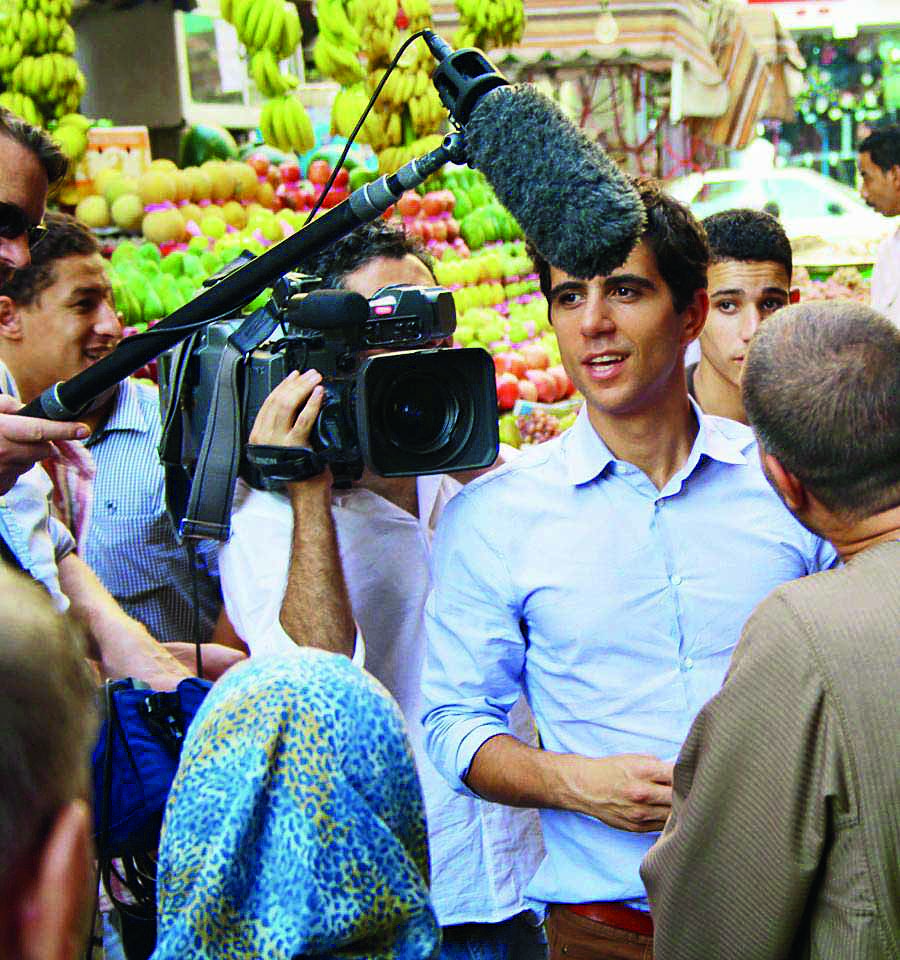
These are some of Abdul Karim’s proudest moments, and he is staunch advocate of journalism being most effective across multimedia platforms.
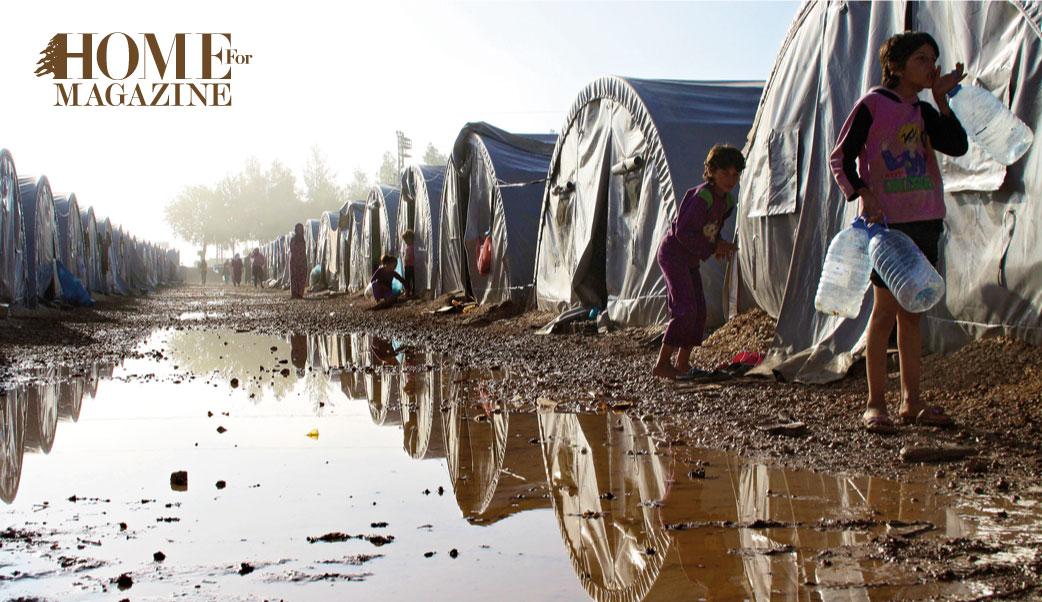
In an age where anyone can be a journalist so long as they have a phone and an opinion, he encourages everyone to play a part. Particularly in the wake of Arab Spring, young people suddenly have the power to express themselves in large numbers. “Eighteenyear- olds tweeting their insights from Egypt or Libya is more important than anything happening inside a news studio,” he says. This isn’t just a hollow statement, as Abdul Karim embodies it himself, never afraid to embed himself in his stories on the ground and meet his subjects up close. He has spent time as front line reporter covering the news from Libya, Egypt, Tunisia and the Syria-Turkey border.
While he is the first to admit that life in the fast lane can be intense. Abdul Karim still finds some time for himself. He unwinds by swimming and going to musicals, and naturally Lebanon holds an important place in his heart. “I feel a special connection to Beirut and I have a strongly affinity with its international, melting pot culture. There are political challenges every minute of the day but the young Beirutis are always among the most optimistic and forward thinking.” Abdul Karim is the flagship of this generation and his successes are an inspiration for anyone looking to carve out a path in the media world.

HOMEland Magazine
We firmly believe that the internet should be available and accessible to anyone, and are committed to providing a website that is accessible to the widest possible audience, regardless of circumstance and ability.
To fulfill this, we aim to adhere as strictly as possible to the World Wide Web Consortium’s (W3C) Web Content Accessibility Guidelines 2.1 (WCAG 2.1) at the AA level. These guidelines explain how to make web content accessible to people with a wide array of disabilities. Complying with those guidelines helps us ensure that the website is accessible to all people: blind people, people with motor impairments, visual impairment, cognitive disabilities, and more.
This website utilizes various technologies that are meant to make it as accessible as possible at all times. We utilize an accessibility interface that allows persons with specific disabilities to adjust the website’s UI (user interface) and design it to their personal needs.
Additionally, the website utilizes an AI-based application that runs in the background and optimizes its accessibility level constantly. This application remediates the website’s HTML, adapts Its functionality and behavior for screen-readers used by the blind users, and for keyboard functions used by individuals with motor impairments.
If you’ve found a malfunction or have ideas for improvement, we’ll be happy to hear from you. You can reach out to the website’s operators by using the following email
Our website implements the ARIA attributes (Accessible Rich Internet Applications) technique, alongside various different behavioral changes, to ensure blind users visiting with screen-readers are able to read, comprehend, and enjoy the website’s functions. As soon as a user with a screen-reader enters your site, they immediately receive a prompt to enter the Screen-Reader Profile so they can browse and operate your site effectively. Here’s how our website covers some of the most important screen-reader requirements, alongside console screenshots of code examples:
Screen-reader optimization: we run a background process that learns the website’s components from top to bottom, to ensure ongoing compliance even when updating the website. In this process, we provide screen-readers with meaningful data using the ARIA set of attributes. For example, we provide accurate form labels; descriptions for actionable icons (social media icons, search icons, cart icons, etc.); validation guidance for form inputs; element roles such as buttons, menus, modal dialogues (popups), and others. Additionally, the background process scans all the website’s images and provides an accurate and meaningful image-object-recognition-based description as an ALT (alternate text) tag for images that are not described. It will also extract texts that are embedded within the image, using an OCR (optical character recognition) technology. To turn on screen-reader adjustments at any time, users need only to press the Alt+1 keyboard combination. Screen-reader users also get automatic announcements to turn the Screen-reader mode on as soon as they enter the website.
These adjustments are compatible with all popular screen readers, including JAWS and NVDA.
Keyboard navigation optimization: The background process also adjusts the website’s HTML, and adds various behaviors using JavaScript code to make the website operable by the keyboard. This includes the ability to navigate the website using the Tab and Shift+Tab keys, operate dropdowns with the arrow keys, close them with Esc, trigger buttons and links using the Enter key, navigate between radio and checkbox elements using the arrow keys, and fill them in with the Spacebar or Enter key.Additionally, keyboard users will find quick-navigation and content-skip menus, available at any time by clicking Alt+1, or as the first elements of the site while navigating with the keyboard. The background process also handles triggered popups by moving the keyboard focus towards them as soon as they appear, and not allow the focus drift outside it.
Users can also use shortcuts such as “M” (menus), “H” (headings), “F” (forms), “B” (buttons), and “G” (graphics) to jump to specific elements.
We aim to support the widest array of browsers and assistive technologies as possible, so our users can choose the best fitting tools for them, with as few limitations as possible. Therefore, we have worked very hard to be able to support all major systems that comprise over 95% of the user market share including Google Chrome, Mozilla Firefox, Apple Safari, Opera and Microsoft Edge, JAWS and NVDA (screen readers).
Despite our very best efforts to allow anybody to adjust the website to their needs. There may still be pages or sections that are not fully accessible, are in the process of becoming accessible, or are lacking an adequate technological solution to make them accessible. Still, we are continually improving our accessibility, adding, updating and improving its options and features, and developing and adopting new technologies. All this is meant to reach the optimal level of accessibility, following technological advancements. For any assistance, please reach out to