Everyday wonderful acts of kindness are being displayed on Liban Troc, a site launched in December 2019. It is a testament to the astounding compassion and generosity of the Lebanese people, explains Liban Troc founder Hala Dahrouge. “One man offered his plot of land for people to come use it to grow food and start a business. Another woman asked if her lonely brother with Down Syndrome can find a job or some company. Within hours, the sister was inundated with people wanting to offer him a job or to meet and hang out with him. This is really heartwarming!” Dahrouge says.
If there is a silver lining during the country’s deepening economic crisis, it is no doubt the amazing solidarity of the Lebanese people. And for many, social media has become the go-to place to ask for help.
Liban TROC’s Facebook page has become a useful portal where the supply and demand of people’s basic needs are being met. “It simply began as a barter page so we can help others,” says Dahrouge. In a few months of operation, the platform has made an immense difference for countless people. It currently has over 40,000 followers/volunteers.
Dahrouge, a single mother of three children, manages Liban TROC in addition to maintain a day job as the creative director of a Lebanese advertising agency.
“Initially it was about barters. So, for example, if you had a table you didn’t want, you would post it and someone would take it in exchange for a bookshelf from someone else, and so forth. But soon it became much more. People began to offer housing, food, jobs, coaching, and many more goods and services for those in urgent need and for free,” says Dahrouge. In fact, in its short life span, Liban TROC has successfully handled more than 20 suicidal cases, managed to find shelter for over 20 HOMEless people, while more than a dozen families got their dilapidated HOMEs fixed or were relocated to safer HOMEs.
Liban TROC has become a unique virtual community that has also spawned new friendships and family-like bonds between Lebanese all over Lebanon and the world.
“Many NGOs are founded by politicians who serve those who vote for them.
For Dahrouge, it was clear that many Lebanese were ready to help others in less fortunate positions when the crisis unfolded with the revolution, but she was reluctant to go through a third party to make this happen, she explains. “Many NGOs are founded by politicians who serve those who vote for them. This is why we felt it was important to establish direct peer-to-peer contact, whether the need was monetary, in kind or with services.”
With the help of a few close friends, Dahrouge keeps a keen eye on fraudulent and abusive requests. She gets the assistance of Nadim Attieh, a childhood friend, who is helping from overseas, along with the help of hundreds of volunteers who spend their days checking and verifying requests before they are posted. “Many from the Lebanese Diaspora wish to make monetary donations but don’t know how and where to send them. We try to make sure the money being transferred is sent directly to the right beneficiary,” she says. “In case of help with rental, we also ask for papers and legal documents to verify the legitimacy of the requests, as it is easy to prey on others on-line with fake pleas for help.”
Liban TROC is also collaborating with NGOs, the latter offering assistance and, at times, even asking for donations. Many professionals, such as doctors and lawyers are also offering their services for free.
Liban TROC also encourages people to start initiatives from HOME to generate an income. Currently, they are running a trial for Liban Mouneh, an initiative for people to make food products at HOME so that they can sell them on the portal. “Many don’t have contacts and don’t know how to sell their HOME-made jam and other mouneh products. Liban Mouneh can be a way to generate income for them without any overhead costs,” Dahrouge says.
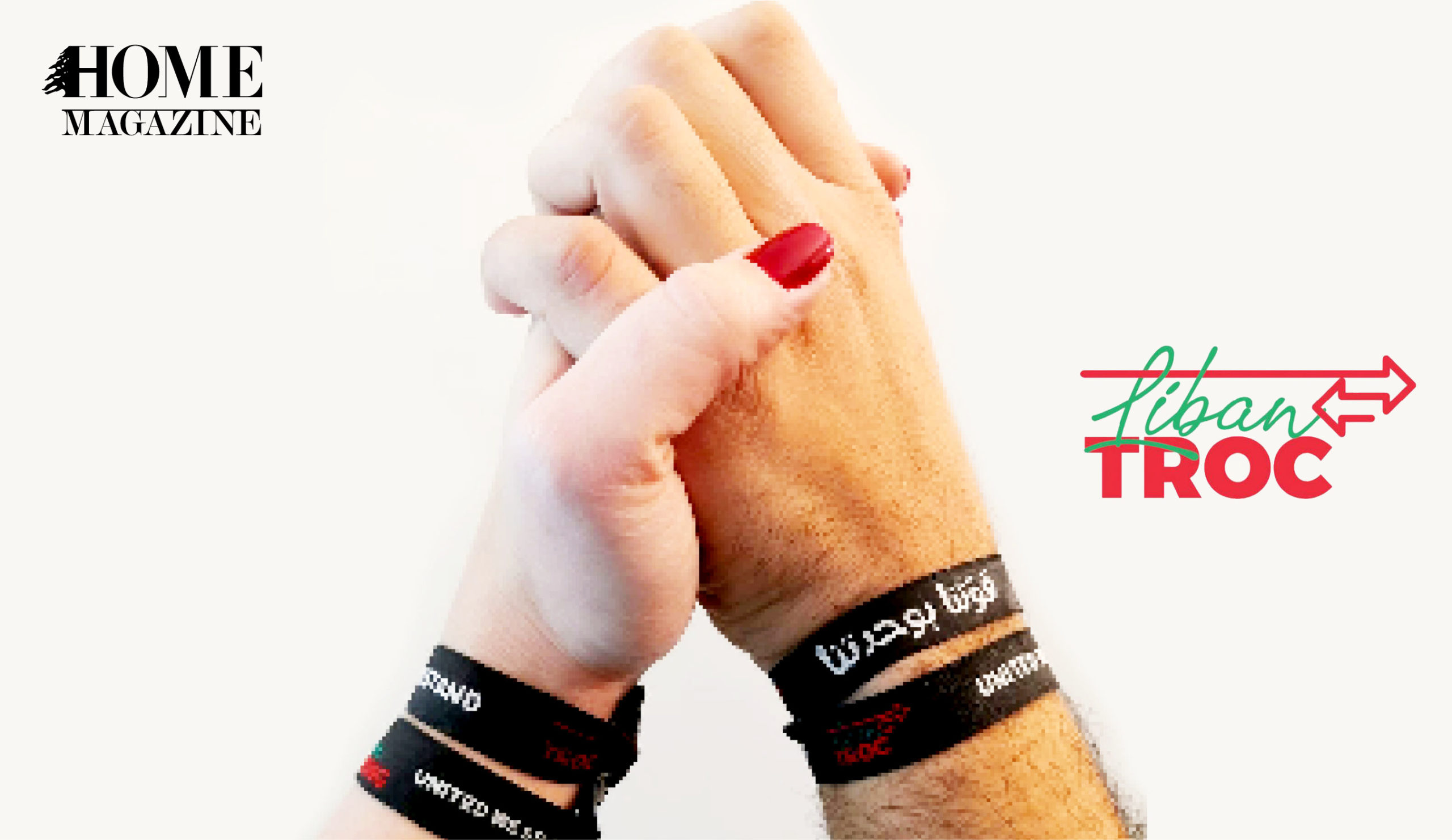
Liban Troc also sells branded bracelets with the message “United We Stand.” The bracelets, which cost 3,000 Lira in Lebanon, are also being distributed to oversees volunteers who are selling them to their Lebanese network of friends. (In the United Arab Emirates, they go for 10 Dirhams and for $5 in the United States).
While Liban Troc takes up much of Dahrouge’s time these days, the reward, she tells HOME, is priceless. “In these times of crisis and through the platform, we are striving to restore hope and to spread positive vibes versus the news on TV, which is mostly depressing. I get a lot of happiness from this. And I must say, karma is amazing! People who know what I am doing are ready to help me, too. For example, if I go to the vet, my pet gets free vaccines or my doctor won’t charge me!”
Acts of kindness are perhaps the “new currency” of Lebanon and, unlike money, will never devalue.

HOMEland Magazine
We firmly believe that the internet should be available and accessible to anyone, and are committed to providing a website that is accessible to the widest possible audience, regardless of circumstance and ability.
To fulfill this, we aim to adhere as strictly as possible to the World Wide Web Consortium’s (W3C) Web Content Accessibility Guidelines 2.1 (WCAG 2.1) at the AA level. These guidelines explain how to make web content accessible to people with a wide array of disabilities. Complying with those guidelines helps us ensure that the website is accessible to all people: blind people, people with motor impairments, visual impairment, cognitive disabilities, and more.
This website utilizes various technologies that are meant to make it as accessible as possible at all times. We utilize an accessibility interface that allows persons with specific disabilities to adjust the website’s UI (user interface) and design it to their personal needs.
Additionally, the website utilizes an AI-based application that runs in the background and optimizes its accessibility level constantly. This application remediates the website’s HTML, adapts Its functionality and behavior for screen-readers used by the blind users, and for keyboard functions used by individuals with motor impairments.
If you’ve found a malfunction or have ideas for improvement, we’ll be happy to hear from you. You can reach out to the website’s operators by using the following email
Our website implements the ARIA attributes (Accessible Rich Internet Applications) technique, alongside various different behavioral changes, to ensure blind users visiting with screen-readers are able to read, comprehend, and enjoy the website’s functions. As soon as a user with a screen-reader enters your site, they immediately receive a prompt to enter the Screen-Reader Profile so they can browse and operate your site effectively. Here’s how our website covers some of the most important screen-reader requirements, alongside console screenshots of code examples:
Screen-reader optimization: we run a background process that learns the website’s components from top to bottom, to ensure ongoing compliance even when updating the website. In this process, we provide screen-readers with meaningful data using the ARIA set of attributes. For example, we provide accurate form labels; descriptions for actionable icons (social media icons, search icons, cart icons, etc.); validation guidance for form inputs; element roles such as buttons, menus, modal dialogues (popups), and others. Additionally, the background process scans all the website’s images and provides an accurate and meaningful image-object-recognition-based description as an ALT (alternate text) tag for images that are not described. It will also extract texts that are embedded within the image, using an OCR (optical character recognition) technology. To turn on screen-reader adjustments at any time, users need only to press the Alt+1 keyboard combination. Screen-reader users also get automatic announcements to turn the Screen-reader mode on as soon as they enter the website.
These adjustments are compatible with all popular screen readers, including JAWS and NVDA.
Keyboard navigation optimization: The background process also adjusts the website’s HTML, and adds various behaviors using JavaScript code to make the website operable by the keyboard. This includes the ability to navigate the website using the Tab and Shift+Tab keys, operate dropdowns with the arrow keys, close them with Esc, trigger buttons and links using the Enter key, navigate between radio and checkbox elements using the arrow keys, and fill them in with the Spacebar or Enter key.Additionally, keyboard users will find quick-navigation and content-skip menus, available at any time by clicking Alt+1, or as the first elements of the site while navigating with the keyboard. The background process also handles triggered popups by moving the keyboard focus towards them as soon as they appear, and not allow the focus drift outside it.
Users can also use shortcuts such as “M” (menus), “H” (headings), “F” (forms), “B” (buttons), and “G” (graphics) to jump to specific elements.
We aim to support the widest array of browsers and assistive technologies as possible, so our users can choose the best fitting tools for them, with as few limitations as possible. Therefore, we have worked very hard to be able to support all major systems that comprise over 95% of the user market share including Google Chrome, Mozilla Firefox, Apple Safari, Opera and Microsoft Edge, JAWS and NVDA (screen readers).
Despite our very best efforts to allow anybody to adjust the website to their needs. There may still be pages or sections that are not fully accessible, are in the process of becoming accessible, or are lacking an adequate technological solution to make them accessible. Still, we are continually improving our accessibility, adding, updating and improving its options and features, and developing and adopting new technologies. All this is meant to reach the optimal level of accessibility, following technological advancements. For any assistance, please reach out to