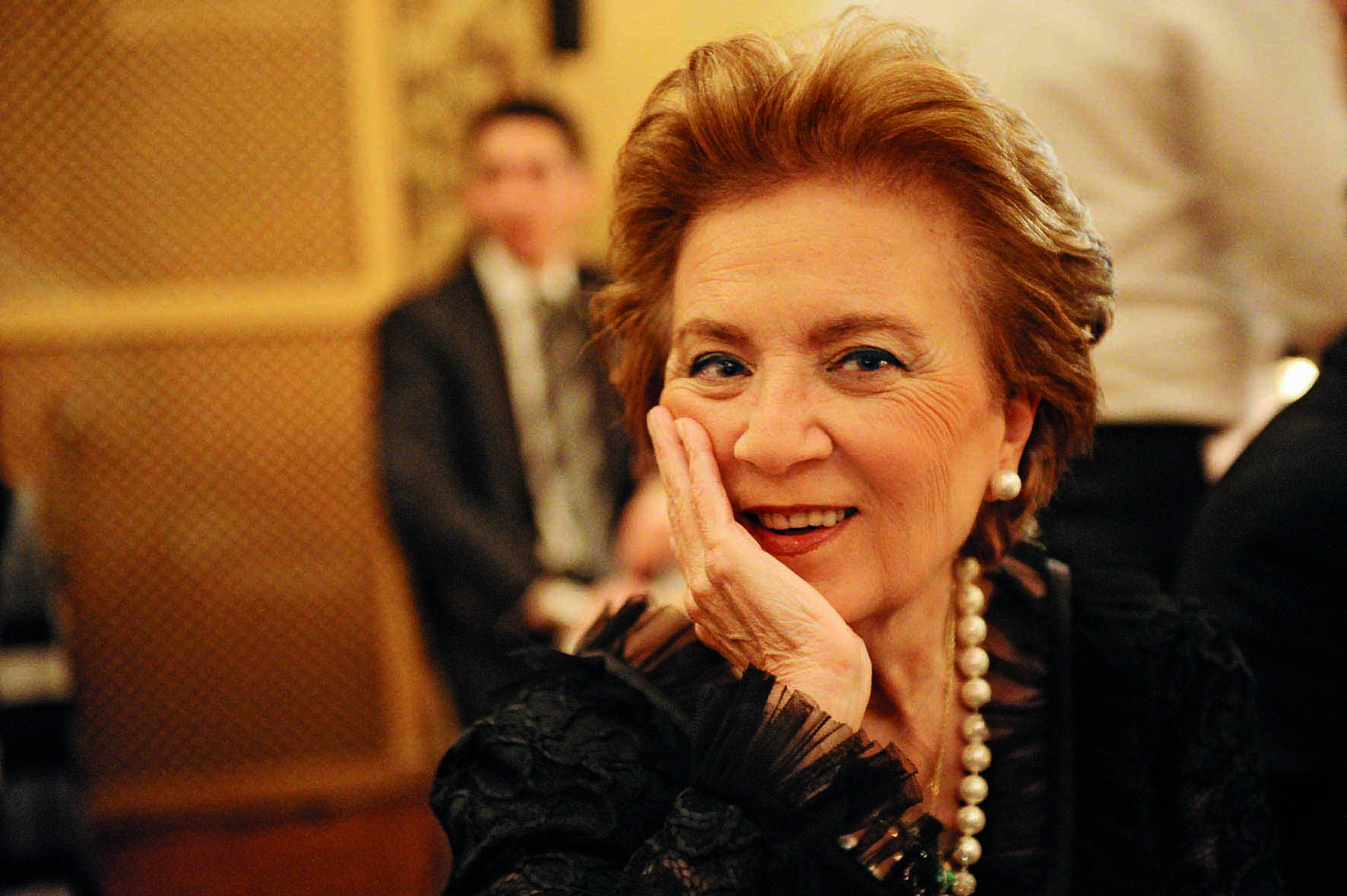
Al Bustan international festival of music and arts and member of the European Festival Association, since it was founded in 1994, has put Lebanon on a pedestal as a unique and unprecedented tradition of a music season in winter. The festival founders wished to revive the cultural life of a country reemerging after 17 years of war. With more than thirty performances seasonally presented every year, over a wintery period from February to March, with a predominance of chamber music, the festival includes opera, orchestral concerts, dance, marionettes and theater. Developed around cultural and special themes, the festival is distinguished each and every year with one-of-a-kind choices of artists, works and performances, creating a unique bond between artists and their audience in a warm atmosphere.
Renowned for her punctuality, Myrna Bustani arrived just on time for our meeting. Over the years, the International Al Bustan Festival of Music and Arts has always started at 8:30 sharp. She simply believes that each and everyone starts with their own selves to give the right example. Bustani was the first woman to be elected as a member of the Lebanese Parliament in 1963, but didn’t enjoy the experience there. However, she attests that there were many people who were giving a positive input at the time, such as Nayla Mouawad.
Bustani describes the beginning: “It all started when I went to attend a piano festival near here, and I was shocked to see people talking and projectors placing emphasis on the audience instead of the pianist, the light supposed to frame the musician on stage actually ended up blinding him temporarily. I shared my concerns with Walid Gholmieh and he answered, ‘That’s how Lebanon is, what can we do?’ And so I decided to do something about it and lo, the International Al Bustan Festival of Music and Arts was born.” It started with simple piano concerts, but has evolved in crescendo to opera, which the audience has appreciated more and more every year.
“It started with simple piano concerts, but has evolved in crescendo to opera”
A success story
The keys to Bustani’s success were nothing more than hard work, perseverance and quality. Still, that required a lot of dedication, motivation and effort. She believed in bringing back to life “the music of the dead,” which was the status of classical music at that time. The only time classical music concerts were shown on TV was when someone had died. She wanted to invite people to look and listen, beyond their normal experiences. Furthermore she added her own touch to the music festival, holding art exhibitions and seasonal workshops that used to happen during the festival at the conservatoire in the beginning, but were shifted to Broumanna at a later stage.
“The keys to my success were nothing more than hard work, perseverance and quality.”
Upcoming program
The festival’s upcoming theme is Shakespeare, in homage to the 500-year anniversary of Shakespeare’s death in 2016. The theme for the year after that (as themes are planned for two consecutive years) will be “Women of Orient” – an ode to Cleopatra, Shehrazade and many more.
An ode to Fairuz
“Today, youth doesn’t know the real Lebanon, and the feeling of being Lebanese. Youngsters are forgetting their own identity. They need to know that they are not like anyone else and that they have their own identity should and be proud of it. Besides, in our today’s hectic world, a big part of our heritage is lost.” The iron lady surrendered to her emotions the very first time she heard the word “Lebanon.” A Lebanon she cherished, loved and venerated, a Lebanon who knew the glory of Beirut and the magical tones of Fairuz’s voice. She even recalled Fairuz concert that they organized in the Royal Festival Hall in London in 1986, when war in Lebanon was at its peak and Lebanese people attending weren’t talking to each other.
“Maybe it’s time to put our hands together and build a Lebanon of culture, beauty and civism.”
The concert was an amazing glorious moment in time, eternalized by Fairuz’s enchanting voice, a voice that holds within so much historical, authentic and emotional heritage. Even unflinching British policemen stated with swollen eyes that they have never heard such a beautiful voice. Nada Massoud, responsible for communication at Al Boustan Festival added, quoting a documentary about Fairuz by Frederic Mitterand, “Don’t count on Fairuz to solve your problems and get you together.”

HOMEland Magazine
We firmly believe that the internet should be available and accessible to anyone, and are committed to providing a website that is accessible to the widest possible audience, regardless of circumstance and ability.
To fulfill this, we aim to adhere as strictly as possible to the World Wide Web Consortium’s (W3C) Web Content Accessibility Guidelines 2.1 (WCAG 2.1) at the AA level. These guidelines explain how to make web content accessible to people with a wide array of disabilities. Complying with those guidelines helps us ensure that the website is accessible to all people: blind people, people with motor impairments, visual impairment, cognitive disabilities, and more.
This website utilizes various technologies that are meant to make it as accessible as possible at all times. We utilize an accessibility interface that allows persons with specific disabilities to adjust the website’s UI (user interface) and design it to their personal needs.
Additionally, the website utilizes an AI-based application that runs in the background and optimizes its accessibility level constantly. This application remediates the website’s HTML, adapts Its functionality and behavior for screen-readers used by the blind users, and for keyboard functions used by individuals with motor impairments.
If you’ve found a malfunction or have ideas for improvement, we’ll be happy to hear from you. You can reach out to the website’s operators by using the following email
Our website implements the ARIA attributes (Accessible Rich Internet Applications) technique, alongside various different behavioral changes, to ensure blind users visiting with screen-readers are able to read, comprehend, and enjoy the website’s functions. As soon as a user with a screen-reader enters your site, they immediately receive a prompt to enter the Screen-Reader Profile so they can browse and operate your site effectively. Here’s how our website covers some of the most important screen-reader requirements, alongside console screenshots of code examples:
Screen-reader optimization: we run a background process that learns the website’s components from top to bottom, to ensure ongoing compliance even when updating the website. In this process, we provide screen-readers with meaningful data using the ARIA set of attributes. For example, we provide accurate form labels; descriptions for actionable icons (social media icons, search icons, cart icons, etc.); validation guidance for form inputs; element roles such as buttons, menus, modal dialogues (popups), and others. Additionally, the background process scans all the website’s images and provides an accurate and meaningful image-object-recognition-based description as an ALT (alternate text) tag for images that are not described. It will also extract texts that are embedded within the image, using an OCR (optical character recognition) technology. To turn on screen-reader adjustments at any time, users need only to press the Alt+1 keyboard combination. Screen-reader users also get automatic announcements to turn the Screen-reader mode on as soon as they enter the website.
These adjustments are compatible with all popular screen readers, including JAWS and NVDA.
Keyboard navigation optimization: The background process also adjusts the website’s HTML, and adds various behaviors using JavaScript code to make the website operable by the keyboard. This includes the ability to navigate the website using the Tab and Shift+Tab keys, operate dropdowns with the arrow keys, close them with Esc, trigger buttons and links using the Enter key, navigate between radio and checkbox elements using the arrow keys, and fill them in with the Spacebar or Enter key.Additionally, keyboard users will find quick-navigation and content-skip menus, available at any time by clicking Alt+1, or as the first elements of the site while navigating with the keyboard. The background process also handles triggered popups by moving the keyboard focus towards them as soon as they appear, and not allow the focus drift outside it.
Users can also use shortcuts such as “M” (menus), “H” (headings), “F” (forms), “B” (buttons), and “G” (graphics) to jump to specific elements.
We aim to support the widest array of browsers and assistive technologies as possible, so our users can choose the best fitting tools for them, with as few limitations as possible. Therefore, we have worked very hard to be able to support all major systems that comprise over 95% of the user market share including Google Chrome, Mozilla Firefox, Apple Safari, Opera and Microsoft Edge, JAWS and NVDA (screen readers).
Despite our very best efforts to allow anybody to adjust the website to their needs. There may still be pages or sections that are not fully accessible, are in the process of becoming accessible, or are lacking an adequate technological solution to make them accessible. Still, we are continually improving our accessibility, adding, updating and improving its options and features, and developing and adopting new technologies. All this is meant to reach the optimal level of accessibility, following technological advancements. For any assistance, please reach out to