
One Lebanon is an apolitical cultural movement gathering people who believe in the importance of unity.
One Lebanon’s mission is to positively influence the collective attitude of today’s Lebanese by creating, through cultural activities, an area of convergence, dialogue, cooperation and exchange of experience within an atmosphere of respect, reconciliation, peace and unity.
It all starts with believing in an idea Tania Kassis is a Lebanese soprano who defends cultural diversity as well as religious dialogues. Among her many national and international achievements, she is also known for her “Islamo-Christian Ave” (a rendition of Ave Maria at sound of the muezzin’s “Allah Akbar”) that highlighted the dialogue between Christian and Muslims. https://www.youtube.com/watch?v=IhwJpac61Dg
It was in the summer of 2013 that she started receiving numerous messages from friends expressing happiness in leaving Lebanon for opportunities abroad. This is not what she wanted to hear. She had lived in Paris for seven years and left everything to come back and live in Lebanon. She wanted things to change and believed in the new generations. So she started thinking about what she could do as a public figure to influence new generations and make them believe that everything is possible, even when things get complicated.
One day she was having lunch with British Ambassador Tom Fletcher, and expressing her frustration and spontaneously she spoke the one sentence that would start a movement.
She said, “I wish one day all the Lebanese singers could be united on one stage and sing for Lebanon.”
With Tom’s encouragement, she went back HOME and wrote him an email with the subject: “My Crazy Project.”
Two beyond-successful years later, One Lebanon is one of the most exciting events of the year in Lebanon, and there’s much more to come. Not such a crazy project after all.
“I never imaged it would lead somewhere, but I tried and started contacting some celebrities I knew,” she revealed. “At the beginning it was funny because people would say OK but didn’t expect much from it.” That was soon to change.
Music brings people together
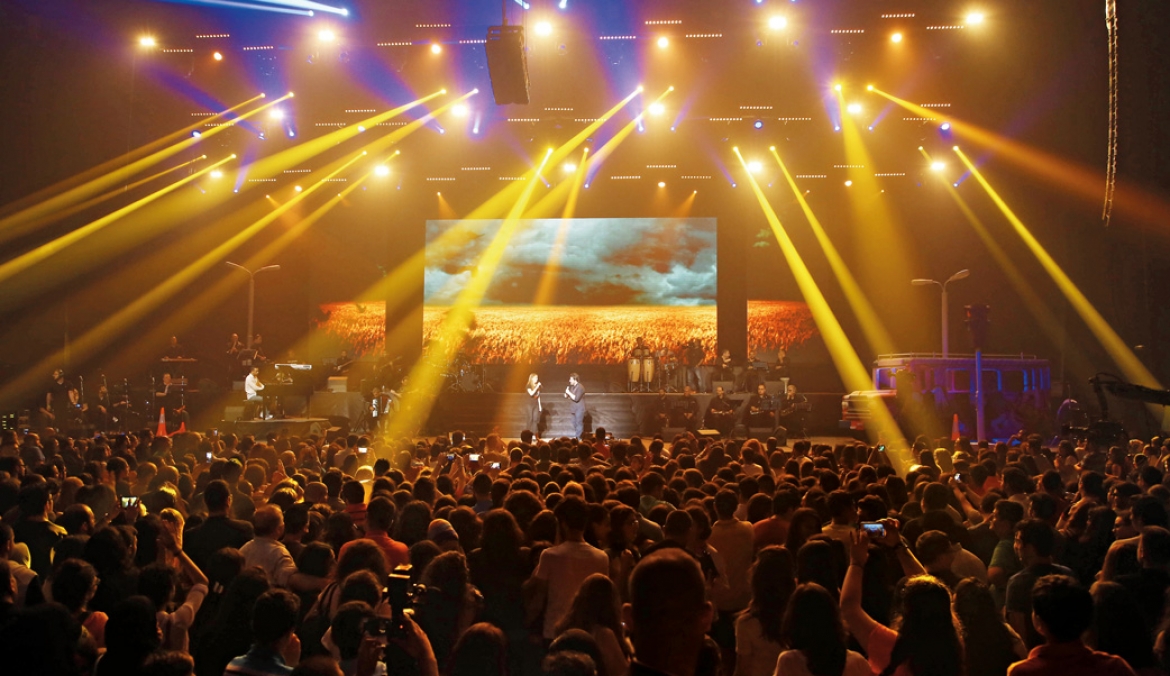
In February of 2014, the first One Lebanon concert gathered over 20 celebrities, a choir of 160 singers from all regions of Lebanon, and an audience of 7 thousand people at Forum de Beirut. The main purpose was for it not to be just a concert, but also a message that we can be united and nothing is impossible – to set an example for new generations to be united in the same way when it comes to Lebanon.
“For us, it was the launch of our mission, not only of an NGO but more of a movement of any person who really believed we could be united. Our aim is not to convince anyone of anything, or make people think the same way, it’s about respecting diversity and coming together,” said Kasiss, passion for her country radiating from her voice. “The celebrities really believed in my mission and wanted to join their voices in this message.”
This year, the concert brought in a crowd of 10,000 people, and over 35 celebrity performers: singers, presenters and actors from all generations, and for the first time participation was extended to performers from the Lebanese Diaspora.
The celebrities were from all ages. It was simply startling to see superstars of the war generation such as internationally acclaimed Elias Rahbani, crooner Nicolas Osta, rock star Ghassan Rahbani, and Re- Mi Bandali (in her come back 30 years later) intermingle on stage with younger-generation stars like Tania Kassis, arranger Michel Fadel, Melhem Zein, Joseph Attieh, Anthony Touma, Aline Lahoud, Saad Ramadan, Omar Dean (X-Factor Australia finalist of Lebanese origins), Carlos Azar, Nizar Francis, Mike Massy, Brigitte Yaghi, Maguy Bou Ghosn, Michel Abou Sleiman, Nicolas Mouawad, Tony Abou Jaoude, Nada Abou Farhat, Tony Issa, Maritta Assi Hallani, Zeina Daccache, Joseph Hoayek, Bruno Tabbal, Grace Ayanian, Elie Rustom, Silvio Chiha, Charbel Ragy, Rahaf Abdallah, the rappers Mn-el-Ekher, rock band The Coolcumbers as well as Wissam Breidy, in a surprising and moving appearance.
They performed on stage in duos, trios or in a group, to sing and carry out a message of love, reconciliation and unity. The basic principle and philosophy behind One Lebanon is to never sing alone in solo, but to come together as one voice. Profits from the concert will go to the families of Lebanese Army martyrs.
As for the concert being taken to another country: “We’ve been asked to do the concert abroad. It’s a big debate in the committee, but for me, I want One Lebanon to be THE rendezvous in Lebanon. This year, we have people specially coming just for the concert next year in March 2016. ”
Save the date!
Unity is important in all industries
Although they’ve had huge success with the annual concert, that’s not the only project One Lebanon is involved in. They want to spread their message to as many sectors as possible. Besides the music industry, they’ve also reached out to the performing arts field, sports industry, educational field, public and private sectors, and the press.
She believes in the importance of the Diaspora and aims to get them more involved. On July 26, they will have the “I’ll Be the Change” summer festival.
The aim is to gather young Lebanese, promoting young choirs, and talent (pop bands, rock bands, etc.) to perform in the presence of over 185 young spectators from the Lebanese Diaspora, coming from over 20 countries through the World Lebanese
Cultural Union. Here, in this musically diverse and exciting platform, the diaspora will get a chance to mingle and meet people living in Lebanon to create liaisons and build lasting friendships.
Sports are another way to bring people together. On June 27th, One Lebanon will be hosting a football game, Lebanon vs. the rest of world, with the Lebanon team members being celebrities and rest of world team will be ambassadors. Last year, they conducted a football match imitating the Christmas truce, on December 24, 1914, when a football game took place between the British and Germans troops during World War I.
“Lebanon is my HOMEland. It’s my roots, my baby. It’s someone that needs a lot of attention, and care,” said Kassis. Like a child, if we help it grow big and strong, it will return our love with more love.
If you would like more information, please visit: Onelebanon.org


HOMEland THEMES
Coming Soon
HOMEland Events & Collaborations
Coming Soon
 Signature Boutique