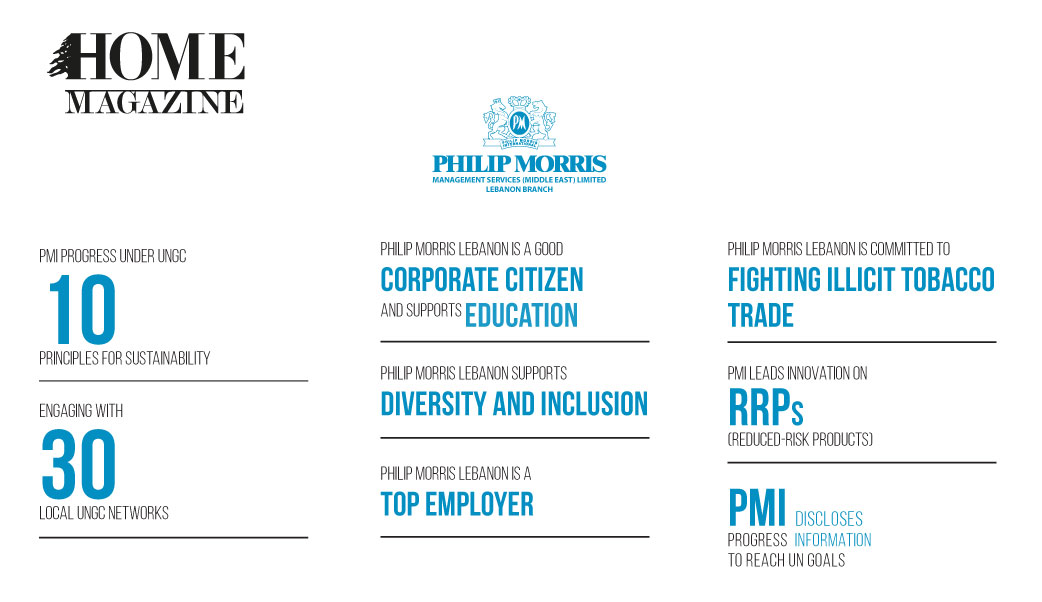
Philip Morris International (PMI) joined the United Nations Global Compact (UNGC) in 2015. The UNGC is a voluntary public-private partnership aimed at advancing global sustainability goals through business commitment to ten fundamental principles relating to Human Rights, Labor Rights, Environmental Responsibility, and Anti-corruption measures.
PMI published in June 2016 its first ‘Communication on Progress’ report in which it illustrates how Philip Morris International, and consequently its branch in Lebanon, otherwise known as ‘Philip Morris Management Services (Middle East) Limited – Lebanon Branch’ (PMMS), manage their business with regard to the Ten Principles and describes the company’s policies, activities, measurements and future plans for key topics across the value chain. PMI is also taking action to support broader UN goals and to participate in local UN Global Compact networks. At this time, the company has engaged at the market level with nearly 30 local UN Global Compact networks, including the network in Lebanon.
In Lebanon, Philip Morris actively carries out a number of corporate social responsibility initiatives that seek to provide underprivileged members of the local community with education opportunities where they would otherwise not have them. Working with the Syndicate of Lebanese Tobacco Growers, PMMS has succeeded in supporting the educational ventures of tobacco farmers’ children, and in bringing educational activities to underprivileged regions of the country.
Further to the company’s commitment to sustainable development, at Philip Morris, the priority is to attract, support and hold on to diverse and unique individuals from every corner of the planet – no matter what the age, background, gender, religion, sexual orientation or physical ability.
The company’s diverse, multifaceted and multigenerational workforce is its best asset as it fosters a culture of openness and respect for others.
Principle ten of the UNGC regards anti-corruption practices. Preventing illegal sales of tobacco products is one of the company’s core business strategies. It is a key element of sustainability since reducing illicit trade is not only good for PMMS’ business, but also important to mitigate the devastating consequences illicit trade has on governments, societies and communities. Illicit trade accounts for 10-12% of consumed cigarettes worldwide and strips governments of tax revenues of up to USD 40-50 billion each year. At the market level, PMMS has actively and continuously collaborated with local authorities to reduce illicit tobacco trade in Lebanon, effectively returning a considerable amount of taxes to the national economy.
On the research and innovation front, and as Philip Morris understands the millions of current adult smokers who are looking for less harmful, yet satisfying, alternatives to smoking, PMI embarked on a journey to give them that choice and fulfill that commitment by pursuing its long-term vision for a smoke-free future. Society expects the company to act responsibly, and that is why PMI announced its ambitious goal to lead a full-scale effort to ensure that Reduced-Risk Products (RRPs) ultimately replace cigarettes. The company envisions a smoke-free world where RRPs provide a much better choice for adult smokers than conventional cigarettes.
PMI’s release of its ‘Communication on Progress’ report under the UNGC sets the company and each of its subsidiaries up to continuously, transparently, and publicly disclose information about its progress toward reaching UN sustainability standards, and invites a stakeholder discussion on how best to achieve a post-2015 development agenda.


HOMEland Magazine
We firmly believe that the internet should be available and accessible to anyone, and are committed to providing a website that is accessible to the widest possible audience, regardless of circumstance and ability.
To fulfill this, we aim to adhere as strictly as possible to the World Wide Web Consortium’s (W3C) Web Content Accessibility Guidelines 2.1 (WCAG 2.1) at the AA level. These guidelines explain how to make web content accessible to people with a wide array of disabilities. Complying with those guidelines helps us ensure that the website is accessible to all people: blind people, people with motor impairments, visual impairment, cognitive disabilities, and more.
This website utilizes various technologies that are meant to make it as accessible as possible at all times. We utilize an accessibility interface that allows persons with specific disabilities to adjust the website’s UI (user interface) and design it to their personal needs.
Additionally, the website utilizes an AI-based application that runs in the background and optimizes its accessibility level constantly. This application remediates the website’s HTML, adapts Its functionality and behavior for screen-readers used by the blind users, and for keyboard functions used by individuals with motor impairments.
If you’ve found a malfunction or have ideas for improvement, we’ll be happy to hear from you. You can reach out to the website’s operators by using the following email
Our website implements the ARIA attributes (Accessible Rich Internet Applications) technique, alongside various different behavioral changes, to ensure blind users visiting with screen-readers are able to read, comprehend, and enjoy the website’s functions. As soon as a user with a screen-reader enters your site, they immediately receive a prompt to enter the Screen-Reader Profile so they can browse and operate your site effectively. Here’s how our website covers some of the most important screen-reader requirements, alongside console screenshots of code examples:
Screen-reader optimization: we run a background process that learns the website’s components from top to bottom, to ensure ongoing compliance even when updating the website. In this process, we provide screen-readers with meaningful data using the ARIA set of attributes. For example, we provide accurate form labels; descriptions for actionable icons (social media icons, search icons, cart icons, etc.); validation guidance for form inputs; element roles such as buttons, menus, modal dialogues (popups), and others. Additionally, the background process scans all the website’s images and provides an accurate and meaningful image-object-recognition-based description as an ALT (alternate text) tag for images that are not described. It will also extract texts that are embedded within the image, using an OCR (optical character recognition) technology. To turn on screen-reader adjustments at any time, users need only to press the Alt+1 keyboard combination. Screen-reader users also get automatic announcements to turn the Screen-reader mode on as soon as they enter the website.
These adjustments are compatible with all popular screen readers, including JAWS and NVDA.
Keyboard navigation optimization: The background process also adjusts the website’s HTML, and adds various behaviors using JavaScript code to make the website operable by the keyboard. This includes the ability to navigate the website using the Tab and Shift+Tab keys, operate dropdowns with the arrow keys, close them with Esc, trigger buttons and links using the Enter key, navigate between radio and checkbox elements using the arrow keys, and fill them in with the Spacebar or Enter key.Additionally, keyboard users will find quick-navigation and content-skip menus, available at any time by clicking Alt+1, or as the first elements of the site while navigating with the keyboard. The background process also handles triggered popups by moving the keyboard focus towards them as soon as they appear, and not allow the focus drift outside it.
Users can also use shortcuts such as “M” (menus), “H” (headings), “F” (forms), “B” (buttons), and “G” (graphics) to jump to specific elements.
We aim to support the widest array of browsers and assistive technologies as possible, so our users can choose the best fitting tools for them, with as few limitations as possible. Therefore, we have worked very hard to be able to support all major systems that comprise over 95% of the user market share including Google Chrome, Mozilla Firefox, Apple Safari, Opera and Microsoft Edge, JAWS and NVDA (screen readers).
Despite our very best efforts to allow anybody to adjust the website to their needs. There may still be pages or sections that are not fully accessible, are in the process of becoming accessible, or are lacking an adequate technological solution to make them accessible. Still, we are continually improving our accessibility, adding, updating and improving its options and features, and developing and adopting new technologies. All this is meant to reach the optimal level of accessibility, following technological advancements. For any assistance, please reach out to