

HOMEland
Coming Soon
HOMEland Events & Collaborations
Coming Soon
 Signature Boutique


While no one ever calls the Lebanese reserved, it is natural for humans to have a fear of public speaking. Apparently, the Lebanese are eager to overcome it.
Is it the outgoing personality? The confidence? Or always having an opinion? What is it about the Lebanese and public speaking that make such a good fit?
In the past decade, a huge self-help movement has evolved in Lebanon around public speaking. From Toastmasters to TEDx to a variety of competitions, people in Lebanon are flocking to public speaking opportunities. So set up the mic!
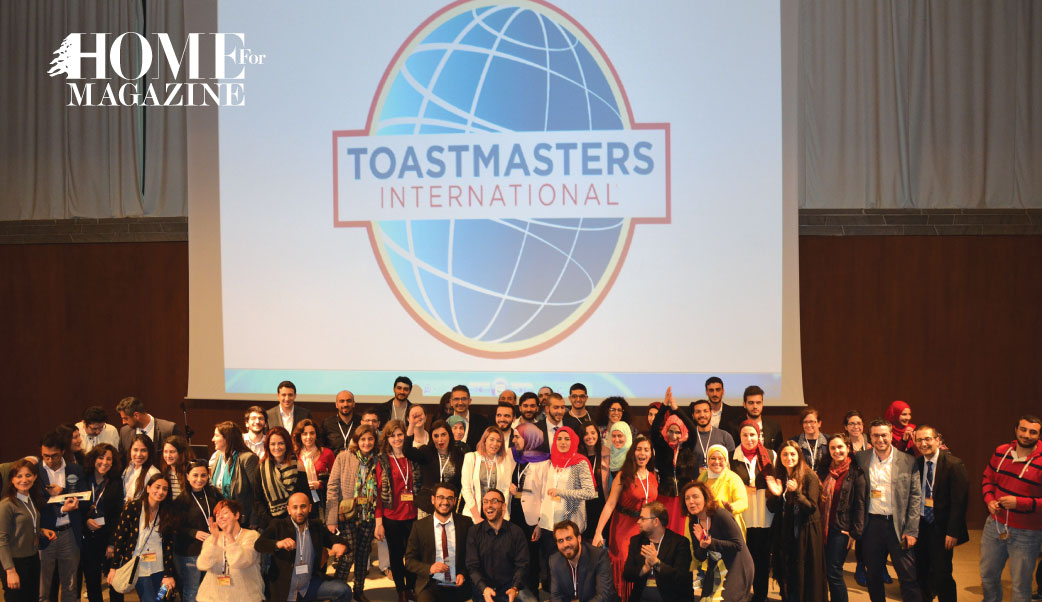
Toastmasters International – Where Leaders are Made
“I was really shy. When called on to speak, I’d go blank,” said Zahraa Shaito, Toastmasters International’s Area Director for Lebanon. She is now a frequent keynote speaker, who often trains CEOs and TEDx speakers in the art of public speaking. Toastmasters combines a supportive environment with challenging experiences for developing public speaking skills in a systematic way, she says.
“Today I can always find things to say. That came with lots of practice.” The “amazing support” at Toastmasters kept her coming to the weekly meetings, she said. Club meetings are workshops in which members learn by watching and doing, sharing suggestions and feedback with others who are there for the same reasons you are.
“Maybe we are driven by ambition,” Shaito speculated. “Lebanese people forecast what is needed – presentation skills, interview skills – and they will work on self-improvement. They know if they want an edge, they need to work on themselves.”
“Or a lack of inhibition,” she added. “We have no fear of trying new things.”
When storyteller, writer and academic Sadika Kebbi attended her first Toastmasters meeting, she was hooked. “Everyone leaves everything outside the door – the sectarianism, the titles, the affiliations, all the things that divide us. Once we step in that room, anyone there can become your mentor,” Kebbi said.
Through Toastmasters’ worldwide network, members challenge themselves in competitions in Lebanon, then the region and internationally. “I’ve met so many wonderful people,” she said.
TEDX – Taking your message to the world
Created in the spirit of the famous TED conference, TEDx’s mission is to share “ideas worth spreading.” TEDx’s great popularity in Lebanon and around the world “highlights the need for more positive voices, stories and actions,” said Sara Sibai, a TEDx organizer in the community.
“TEDx’s great popularity in Lebanon and around the world highlights the need for more positive voices, stories and actions.”
Patricia Zougheib brought TEDx to Lebanon in 2009 in the form of weekly salons she hosted, and still hosts, in her living room. In 2011 and 2012, Zougheib enlarged her effort to create TEDxBeirut, inviting Lebanese with novel ideas to audition for the chance to share their ideas on stage.
The idea caught on like wildfire, sparking others to create their own TEDx talks in public venues and universities in Lebanon. TEDxYouth was also developed for a younger crowd.
Sibai said, “TEDx allows me to tap into my passion for public speaking and storytelling by helping our speakers share their ideas in a way that can reach the hearts and minds of our audience.”
Anyone with a good idea can submit the idea to one of Lebanon’s many TEDx events and audition for a chance to present the idea on stage. A team of TEDx volunteers, often including Toastmasters, will train the speakers before their big day.
Like Toastmasters, the experience is more than skill training. Whether you are on the stage or behind the scenes, “it’s exciting to be a part of something meaningful and larger than yourself,” said Sibai, “to work on a team creating this unique platform for the community to share their stories, inventions, and new perspectives.”
Engaging Youth in the Public Speaking Challenge
Two nationwide competitions challenge Lebanese to develop their public speaking skills: the English Speaking Union’s annual National Public Speaking Competition for university students, hosted at the Lebanese American University, and the National Public Speaking School Competition for students in grades 11 and 12, held at Rafik Hariri University. Popular TV host Zaven Kouyoumdjian serves as the celebrity judge in both competitions, which crown Lebanon’s champion public speakers.
For more info
 Signature Boutique
Lebanon, in your inbox

HOMEland Magazine
We firmly believe that the internet should be available and accessible to anyone, and are committed to providing a website that is accessible to the widest possible audience, regardless of circumstance and ability.
To fulfill this, we aim to adhere as strictly as possible to the World Wide Web Consortium’s (W3C) Web Content Accessibility Guidelines 2.1 (WCAG 2.1) at the AA level. These guidelines explain how to make web content accessible to people with a wide array of disabilities. Complying with those guidelines helps us ensure that the website is accessible to all people: blind people, people with motor impairments, visual impairment, cognitive disabilities, and more.
This website utilizes various technologies that are meant to make it as accessible as possible at all times. We utilize an accessibility interface that allows persons with specific disabilities to adjust the website’s UI (user interface) and design it to their personal needs.
Additionally, the website utilizes an AI-based application that runs in the background and optimizes its accessibility level constantly. This application remediates the website’s HTML, adapts Its functionality and behavior for screen-readers used by the blind users, and for keyboard functions used by individuals with motor impairments.
If you’ve found a malfunction or have ideas for improvement, we’ll be happy to hear from you. You can reach out to the website’s operators by using the following email
Our website implements the ARIA attributes (Accessible Rich Internet Applications) technique, alongside various different behavioral changes, to ensure blind users visiting with screen-readers are able to read, comprehend, and enjoy the website’s functions. As soon as a user with a screen-reader enters your site, they immediately receive a prompt to enter the Screen-Reader Profile so they can browse and operate your site effectively. Here’s how our website covers some of the most important screen-reader requirements, alongside console screenshots of code examples:
Screen-reader optimization: we run a background process that learns the website’s components from top to bottom, to ensure ongoing compliance even when updating the website. In this process, we provide screen-readers with meaningful data using the ARIA set of attributes. For example, we provide accurate form labels; descriptions for actionable icons (social media icons, search icons, cart icons, etc.); validation guidance for form inputs; element roles such as buttons, menus, modal dialogues (popups), and others. Additionally, the background process scans all the website’s images and provides an accurate and meaningful image-object-recognition-based description as an ALT (alternate text) tag for images that are not described. It will also extract texts that are embedded within the image, using an OCR (optical character recognition) technology. To turn on screen-reader adjustments at any time, users need only to press the Alt+1 keyboard combination. Screen-reader users also get automatic announcements to turn the Screen-reader mode on as soon as they enter the website.
These adjustments are compatible with all popular screen readers, including JAWS and NVDA.
Keyboard navigation optimization: The background process also adjusts the website’s HTML, and adds various behaviors using JavaScript code to make the website operable by the keyboard. This includes the ability to navigate the website using the Tab and Shift+Tab keys, operate dropdowns with the arrow keys, close them with Esc, trigger buttons and links using the Enter key, navigate between radio and checkbox elements using the arrow keys, and fill them in with the Spacebar or Enter key.Additionally, keyboard users will find quick-navigation and content-skip menus, available at any time by clicking Alt+1, or as the first elements of the site while navigating with the keyboard. The background process also handles triggered popups by moving the keyboard focus towards them as soon as they appear, and not allow the focus drift outside it.
Users can also use shortcuts such as “M” (menus), “H” (headings), “F” (forms), “B” (buttons), and “G” (graphics) to jump to specific elements.
We aim to support the widest array of browsers and assistive technologies as possible, so our users can choose the best fitting tools for them, with as few limitations as possible. Therefore, we have worked very hard to be able to support all major systems that comprise over 95% of the user market share including Google Chrome, Mozilla Firefox, Apple Safari, Opera and Microsoft Edge, JAWS and NVDA (screen readers).
Despite our very best efforts to allow anybody to adjust the website to their needs. There may still be pages or sections that are not fully accessible, are in the process of becoming accessible, or are lacking an adequate technological solution to make them accessible. Still, we are continually improving our accessibility, adding, updating and improving its options and features, and developing and adopting new technologies. All this is meant to reach the optimal level of accessibility, following technological advancements. For any assistance, please reach out to
