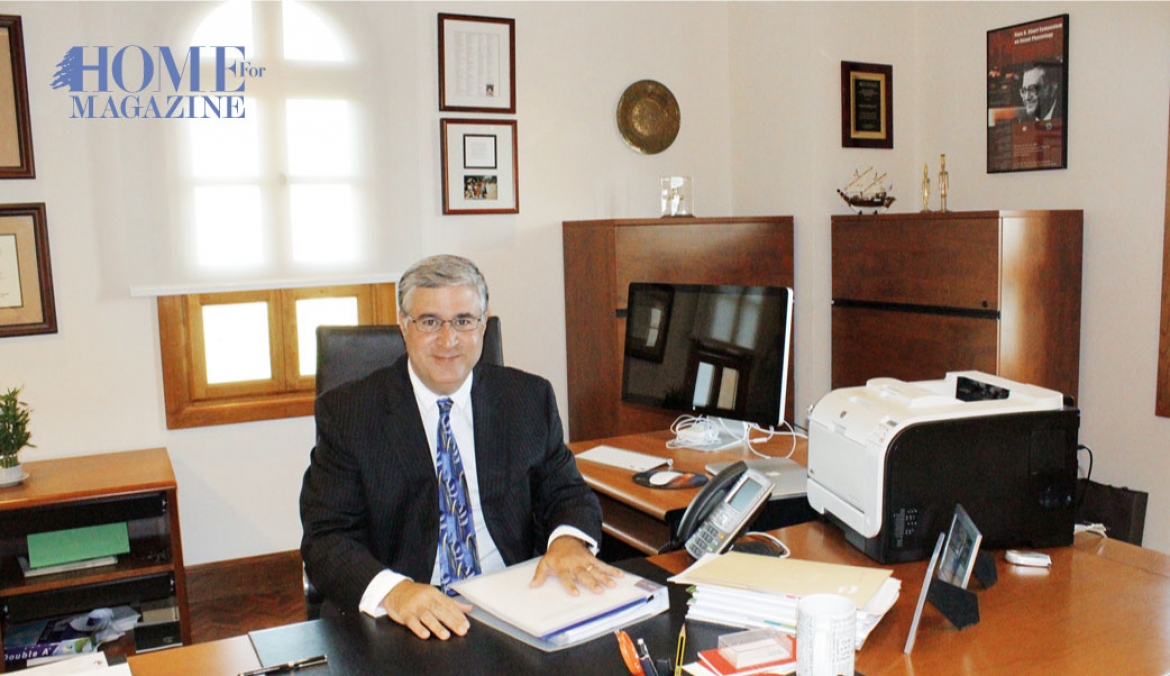
HOME for Magazine talks with Fadlo R. Khuri, MD, the 16th president of the American University of Beirut, about the importance of education and the land of his ancestors.
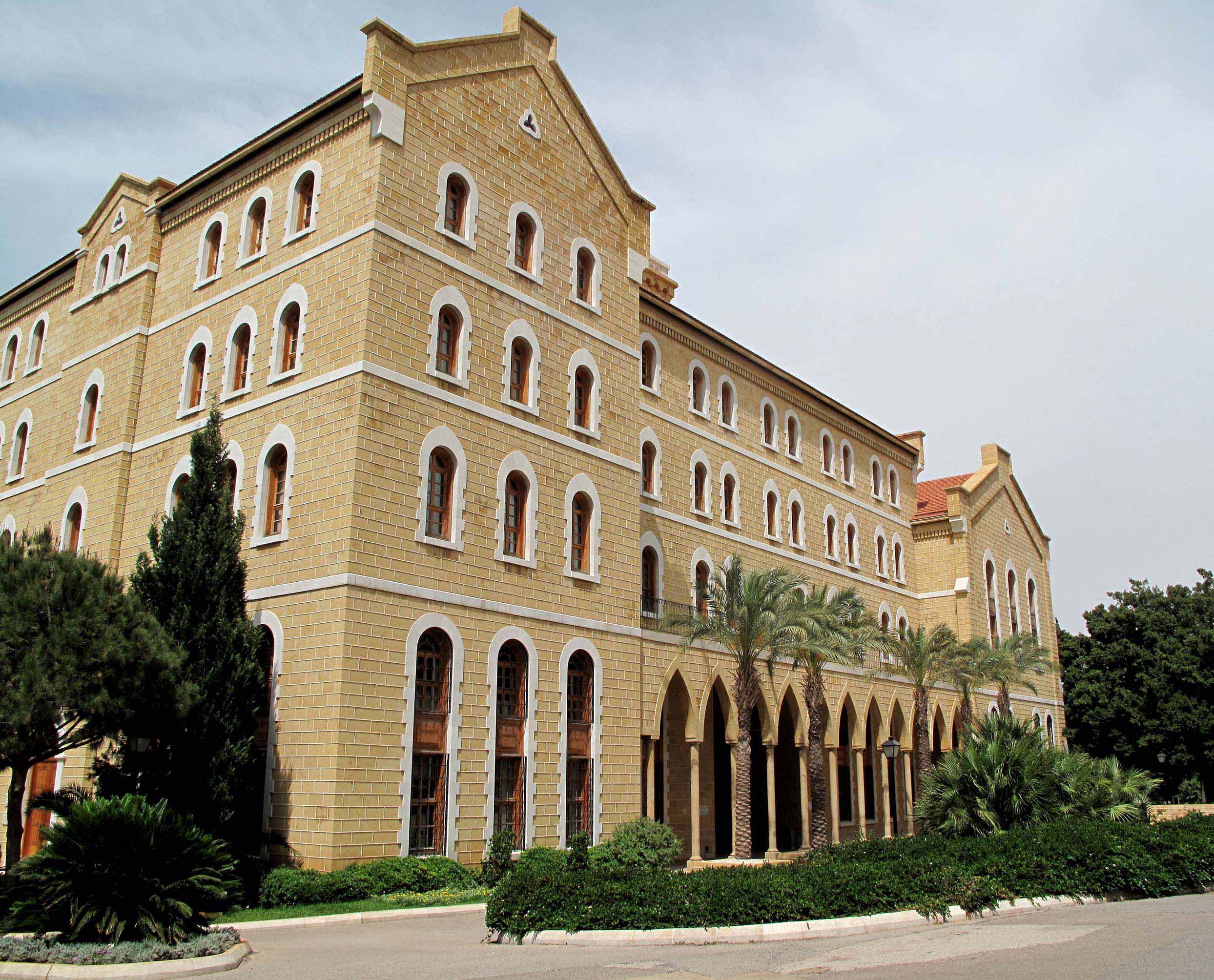
The American University of Beirut is ranked as the No. 1 university in Lebanon and, according to QS World University Rankings, the university is one of the top 250 universities in the world. Dr. Fadlo Khuri, the president of AUB, is an accomplished educator and chairman of the department of hematology and medical oncology, Emory University School of Medicine. Dr. Khuri is an executive associate dean for research of the Emory University School of Medicine. He was born in the United States, and earned his bachelor’s degree from Yale University, and his MD from Columbia University in New York. HOME for Magazine had the pleasure of interviewing Dr. Khuri at the AUB campus in Beirut, and he talked about Lebanese influence in his life and about new projects at the university.
Dr. Fadlo Khuri, we are aware that AUB, after 150 years of existence, is a reference in the education field not only in Lebanon but also throughout the Middle East. How did it feel to be the 16th president of such an important institution?
I was humbled and very proud to be asked to serve as the 16th president of the American University of Beirut. The institution that has helped educate me and four generations of my family. I was also grateful to be given the opportunity to help lead this matchless institution of higher learning. AUB has transformed so many minds and changed tens of thousands of lives for the better, and I am joining it in a period when the opportunity is there to make it even greater than it already is.
Despite being born in the U.S. your roots are Lebanese. How do you see the Lebanese influence in your career and how is the feeling of being in your ancestors’ land?
I was born in the U.S., but grew up in Lebanon as the son of two proud, accomplished and positive Lebanese intellectuals and citizens. My brother and I grew up with a great love of Lebanon and genuine appreciation of its culture and history, as did my wife and her brother. I admire the Lebanese can-do spirit, and the rich sense of belonging that the people here enjoy. I grew up very comfortable with my dual Lebanese and American identities, and since I left here, just before my 19th birthday, I have kept in touch with my friends, family and the Lebanese culture. It is a deeply meaningful homecoming for me, and one I intend to use to make a difference in the lives of the people of AUB, the country and the region.
“I admire the Lebanese can-do spirit”
What is your point of view regarding the education in the Arab world? What are the challenges that AUB must overcome in the future?
Education in the Arab world is at an interesting crossroads. In addition to the many superb, exported branches of top-flight American universities, a series of good quality for-profit institutions have started to take root in the region. Quality higher education is broadly available in the Middle East, and even though AUB is really the oldest and in my view still the strongest and deepest research institution of higher learning in the region, the competition is real. We also have a vital niche that we fill in the region, in that we aspire to reach and impact bright students who do not have the resources to obtain college, graduate and professional training. Our goal is nothing less than effectively and consistently transforming their lives. This phenomenon has been broadly available in the U.S. and Europe, and increasingly across Australia, the Americas and Asia, but a genuinely great liberal arts education in a research university remains a rare and precious commodity in the Middle East. This is precisely where AUB and other excellent institutions of higher learning must lead, if we are help to further build momentum for a fair and just society in the Arab world.
HOMEland Magazine
We firmly believe that the internet should be available and accessible to anyone, and are committed to providing a website that is accessible to the widest possible audience, regardless of circumstance and ability.
To fulfill this, we aim to adhere as strictly as possible to the World Wide Web Consortium’s (W3C) Web Content Accessibility Guidelines 2.1 (WCAG 2.1) at the AA level. These guidelines explain how to make web content accessible to people with a wide array of disabilities. Complying with those guidelines helps us ensure that the website is accessible to all people: blind people, people with motor impairments, visual impairment, cognitive disabilities, and more.
This website utilizes various technologies that are meant to make it as accessible as possible at all times. We utilize an accessibility interface that allows persons with specific disabilities to adjust the website’s UI (user interface) and design it to their personal needs.
Additionally, the website utilizes an AI-based application that runs in the background and optimizes its accessibility level constantly. This application remediates the website’s HTML, adapts Its functionality and behavior for screen-readers used by the blind users, and for keyboard functions used by individuals with motor impairments.
If you’ve found a malfunction or have ideas for improvement, we’ll be happy to hear from you. You can reach out to the website’s operators by using the following email
Our website implements the ARIA attributes (Accessible Rich Internet Applications) technique, alongside various different behavioral changes, to ensure blind users visiting with screen-readers are able to read, comprehend, and enjoy the website’s functions. As soon as a user with a screen-reader enters your site, they immediately receive a prompt to enter the Screen-Reader Profile so they can browse and operate your site effectively. Here’s how our website covers some of the most important screen-reader requirements, alongside console screenshots of code examples:
Screen-reader optimization: we run a background process that learns the website’s components from top to bottom, to ensure ongoing compliance even when updating the website. In this process, we provide screen-readers with meaningful data using the ARIA set of attributes. For example, we provide accurate form labels; descriptions for actionable icons (social media icons, search icons, cart icons, etc.); validation guidance for form inputs; element roles such as buttons, menus, modal dialogues (popups), and others. Additionally, the background process scans all the website’s images and provides an accurate and meaningful image-object-recognition-based description as an ALT (alternate text) tag for images that are not described. It will also extract texts that are embedded within the image, using an OCR (optical character recognition) technology. To turn on screen-reader adjustments at any time, users need only to press the Alt+1 keyboard combination. Screen-reader users also get automatic announcements to turn the Screen-reader mode on as soon as they enter the website.
These adjustments are compatible with all popular screen readers, including JAWS and NVDA.
Keyboard navigation optimization: The background process also adjusts the website’s HTML, and adds various behaviors using JavaScript code to make the website operable by the keyboard. This includes the ability to navigate the website using the Tab and Shift+Tab keys, operate dropdowns with the arrow keys, close them with Esc, trigger buttons and links using the Enter key, navigate between radio and checkbox elements using the arrow keys, and fill them in with the Spacebar or Enter key.Additionally, keyboard users will find quick-navigation and content-skip menus, available at any time by clicking Alt+1, or as the first elements of the site while navigating with the keyboard. The background process also handles triggered popups by moving the keyboard focus towards them as soon as they appear, and not allow the focus drift outside it.
Users can also use shortcuts such as “M” (menus), “H” (headings), “F” (forms), “B” (buttons), and “G” (graphics) to jump to specific elements.
We aim to support the widest array of browsers and assistive technologies as possible, so our users can choose the best fitting tools for them, with as few limitations as possible. Therefore, we have worked very hard to be able to support all major systems that comprise over 95% of the user market share including Google Chrome, Mozilla Firefox, Apple Safari, Opera and Microsoft Edge, JAWS and NVDA (screen readers).
Despite our very best efforts to allow anybody to adjust the website to their needs. There may still be pages or sections that are not fully accessible, are in the process of becoming accessible, or are lacking an adequate technological solution to make them accessible. Still, we are continually improving our accessibility, adding, updating and improving its options and features, and developing and adopting new technologies. All this is meant to reach the optimal level of accessibility, following technological advancements. For any assistance, please reach out to