


HOMEland THEMES
Coming Soon
HOMEland Events & Collaborations
Coming Soon
 Signature Boutique

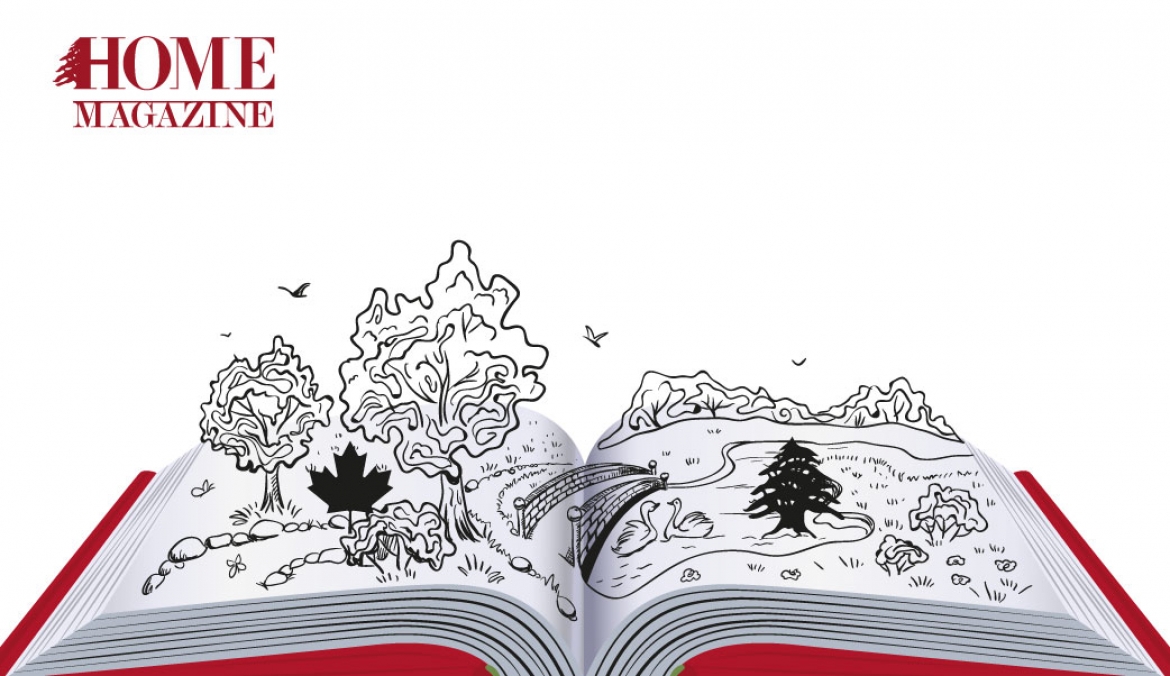
A new buzz of storytelling has hit Montreal. With a Lebanese flavor that ignites a longing for the HOMEland, this activity promotes attachment to HOME.
We see a sparkle in the eyes of the children and their parents, the reading of the story begins. These are tales about the country they left behind; they awaken very strong, long-dormant emotions. The children are very curious and ask many questions. They just love being introduced to the traditions and the beautiful culture of Lebanon that are often forgotten. Storytelling is magical both for the author and the listener. Montreal is known to be a multicultural metropolis. According to the latest census, some 26% of the population of Montreal are members of a visible minority, such as Arabs, Greeks, Italians, Latin Americans, South Asians, and Chinese. Being so multifaceted, the city bursts with activities and a vast gastronomical explosion of flavors, perfumes, and colors.
In this vibrant city, the new buzz is storytelling and it has a Lebanese flavor. Lebanese-born authors unite to tell their stories in the public libraries of their adopted city. The main goal is to create a circle of words, written with love and respect for their roots, and transmitted with love.
The oriental community is responding very fast to this initiative. Authors are being asked to read at Lebanese and French schools and at festivals.
The Arab community is also reacting very favorably through increased participation. Quebeckers are attending the sessions and touched to learn more about newcomers. At the end of the reading, they often hug the author and express a very deep and felt sense of emotion. Very often they say that it is very different from the scenes of violence they see on TV and that they never suspected that the country could be so beautiful and the people so warm. They also confide that they never imagined that the cultural heritage is so rich.
Roula Ragheb Fayad starts the ball rolling with the reading of her book, Le trésor des cèdres (The Treasure of the Cedars). The action takes place in the high mountains of Lebanon, around the great cedar forest. Kamal, a young peasant, leads a laborious life filled with his love for Rosana. However, the discovery of a treasure rocks his entire existence and may reveal a great secret.
The whole activity lasts for an hour to allow questions and interactions with the author.
Frida Anbar follows with the reading of her magical tale, Les racines du cœur (The Roots of the Heart). This time, the plot begins in America. In her large and luxurious HOME, little Nina is bored. One evening, when she is feeling particularly lonely, she wanders among the Christmas decorations, her soul in unbearable pain. Out of sorrow, a tear flows, explodes, and animates a tarbouch (oriental hat) in a forgotten briefcase in the attic. The tarbouch will spend a few days with her to introduce her to the traditions and customs of her father’s native country, Lebanon. This tarbouch will take the girl on a journey to discover her family and collective past.
At the end of the reading, very frequently, listeners say that they can visualize the setting of the story from the author’s description, enabling them to connect with the plot. With every reading, the magic of Lebanon comes alive and ignites a new flame in the most vulnerable spot, the heart. The circle is complete: the author has shared, the reader has received.
What really emerges out of this activity is the love of the native land woven into the pages. Both authors and audiences are swept along by a strong wave of emotion. For the adults, it returns the soul to a forgotten past. It also shapes the Lebanese values to be transmitted to the children of the diaspora: generosity, hard work, love of the family, and the bold Phoenician heritage.
The biggest storyteller of all time, Walt Disney, once wrote, “There is more treasure in books than in the entire pirate’s loot on Treasure Island.” Why, then, deprive yourself of such delights?
As long as there have been people, there have been stories to tell. Stories are the heartbeat of every nation. They narrate the core of a country, making us feel proud. Will you come along with us next time we have a story to share?
Signature Boutique 

HOMEland Magazine
We firmly believe that the internet should be available and accessible to anyone, and are committed to providing a website that is accessible to the widest possible audience, regardless of circumstance and ability.
To fulfill this, we aim to adhere as strictly as possible to the World Wide Web Consortium’s (W3C) Web Content Accessibility Guidelines 2.1 (WCAG 2.1) at the AA level. These guidelines explain how to make web content accessible to people with a wide array of disabilities. Complying with those guidelines helps us ensure that the website is accessible to all people: blind people, people with motor impairments, visual impairment, cognitive disabilities, and more.
This website utilizes various technologies that are meant to make it as accessible as possible at all times. We utilize an accessibility interface that allows persons with specific disabilities to adjust the website’s UI (user interface) and design it to their personal needs.
Additionally, the website utilizes an AI-based application that runs in the background and optimizes its accessibility level constantly. This application remediates the website’s HTML, adapts Its functionality and behavior for screen-readers used by the blind users, and for keyboard functions used by individuals with motor impairments.
If you’ve found a malfunction or have ideas for improvement, we’ll be happy to hear from you. You can reach out to the website’s operators by using the following email
Our website implements the ARIA attributes (Accessible Rich Internet Applications) technique, alongside various different behavioral changes, to ensure blind users visiting with screen-readers are able to read, comprehend, and enjoy the website’s functions. As soon as a user with a screen-reader enters your site, they immediately receive a prompt to enter the Screen-Reader Profile so they can browse and operate your site effectively. Here’s how our website covers some of the most important screen-reader requirements, alongside console screenshots of code examples:
Screen-reader optimization: we run a background process that learns the website’s components from top to bottom, to ensure ongoing compliance even when updating the website. In this process, we provide screen-readers with meaningful data using the ARIA set of attributes. For example, we provide accurate form labels; descriptions for actionable icons (social media icons, search icons, cart icons, etc.); validation guidance for form inputs; element roles such as buttons, menus, modal dialogues (popups), and others. Additionally, the background process scans all the website’s images and provides an accurate and meaningful image-object-recognition-based description as an ALT (alternate text) tag for images that are not described. It will also extract texts that are embedded within the image, using an OCR (optical character recognition) technology. To turn on screen-reader adjustments at any time, users need only to press the Alt+1 keyboard combination. Screen-reader users also get automatic announcements to turn the Screen-reader mode on as soon as they enter the website.
These adjustments are compatible with all popular screen readers, including JAWS and NVDA.
Keyboard navigation optimization: The background process also adjusts the website’s HTML, and adds various behaviors using JavaScript code to make the website operable by the keyboard. This includes the ability to navigate the website using the Tab and Shift+Tab keys, operate dropdowns with the arrow keys, close them with Esc, trigger buttons and links using the Enter key, navigate between radio and checkbox elements using the arrow keys, and fill them in with the Spacebar or Enter key.Additionally, keyboard users will find quick-navigation and content-skip menus, available at any time by clicking Alt+1, or as the first elements of the site while navigating with the keyboard. The background process also handles triggered popups by moving the keyboard focus towards them as soon as they appear, and not allow the focus drift outside it.
Users can also use shortcuts such as “M” (menus), “H” (headings), “F” (forms), “B” (buttons), and “G” (graphics) to jump to specific elements.
We aim to support the widest array of browsers and assistive technologies as possible, so our users can choose the best fitting tools for them, with as few limitations as possible. Therefore, we have worked very hard to be able to support all major systems that comprise over 95% of the user market share including Google Chrome, Mozilla Firefox, Apple Safari, Opera and Microsoft Edge, JAWS and NVDA (screen readers).
Despite our very best efforts to allow anybody to adjust the website to their needs. There may still be pages or sections that are not fully accessible, are in the process of becoming accessible, or are lacking an adequate technological solution to make them accessible. Still, we are continually improving our accessibility, adding, updating and improving its options and features, and developing and adopting new technologies. All this is meant to reach the optimal level of accessibility, following technological advancements. For any assistance, please reach out to