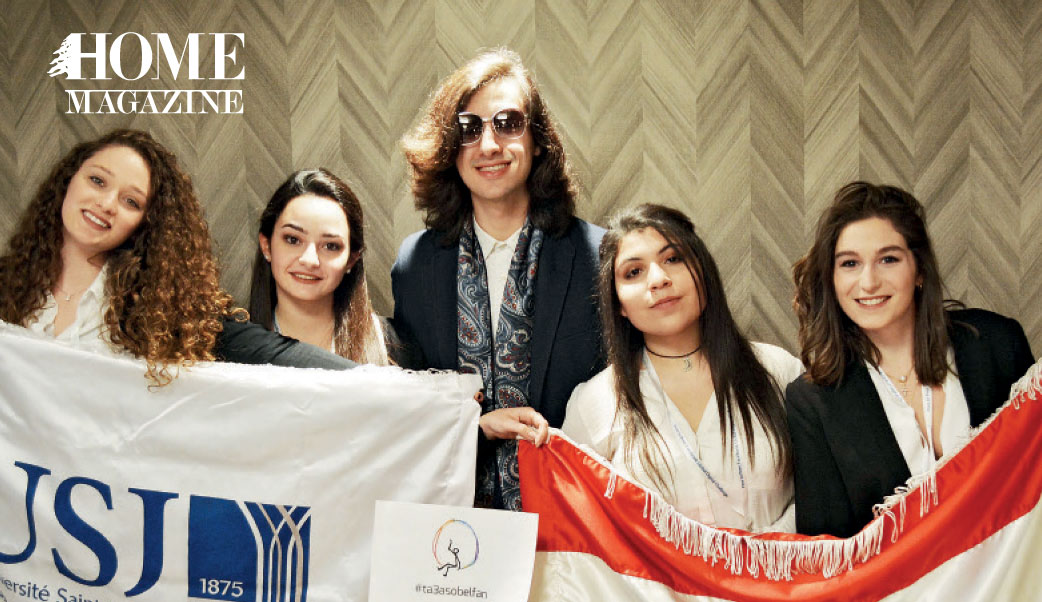
A university project unlocks students’ passion for giving voice to vulnerable youths in Lebanon.
It is not until our interview is winding up that Lea Ibrahim says: “I think we have to talk about our trip to Washington.” For almost half an hour, Lea (20) and Isabelle Wakim (22) have been animatedly describing Ta3a Sob El Fan, a peer-to-peer campaign to fight extremism in Lebanon, which they, along with nine other Université Saint Joseph (USJ) students, set up last year. They designed the campaign as part of a university course as well as to compete in the regional fall 2016 Peer-to-Peer Challenging Extremism competition run by EdVenture Partners (EVP) in partnership with NESA Center for Strategic Studies. The NESA Center is a US Department of Defense regional organization that aims to improve international security cooperation in the Near East and South Asia (NESA).
The competition ultimately led the USJ team to Washington to present their project, where, against strong competition from Jordan and Kuwait, they were awarded first prize and asked to deliver their presentation a second time, this time to the United Nations Counter-Terrorism Committee. But neither the accolades nor the excitement of international travel trumps Lea and Isabelle’s eagerness to talk about the project itself.
A play on words
With just $2,000 to design a campaign, Lea, Isabelle and their colleagues conceived Ta3a Sob El Fan. The name offers a wordplay on two meanings: “come towards art” and “extremism of art.” Ta3a Sob El Fan ran focus groups for vulnerable teenagers in the Bab al-Tabaneh and Qobbah neighborhoods of Tripoli, engaging the youths through the medium referenced in the organization’s title: art. Teenagers aged 13–15 came together to draw and paint images representing their daily lives and what Lebanon means to them; and also, at Ta3a Sob El Fan’s encouragement, to express whatever they had been told not to say. Ta3a Sob El Fan then posted these images on its online platform, thereby sharing the artworks with the wider Lebanese community and giving the teenagers a public voice.

Choosing Tripoli
Although the team initially considered launching the project in Arsal, near the Syrian border, the present level of violence there led them to look for an alternative. Isabelle explains: “We started our campaign by doing one full month of research on … the poor neighborhoods of Lebanon and we realized that in Tripoli the Tripolitans feel marginalized from the rest of Lebanon and that … most of the children in Bab al-Tabaneh and Qobbah (neighborhoods of Tripoli) don’t go to school.” In recent years, these neighborhoods’ exposure to Syrian war-related violence has left their youth especially vulnerable to radicalization and extremism.
For Tripolitans, the rest of Lebanon may feel remote, but at the project’s outset Tripoli felt equally remote to the Ta3a Sob El Fan team.
“The first time we went to Tripoli it was very hard for us,” Isabelle begins. “And scary,” Lea chimes in. “We were not very comfortable,” Lea continues, proceeding to relay an anecdote about arriving at the designated meeting place in Bab al-Tabaneh and discovering 20 children had shown up for the focus group rather than the eight agreed upon. “It was crazy. They were so excited we were there. They wanted to learn, they wanted to meet us, they wanted to draw,” Isabelle says, grinning.
According to the report Urban Poverty in Tripoli published by UN-ESCWA and the Arab Urban Development Institute, 57% of Tripoli’s families are deprived, and of these, 26% are considered extremely deprived.
Nationwide engagement
Over the course of the campaign, Ta3a Sob El Fan worked with two Lebanese NGOs – Basmeh and Zeitouneh and Forever Lebanon – as well as with public schools, to hold more than 10 art sessions, which engaged a total of 135 youths in Tripoli. However, their campaign reached and engaged a far greater number than those involved in the actual sessions.
“We were kind of the voice of the children so we took all of their drawings and everything and put it on Facebook… This is how we wanted to engage with the Beirut crowd or the crowd that is not from Tripoli,” Isabelle explains.
The Facebook page quickly attracted plenty of attention. “We got a lot of messages on Facebook from people… sending us drawings, sending us poems. And this was for us a sign that we actually did something,” Isabelle adds. She notes that symbols of a united Lebanese identity – the flag, the army’s colors – as well as the sea, featured repeatedly in these artworks, and poems addressed topics such as: “If I were president.”
The campaign reached more than 200,000 in Lebanon on Facebook alone – that number increases if you add other social media outlets and mainstream media exposure.

NGO aspirations
Many of the people who visited the Facebook page and contacted the project team believed Ta3a Sob El Fan to be an established NGO. “They thought we were something bigger than we are,” Lea says, and Isabelle quickly adds: “We’re just university students doing a project. But… now we want to create an NGO.” Work, studies and other commitments have diminished the original project team of 11 to just five, but those remaining members have established a club for the project within the university and are hoping to attract new members and gain more experience, before they move toward actually creating an NGO. Isabelle is presently studying a master’s in Information and Communication, while Lea is studying a bachelor’s in Sociology and Anthropology. However, following the project, in which Isabelle was the team leader and Lea was involved in public relations and research, both are interested in remaining in the campaigns field.
Lea will likely go on to study PR, and Isabelle has developed a fascination with social media. Ultimately, they both now aim to continue the project, replicating it in other communities across Lebanon. “We couldn’t let the kids down,” Lea says, “we gave them a voice and we want to continue giving them a voice.”
FB: Ta3a Sob El Fan


HOMEland THEMES
Coming Soon
HOMEland Events & Collaborations
Coming Soon
 Signature Boutique