Joumana Accad was born and raised in Lebanon, but has been living in Texas, U.S., since 1979. Her passion and love for her HOME country’s culinary culture resulted in the creation of her blog “Taste of Beirut,” where she shares recipes “with a few sprinkles of stories and historical trivia.” To date the blog contains more than 1,200 recipes and 45 YouTube videos. Thanks to the success of here blog, Joumana has a cookbook deal, with one already published and another on the way. She talks to HOME for Magazine about Proust, hummus and staying true to your roots.
When and why did you decide to start a blog?
I started a blog in 2009 because after attending culinary school in Dallas (El Centro College/Pastry Arts) and working in several bakeries, restaurants, catering, etc. I felt that the food industry was only about “the bottom line” – i.e., making money. Not being business natured, I was more interested in communicating my culture and heritage through food. Editing a blog, creating recipes, sharing stories, images, seemed like the best way to do so.
What kind of community has grown up around your blog?
A lot of expats feel a kindred spirit with my prose and musings. I also noticed that people who are curious or desiring to know more about the cuisine and culture of that region find my blog to be a good, lighthearted way to learn. I also find that a lot of people have had a connection with the Middle East or Lebanese culture, through a visit, a work assignment, a distant relative or whatever. The blog provides a link to that culture and allows them to keep it alive in their memories.
Do you think food is the most important way of connecting to ones homeland?
I think food is the deepest way one communicates with one’s roots. The famous madeleine of the French writer Proust is a perfect example: he had a bite and it brought back his childhood and his grandmother. I am convinced that serving a plate of labneh with a fragrant olive oil, some bread and olives brings back the same longing with Lebanese expats.
Describe your perfect Lebanese meal, food and setting
My perfect Lebanese meal is in a village setting, with the sound of crackling wood in the sobiah . It can be just a few country tomatoes and some labneh, but it has to have the best olive oil and excellent olives, and of course, fresh bread. For lunch, substitute some hummus fatté. Lebanese meals are homey and simple, but to be good need to be made with homegrown and local ingredients.
How much time do you spend in Lebanon?
Lately, I have been spending the major part of the year in Lebanon, half of it in the mountains. When I signed the cookbook deal with HCI, I felt that it would be dishonest to write about Lebanese cuisine from my home in Dallas. I moved back to Beirut, and started cooking with local master cooks and asking lots of questions! I also lived half the time in the Chouf area and befriended locals there. All of this has allowed me to deepen my knowledge of authentic Lebanese cuisine.
What do your American friends think of Lebanese food? What is the most popular dish?
My American friends love Lebanese food, provided it is well cooked! They adore hummus, of course, and many traditional dishes, such as spinach turnovers, kibbeh balls, eggplant stew, mujaddara and others.
Other than the food, what are your favorite things about Lebanon?
I love Lebanese folks who have stayed authentic and true to their roots. They may still be living in the big capital but maintain their love of nature, farming and their love for good homemade cuisine. I also love the Mediterranean nature and climate of Lebanon, and the plethora of wild edible plants and fruits. I love the fact that there is such an amazing diversity in such a tiny country. Every region, every village, has something specific and original to offer the visitor. It is an endless quest.
How can the diaspora best serve Lebanon?
The diaspora can serve Lebanon best by supporting its unique culture, architecture, customs, foods and by reminding the locals of its value.
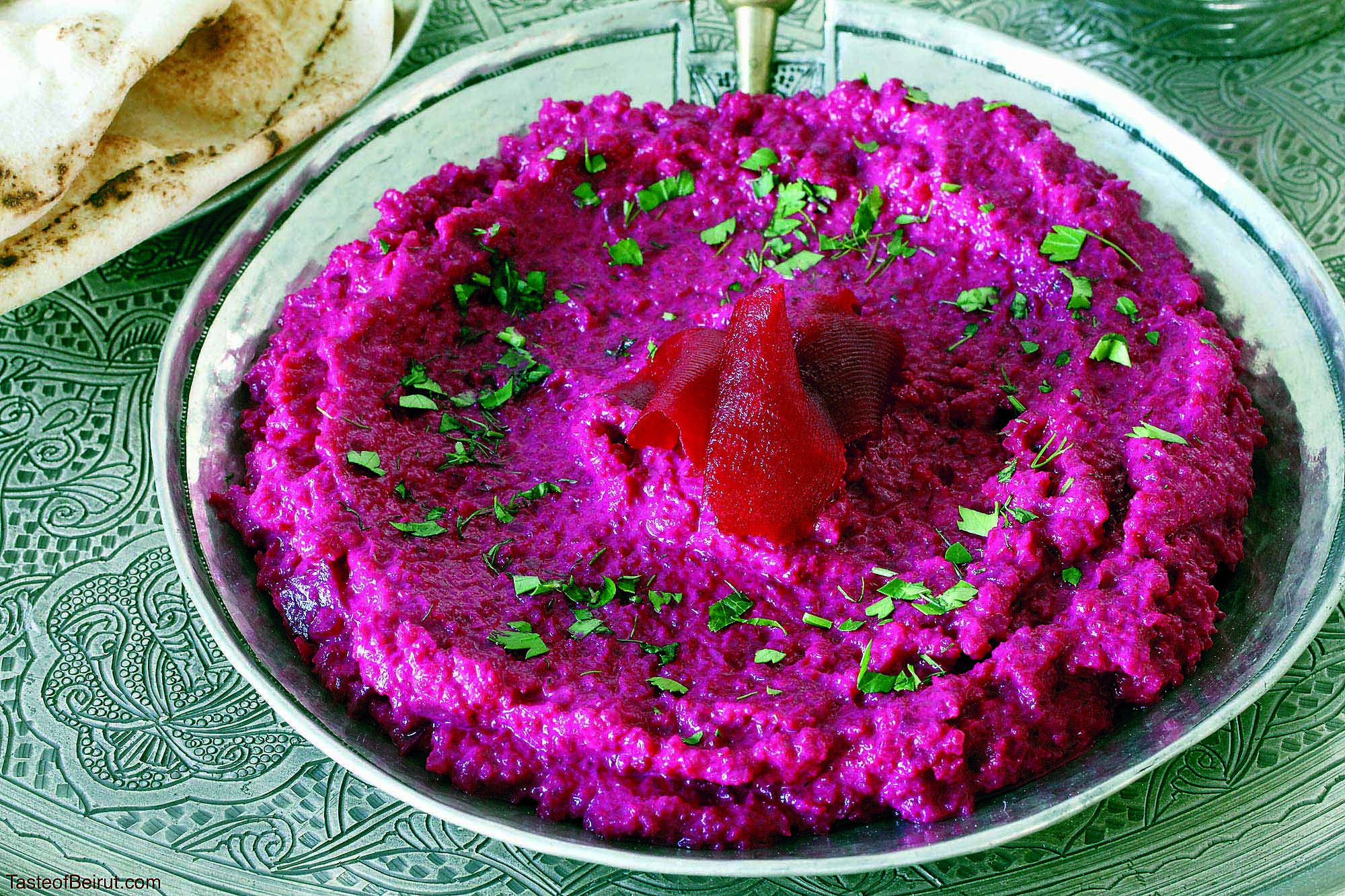
Beet hummus
Recipe from Joumana Accad, editor and founder tasteofbeirut.com
The recipe was published in the cookbook based on the blog “Taste of Beirut”
The recipe for this dip was graciously given to me by Kameel Abu-Hatoum, a great cook and connoisseur of traditional Lebanese cuisine, from Baakline (Chouf mountains).
He coined it mama dall’ou’ah. A counter to the now world-famous baba ghanouj.
Explanation: Baba is daddy and ghanouj means cuddly (or someone who likes to spoil and cuddle their baby or loved one). Mama is mom and dallou’ah means a mamma who loves to be pampered, cuddled, spoilt and cherished.
Ingredients:
2 large beets (about 1 3/4 pounds total)
2 large lemons, juiced (more or less, to taste)
2 cloves of garlic, mashed in a mortar with a dash of salt
1/2 cup of tahini (or more, to taste)
1 tbsp of pomegranate molasses (optional)
1/4 cup of pomegranate arils to garnish (optional)
Instructions (Serves 4):
Roast the beets in a 350F oven for 45 minutes or until tender. Peel and cut into chunks; mash in a processor with the juice of a lemon, garlic and tahini; taste and adjust seasoning, adding more lemon or tahini or garlic. Garnish with the pomegranate arils if desired and serve at room temperature with pita bread or chips.
NOTE: The beet peels can be recycled into a drink, popular in Iraq called sharab shwandar. Gather the peels, add about 2 cups of water and bring to a simmer; let the mixture bubble gently for a few minutes then drain. Add sweetener if desired. Refrigerate. Drink when cold with a squeeze of lime or orange or bitter orange.
HOMEland THEMES
Coming Soon
HOMEland Events & Collaborations
Coming Soon
 Signature Boutique