
HOMEland
Coming Soon
HOMEland Events & Collaborations
Coming Soon
 Signature Boutique


The Ballad of Maria Abdala, a remarkable novel by Juan Gossain, is written in a fine and elegant style. The story takes place at the beginning of the twentieth century when Lebanon was under Turkish occupation and going through violent times. A Lebanese couple decides to emigrate, and settle in a Caribbean town with an unforgettable name, San Bernardo del Viento.
The narrator happens to be the dead son of the Lebanese emigrant couple, putting us straight into a world where the living and the dead coexist. Maria Abdala, the narrator’s mother and the main character, is a charismatic and well-loved woman who did not know a word of Spanish; however, she succeeded in becoming one of the outstanding characters of the town. A mother of four, her great beauty and strong character quickly surpassed the boundaries of the town, attracting all kinds of men and sometimes generating catastrophes impossible to predict.
The novel features the intimate relationship between the emigrant couple and the locals, which is fed by the contradictions between them.
Maria and her beloved husband manage to overcome great differences. They integrate with the locals and gain their respect, leading them to consider this piece of Caribbean land as their own HOMeland.
The representation of that feeling for the Caribbean land is one of Juan Gossain’s greatest achievements. But we must also note how the author conveys the growing maturity of the couple, and how the burning passion they used to have in bed during the first few years of marriage died down with each pregnancy until there was nothing left but hot ash, a warm and latent feeling.
The book is a deep reflection on life experience and old age, the evolution of love and its changing faces, poetry and reality. It also documents the emigration of the Lebanese to Colombia and the inheritance that they passed on to their children.
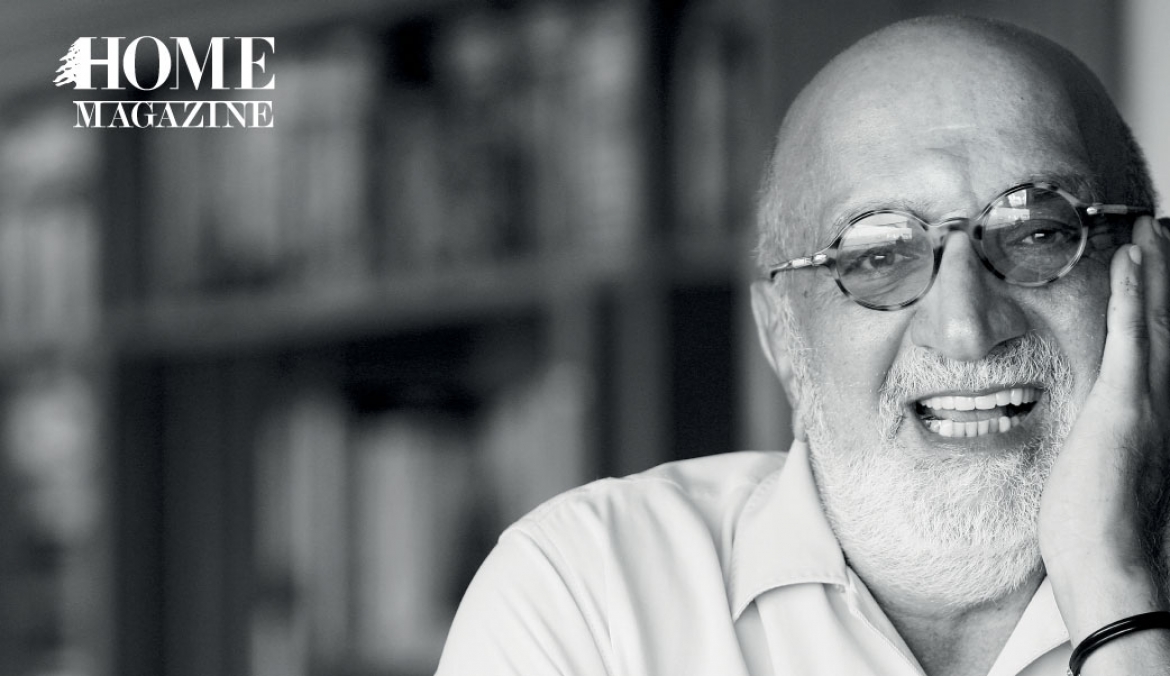
An interview with author Juan Antonio Gossain Abdallah:
What inspired you to become a journalist?
The funny thing is that I never intended to become a journalist, but a writer. At the age of 10, I wrote my first story at school. However, when I needed work, I was offered employment as a journalist and I accepted because there was no other option.
Can you tell us a little about your family?
My parents, Juan Gossain and Bertha Abdala, came from Zahle, the blessed land of Lebanon. We were five siblings; I have three sisters and a brother. My mother and my sisters were very influential in my life: they encouraged me to travel to Bogota, where I was offered my first job as a journalist. There I met my wife Margot Ricci, who is of Italian ancestry, and always gives me good advice. Women have been significant in my life; they have orientated and guided me.
Every writer or journalist has unedited material, sometimes waiting for an economic or other type of opportunity, anxiously waiting to see the light of day. Do you have any books saved that you would like to publish? If so, what are their titles?
I have written nearly two thousand pages of notes, drafts, and amendments. I have spent years trying to write the history of Arab emigrants in the Caribbean. I don’t know if I’ll ever publish it. I don’t even know if I’ll finish it. I have a provisional title: The Last Summer.
Culture is the largest sum of human capital, greater than gold, oil, and technology, and writers are the notaries who bear witness to that wealth
I have written eight books, four of which are novels: The Evil Plant, The Ballad of Maria Abdala, At the End of the Dream and The Death of Bolatriste. Three more are compiled from my chronicles: The Nostalgia of the Gannet, Today’s Chronicle and The Memory of the Gannet. Another is a strange book of loose phrases and diverse subjects, called Etcetera.
Let’s talk about The Ballad of María Abdala. Why did you choose this name? What advice would you give the main character?
That was the name of my maternal grandmother: María Millet de Abdala, the wife of Cecilio Abdala. They were also from Zahle. In San Bernardo del Viento, the Colombian marine village where they settled, everyone called her María Abdala. I named the novel after her because it is the story of all emigrants.
And what advice would you give her?
Wow: I would love for her to be alive to advise me, like she used to while she was watering her garden.
What is the best kept literary secret?
It is this: Why was Khalil Gibran never given the Nobel Prize?
Since you have written so much about Lebanon and its people, when was the last time you visited?
That was in 1992, 25 years ago, with my wife. We went to Zahle to look for our relatives and found them. We gave them a hug that lasted two hours and we had lunch at their house. It was wonderful, going back to our roots.
If it were in your power to be obeyed as a ruler, what rule would you impose on citizens?
I would never be a politician or a ruler, not even in the hypothetical way in which you put it to me. A great Colombian writer, Gabriel García Márquez, once said that “the appetite for power is the result of an incapacity for love.” He was right. I believe that anyone who aspires to command men does so because he does not love them.
In the life of every writer there is a division, a rift between his life in the world and his life in literature. To what extent can a writer speak about what he has written and why is he considered a cultural creator?
Sooner or later, even though he makes enormous efforts to avoid it, every writer ends up writing about what he has seen and what he has lived, even if just partially. There is no better novel than life. As for culture, it is the largest sum of human capital, greater than gold, oil, and technology, and writers are the notaries who bear witness to that wealth, who help preserve it, and who make sure it is not forgotten.
If you were born again, would you choose the same life?
If I were to be born again, I would be the same as I have been, but perhaps I would dedicate a little more time to literature than to journalism. I was asked by HOME to give this interview and was thrilled that that request came from the land of my ancestors, the land of Lebanon, where King Solomon looked for the smell of cedar to give to his beloved. I have always said that I am the legitimate son of a kibbe and an egg-filled Arepa (well-known Colombian food). And here, in my land of Colombia, the people of the Caribbean have a beautiful saying, “blood weighs more than water.”
 Signature Boutique
Lebanon, in your inbox

HOMEland Magazine
We firmly believe that the internet should be available and accessible to anyone, and are committed to providing a website that is accessible to the widest possible audience, regardless of circumstance and ability.
To fulfill this, we aim to adhere as strictly as possible to the World Wide Web Consortium’s (W3C) Web Content Accessibility Guidelines 2.1 (WCAG 2.1) at the AA level. These guidelines explain how to make web content accessible to people with a wide array of disabilities. Complying with those guidelines helps us ensure that the website is accessible to all people: blind people, people with motor impairments, visual impairment, cognitive disabilities, and more.
This website utilizes various technologies that are meant to make it as accessible as possible at all times. We utilize an accessibility interface that allows persons with specific disabilities to adjust the website’s UI (user interface) and design it to their personal needs.
Additionally, the website utilizes an AI-based application that runs in the background and optimizes its accessibility level constantly. This application remediates the website’s HTML, adapts Its functionality and behavior for screen-readers used by the blind users, and for keyboard functions used by individuals with motor impairments.
If you’ve found a malfunction or have ideas for improvement, we’ll be happy to hear from you. You can reach out to the website’s operators by using the following email
Our website implements the ARIA attributes (Accessible Rich Internet Applications) technique, alongside various different behavioral changes, to ensure blind users visiting with screen-readers are able to read, comprehend, and enjoy the website’s functions. As soon as a user with a screen-reader enters your site, they immediately receive a prompt to enter the Screen-Reader Profile so they can browse and operate your site effectively. Here’s how our website covers some of the most important screen-reader requirements, alongside console screenshots of code examples:
Screen-reader optimization: we run a background process that learns the website’s components from top to bottom, to ensure ongoing compliance even when updating the website. In this process, we provide screen-readers with meaningful data using the ARIA set of attributes. For example, we provide accurate form labels; descriptions for actionable icons (social media icons, search icons, cart icons, etc.); validation guidance for form inputs; element roles such as buttons, menus, modal dialogues (popups), and others. Additionally, the background process scans all the website’s images and provides an accurate and meaningful image-object-recognition-based description as an ALT (alternate text) tag for images that are not described. It will also extract texts that are embedded within the image, using an OCR (optical character recognition) technology. To turn on screen-reader adjustments at any time, users need only to press the Alt+1 keyboard combination. Screen-reader users also get automatic announcements to turn the Screen-reader mode on as soon as they enter the website.
These adjustments are compatible with all popular screen readers, including JAWS and NVDA.
Keyboard navigation optimization: The background process also adjusts the website’s HTML, and adds various behaviors using JavaScript code to make the website operable by the keyboard. This includes the ability to navigate the website using the Tab and Shift+Tab keys, operate dropdowns with the arrow keys, close them with Esc, trigger buttons and links using the Enter key, navigate between radio and checkbox elements using the arrow keys, and fill them in with the Spacebar or Enter key.Additionally, keyboard users will find quick-navigation and content-skip menus, available at any time by clicking Alt+1, or as the first elements of the site while navigating with the keyboard. The background process also handles triggered popups by moving the keyboard focus towards them as soon as they appear, and not allow the focus drift outside it.
Users can also use shortcuts such as “M” (menus), “H” (headings), “F” (forms), “B” (buttons), and “G” (graphics) to jump to specific elements.
We aim to support the widest array of browsers and assistive technologies as possible, so our users can choose the best fitting tools for them, with as few limitations as possible. Therefore, we have worked very hard to be able to support all major systems that comprise over 95% of the user market share including Google Chrome, Mozilla Firefox, Apple Safari, Opera and Microsoft Edge, JAWS and NVDA (screen readers).
Despite our very best efforts to allow anybody to adjust the website to their needs. There may still be pages or sections that are not fully accessible, are in the process of becoming accessible, or are lacking an adequate technological solution to make them accessible. Still, we are continually improving our accessibility, adding, updating and improving its options and features, and developing and adopting new technologies. All this is meant to reach the optimal level of accessibility, following technological advancements. For any assistance, please reach out to

Speaking Truth to Power: Pierre Sadek Foundation