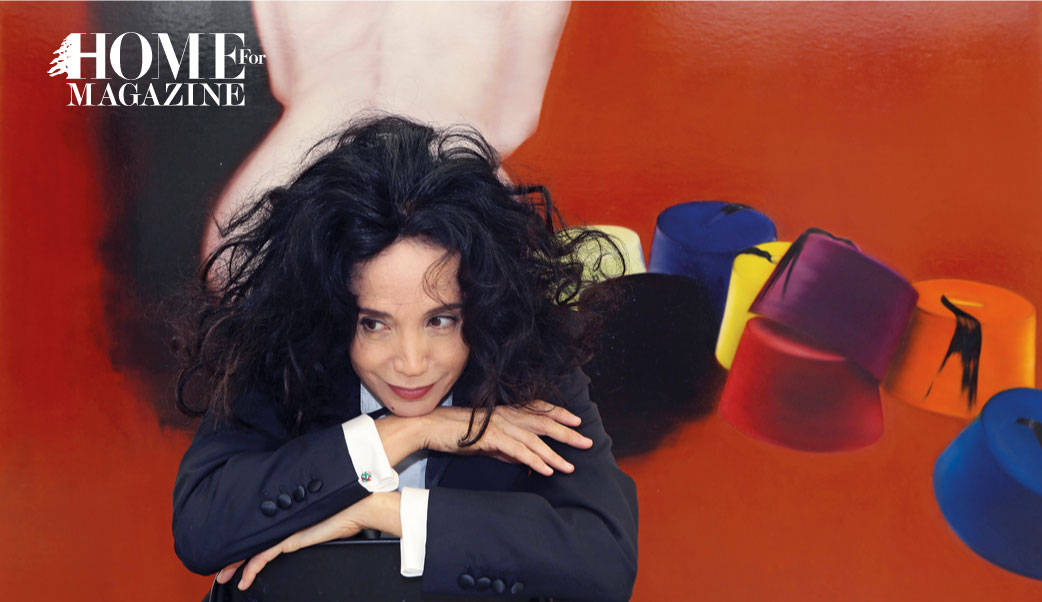
The Tarbouche has long been a symbol of masculinity in the Arab world. Although it may not be the case among the newer generations, the tarbouche continues to be a popular symbol of Middle Eastern culture, history and tradition.
French-Lebanese artist, Mouna Rebeiz held her first solo exhibition in London at the Saatchi Gallery in February of 2015, entitled “Le Tarbouche.”
For her big debut in the London art world, Rebeiz’s exhibition was part of her ongoing work with the female form, using the tarbouche to express the female as a complex combination of the dominant and submissive, the sophisticated and the vulnerable. She uses various techniques from the Old Masters of art to examine contemporary issues, her paintings creating a bridge between two worlds: East and West, male and female.

Open to influences from both Lebanon and France, Rebeiz became fascinated at an early age with the emphasis both cultures place on the dual role of the woman; the essence of femininity as an incongruous mix of soft sensuality and commanding sophistication. This childhood preoccupation comes to the fore in her latest conceptual collection, placing the masculine symbol of the tarbouche at odds with its traditional usage, and reinventing it as a new feminine emblem.
“The question of femininity has always been at stake for me, as it is an inexhaustible subject combining the interior (the soul) and the exterior (the body). At the time when society speaks so much of gender, it has never been so important to reflect upon the very essence of (in the words of philosopher
and psychoanalyst Elsa Godart) ‘the women-being,’” says Rebeiz.
“To portray this universality and to show just how far the women-being surpasses all the stereotypes, I choose a predominantly strong male symbol, the tarbouche. To put the tarbouche on the head of a naked woman is to reclaim the place of the woman in the world. I have hijacked the tarbouche to make it an emblem of femininity.”
“I am proud to be Levantine, one of the oldest civilizations. Europa, princess of Tyre, gave her name to Europe, not to mention Byblos is HOME to the origin of the alphabet. My Lebanese heritage was my major inspiration,” she adds.
Rebeiz was born in Lebanon, into a family of artists, and demonstrated creativity in abundance from an early age. She also showed a particular interest in plastic arts. Growing up amidst musicians, artists and poets, notes and verse later influenced her work.
Fascinated by the human-being and its psyche, she dedicated herself to the study of psychology at the Sorbonne in Paris and she completed her master’s degree in psychology at Université Saint-Joseph in Beirut.
She has exhibited internationally, mainly in Paris, with shows at Galerie Hubert Konrad, Galerie Pierre Alain Challier and the Foundation Ricard.
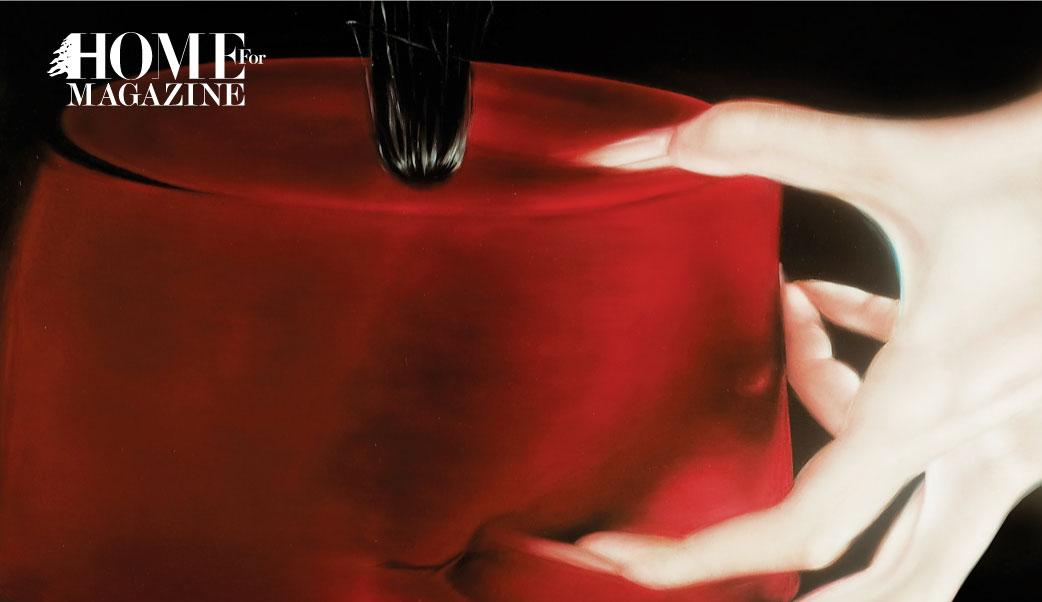
The Auction
To complement the exhibition, Rebeiz partnered with various influential names from the worlds of art, fashion and design to continue the dialogue of her exhibition. Notable names like Lanvin, Twiggy, Pucci, Elie Saab, Star Diamond, Philip Treacy, Giles Deacon and Sandra Choi of Jimmy Choo, among others, each reinvented a tarbouche in their own style to be auctioned by Sotheby’s following the exhibition.
All the proceeds from the tarbouche auction, as well as proceeds from the sale of Rebeiz’s paintings, were donated to Innocence in Danger, a charity close to her heart. Innocence in Danger is a world movement for the protection of children against any form of sexual abuse.
HOMEland Magazine
We firmly believe that the internet should be available and accessible to anyone, and are committed to providing a website that is accessible to the widest possible audience, regardless of circumstance and ability.
To fulfill this, we aim to adhere as strictly as possible to the World Wide Web Consortium’s (W3C) Web Content Accessibility Guidelines 2.1 (WCAG 2.1) at the AA level. These guidelines explain how to make web content accessible to people with a wide array of disabilities. Complying with those guidelines helps us ensure that the website is accessible to all people: blind people, people with motor impairments, visual impairment, cognitive disabilities, and more.
This website utilizes various technologies that are meant to make it as accessible as possible at all times. We utilize an accessibility interface that allows persons with specific disabilities to adjust the website’s UI (user interface) and design it to their personal needs.
Additionally, the website utilizes an AI-based application that runs in the background and optimizes its accessibility level constantly. This application remediates the website’s HTML, adapts Its functionality and behavior for screen-readers used by the blind users, and for keyboard functions used by individuals with motor impairments.
If you’ve found a malfunction or have ideas for improvement, we’ll be happy to hear from you. You can reach out to the website’s operators by using the following email
Our website implements the ARIA attributes (Accessible Rich Internet Applications) technique, alongside various different behavioral changes, to ensure blind users visiting with screen-readers are able to read, comprehend, and enjoy the website’s functions. As soon as a user with a screen-reader enters your site, they immediately receive a prompt to enter the Screen-Reader Profile so they can browse and operate your site effectively. Here’s how our website covers some of the most important screen-reader requirements, alongside console screenshots of code examples:
Screen-reader optimization: we run a background process that learns the website’s components from top to bottom, to ensure ongoing compliance even when updating the website. In this process, we provide screen-readers with meaningful data using the ARIA set of attributes. For example, we provide accurate form labels; descriptions for actionable icons (social media icons, search icons, cart icons, etc.); validation guidance for form inputs; element roles such as buttons, menus, modal dialogues (popups), and others. Additionally, the background process scans all the website’s images and provides an accurate and meaningful image-object-recognition-based description as an ALT (alternate text) tag for images that are not described. It will also extract texts that are embedded within the image, using an OCR (optical character recognition) technology. To turn on screen-reader adjustments at any time, users need only to press the Alt+1 keyboard combination. Screen-reader users also get automatic announcements to turn the Screen-reader mode on as soon as they enter the website.
These adjustments are compatible with all popular screen readers, including JAWS and NVDA.
Keyboard navigation optimization: The background process also adjusts the website’s HTML, and adds various behaviors using JavaScript code to make the website operable by the keyboard. This includes the ability to navigate the website using the Tab and Shift+Tab keys, operate dropdowns with the arrow keys, close them with Esc, trigger buttons and links using the Enter key, navigate between radio and checkbox elements using the arrow keys, and fill them in with the Spacebar or Enter key.Additionally, keyboard users will find quick-navigation and content-skip menus, available at any time by clicking Alt+1, or as the first elements of the site while navigating with the keyboard. The background process also handles triggered popups by moving the keyboard focus towards them as soon as they appear, and not allow the focus drift outside it.
Users can also use shortcuts such as “M” (menus), “H” (headings), “F” (forms), “B” (buttons), and “G” (graphics) to jump to specific elements.
We aim to support the widest array of browsers and assistive technologies as possible, so our users can choose the best fitting tools for them, with as few limitations as possible. Therefore, we have worked very hard to be able to support all major systems that comprise over 95% of the user market share including Google Chrome, Mozilla Firefox, Apple Safari, Opera and Microsoft Edge, JAWS and NVDA (screen readers).
Despite our very best efforts to allow anybody to adjust the website to their needs. There may still be pages or sections that are not fully accessible, are in the process of becoming accessible, or are lacking an adequate technological solution to make them accessible. Still, we are continually improving our accessibility, adding, updating and improving its options and features, and developing and adopting new technologies. All this is meant to reach the optimal level of accessibility, following technological advancements. For any assistance, please reach out to