
HOMEland THEMES
Coming Soon
HOMEland Events & Collaborations
Coming Soon
 Signature Boutique

Shanklish is a Middle Eastern cheese with a similar texture to feta. Made from yoghurt whey, the cheese is salted, shaped into balls and aged.
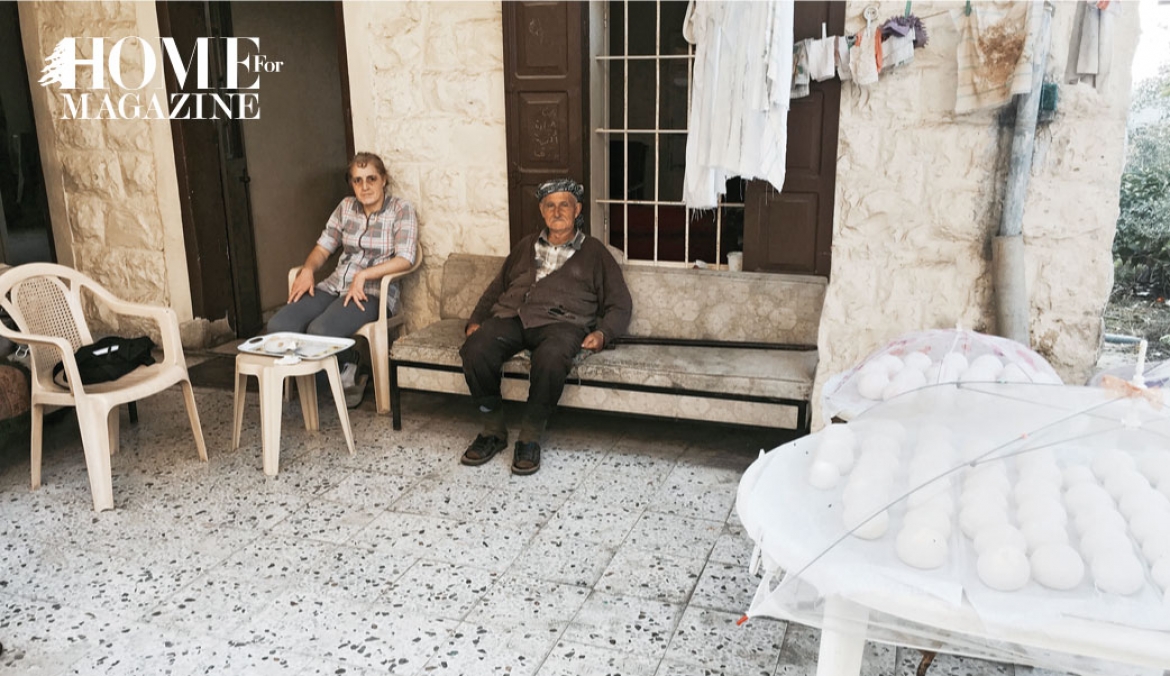
In the mountainous village of Rahbeh, Hanna Ibrahim Rizk explains the process, as he and his daughter Amineh waited for some arisheh to dry in the sun. They both burst into laughter when I told them that in Beirut we eat shanklish with tomato, onion and parsley.
The old man’s reaction was “please, try this shanklish. Although the process is not finished yet, you can try it with some virgin olive oil.
This is the only way for us to eat arisheh,” he said before adding, “with some arak of course!”
Shanklish cheese is a Lebanese mezze, usually served crumbled in the middle of a plate surrounded with chopped onion, diced tomato and hashed parsley. Before savoring it, all ingredients are mixed together with olive oil. It tastes salty and pungent.
Conventionally, shanklish was made of goat cheese. With time, the habits have changed and the last two generations have been preparing it with cow milk. This cheese comes in the form of a dry ball, covered from the outside with different ground spice mixtures like oregano, pepper or cinnamon.
Nowadays, shanklish is produced industrially. But traditionally, it was known as a product of Syria and northern Lebanon, more particularly the Akkar region. Both Gebrayel and Rahbeh villagers used to produce it, and the method of production was handed down the generations. This tradition is a result of an old-fashioned attitude to food, which led to developing a preservation technique that has proven successful.
Making shanklish requires a great deal of intensive manual labor.
First, you have to transform the fresh cow milk into laban. Once the laban is ready, it is poured into a mechanical container that shakes it (until recently, the shaking process was done manually in an elongated pottery container). This separates the samneh (butter) from the aayran (skimmed yogurt). The aayran is once again heated until it breaks down, and then poured into cotton cloth pieces that are hung over a sink till no water is left in the bag (this takes approximately 12 hours). The arisheh is then removed from the cotton clothes, salt is added, and it is rolled into round individual pieces, set on paper towels and left to dry in the sun. Once the balls are completely dried, they are placed in containers (today glass containers have replaced the pottery jars) for two months to ferment slowly in a dark dry place.
“It takes two months to ferment slowly”
Traditionally, the balls were rolled in oregano – and only oregano. Today, different types of spices or a mixture of spices are used.
As one of our traditional foods, shanklish – or “arisheh” as they call it in Rahbeh – deserves to be listed as an intangible cultural heritage item, especially that my visit to Akkar has shown a decline of the traditional shanklish production. In Gebrayel, the grey haired lady that used to produce it has stopped a few years ago, and in Rahbeh, it has been transmitted to younger generations only in a few households. The production is no longer for personal use, but made to order. In other words, you cannot just arrive to Rahbeh and buy local arisheh.
“The cow milk is expensive. If no one has put an order of arisheh, we cannot afford paying for the milk” explained Rizk. “A few years ago, I used to have my own cows, but I had to sell them, and now we have to buy the milk”.
Signature Boutique 

HOMEland Magazine
We firmly believe that the internet should be available and accessible to anyone, and are committed to providing a website that is accessible to the widest possible audience, regardless of circumstance and ability.
To fulfill this, we aim to adhere as strictly as possible to the World Wide Web Consortium’s (W3C) Web Content Accessibility Guidelines 2.1 (WCAG 2.1) at the AA level. These guidelines explain how to make web content accessible to people with a wide array of disabilities. Complying with those guidelines helps us ensure that the website is accessible to all people: blind people, people with motor impairments, visual impairment, cognitive disabilities, and more.
This website utilizes various technologies that are meant to make it as accessible as possible at all times. We utilize an accessibility interface that allows persons with specific disabilities to adjust the website’s UI (user interface) and design it to their personal needs.
Additionally, the website utilizes an AI-based application that runs in the background and optimizes its accessibility level constantly. This application remediates the website’s HTML, adapts Its functionality and behavior for screen-readers used by the blind users, and for keyboard functions used by individuals with motor impairments.
If you’ve found a malfunction or have ideas for improvement, we’ll be happy to hear from you. You can reach out to the website’s operators by using the following email
Our website implements the ARIA attributes (Accessible Rich Internet Applications) technique, alongside various different behavioral changes, to ensure blind users visiting with screen-readers are able to read, comprehend, and enjoy the website’s functions. As soon as a user with a screen-reader enters your site, they immediately receive a prompt to enter the Screen-Reader Profile so they can browse and operate your site effectively. Here’s how our website covers some of the most important screen-reader requirements, alongside console screenshots of code examples:
Screen-reader optimization: we run a background process that learns the website’s components from top to bottom, to ensure ongoing compliance even when updating the website. In this process, we provide screen-readers with meaningful data using the ARIA set of attributes. For example, we provide accurate form labels; descriptions for actionable icons (social media icons, search icons, cart icons, etc.); validation guidance for form inputs; element roles such as buttons, menus, modal dialogues (popups), and others. Additionally, the background process scans all the website’s images and provides an accurate and meaningful image-object-recognition-based description as an ALT (alternate text) tag for images that are not described. It will also extract texts that are embedded within the image, using an OCR (optical character recognition) technology. To turn on screen-reader adjustments at any time, users need only to press the Alt+1 keyboard combination. Screen-reader users also get automatic announcements to turn the Screen-reader mode on as soon as they enter the website.
These adjustments are compatible with all popular screen readers, including JAWS and NVDA.
Keyboard navigation optimization: The background process also adjusts the website’s HTML, and adds various behaviors using JavaScript code to make the website operable by the keyboard. This includes the ability to navigate the website using the Tab and Shift+Tab keys, operate dropdowns with the arrow keys, close them with Esc, trigger buttons and links using the Enter key, navigate between radio and checkbox elements using the arrow keys, and fill them in with the Spacebar or Enter key.Additionally, keyboard users will find quick-navigation and content-skip menus, available at any time by clicking Alt+1, or as the first elements of the site while navigating with the keyboard. The background process also handles triggered popups by moving the keyboard focus towards them as soon as they appear, and not allow the focus drift outside it.
Users can also use shortcuts such as “M” (menus), “H” (headings), “F” (forms), “B” (buttons), and “G” (graphics) to jump to specific elements.
We aim to support the widest array of browsers and assistive technologies as possible, so our users can choose the best fitting tools for them, with as few limitations as possible. Therefore, we have worked very hard to be able to support all major systems that comprise over 95% of the user market share including Google Chrome, Mozilla Firefox, Apple Safari, Opera and Microsoft Edge, JAWS and NVDA (screen readers).
Despite our very best efforts to allow anybody to adjust the website to their needs. There may still be pages or sections that are not fully accessible, are in the process of becoming accessible, or are lacking an adequate technological solution to make them accessible. Still, we are continually improving our accessibility, adding, updating and improving its options and features, and developing and adopting new technologies. All this is meant to reach the optimal level of accessibility, following technological advancements. For any assistance, please reach out to