
HOMEland
Coming Soon
HOMEland Events & Collaborations
Coming Soon
 Signature Boutique


Yara Zgheib shares her experience of playing tourist in Beirut.
Article by: Yara Zgheib
Winter in Beirut means early orange sunsets and crisp air blowing east from the sea. Just as well; it blows fresh on our backs as we race up Saint Nicholas’ Stairs. The stairs are dressed for Christmas and the New Year, lights, and red and green holly. In January, the lights will remain, but the stairs will be just as charming.
At the top and now out of breath, we look down at the traffic we outran. It is Thursday evening, and Gouraud Street is overrun with a dense herd of cars. Everyone is trying to head HOME after work. Everyone except you and me; we are tourists in Beirut, expats on holiday, exploring the city.
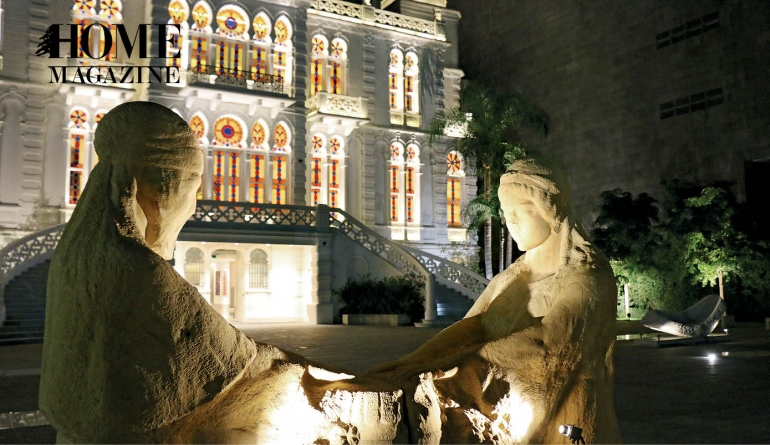
We turn left and walk down a calmer street of palaces. Villa Linda Sursock is on our right, surrounded by deep purple bougainvillea against the yellow stone facade. Its warm light and the smell of roasted chestnuts beckon us in from the street, but we are not ready for dinner yet. We walk a few steps further to another palace — the Nicolas Sursock Museum.
Nocturne at the museum begins at a jasmine-covered iron gate. A wide courtyard, soft lighting, stone sculptures, a café en terrasse. It is chilly, but some brave bon vivants are having coffee outside. The rare patch of clear sky, the rare stars you can glimpse in the middle of the city, are worth it. Perhaps we will have a glass of red wine here after we visit the museum.
“Every place a Lebanese has ever traveled has been brought back and can be found here.”
White arches, white rounding staircases, a regal stained-glass window and balcony. The light from inside shines down onto the courtyard through the orange, blue, red, yellow vitrail. The architecture is 19th-, early-20th-century Lebanese, with Venetian and Ottoman influences converging through it magnificently. We walk in like royalty.
This villa is not a dusty souvenir of Beiruti history. It is Nicolas Sursock’s lifelong dream of endorsing and promoting Lebanese art. It was bequeathed to the city of Beirut upon his death in 1952 to be transformed into a museum that would showcase modern and contemporary artists. Since 1961, almost every year, even through most of the civil war, the Sursock Museum has been discovering and showcasing artists’ work on cardboard and canvas, in oil, chalk and aquarelles, in sculpture, video, sound. Tonight, the museum is open after hours. Someone is playing the violin.
This is Beirut: art that combines East and West, tradition and modernity, religious and profane. The artwork here pushes boundaries, challenges conventions, prays. The heritage is Armenian, Arab, Turkish, French, American, Brazilian. Every place a Lebanese has ever traveled has been brought back and can be found here.
The themes are of civil war, grief and identities. To be Lebanese is to have many. Many perspectives, too. Some artists paint the political, the realistic, the idealized, the surreal. The beauty is that the art is genuine. We walk from room to room and style to style.
There are portraits of aristocrats and quaint village landscapes. Islamic calligraphy on the walls. In Nicolas Sursock’s own wood-paneled office, there are hundreds of old black-and-white postcards and photographs. The Beirut of the past, and just outside the windows, the Beirut of today is lighting up.
There is a movie on the ground floor and a concert in the gallery. We stroll through the temporary exhibition and dance to the music when we are alone.
An hour later, we, two Lebanese in Beirut, playing tourist in our own city, have our glass of red Lebanese wine in the palace’s old courtyard. On the side, bzourat. It feels good to be HOME. Proud to be HOME. Perhaps later we will make it down to the Corniche, have tirmos or castana or kaak with zaatar, then meet up with our old school friends.
Signature Boutique
Lebanon, in your inbox
HOMEland Magazine
We firmly believe that the internet should be available and accessible to anyone, and are committed to providing a website that is accessible to the widest possible audience, regardless of circumstance and ability.
To fulfill this, we aim to adhere as strictly as possible to the World Wide Web Consortium’s (W3C) Web Content Accessibility Guidelines 2.1 (WCAG 2.1) at the AA level. These guidelines explain how to make web content accessible to people with a wide array of disabilities. Complying with those guidelines helps us ensure that the website is accessible to all people: blind people, people with motor impairments, visual impairment, cognitive disabilities, and more.
This website utilizes various technologies that are meant to make it as accessible as possible at all times. We utilize an accessibility interface that allows persons with specific disabilities to adjust the website’s UI (user interface) and design it to their personal needs.
Additionally, the website utilizes an AI-based application that runs in the background and optimizes its accessibility level constantly. This application remediates the website’s HTML, adapts Its functionality and behavior for screen-readers used by the blind users, and for keyboard functions used by individuals with motor impairments.
If you’ve found a malfunction or have ideas for improvement, we’ll be happy to hear from you. You can reach out to the website’s operators by using the following email
Our website implements the ARIA attributes (Accessible Rich Internet Applications) technique, alongside various different behavioral changes, to ensure blind users visiting with screen-readers are able to read, comprehend, and enjoy the website’s functions. As soon as a user with a screen-reader enters your site, they immediately receive a prompt to enter the Screen-Reader Profile so they can browse and operate your site effectively. Here’s how our website covers some of the most important screen-reader requirements, alongside console screenshots of code examples:
Screen-reader optimization: we run a background process that learns the website’s components from top to bottom, to ensure ongoing compliance even when updating the website. In this process, we provide screen-readers with meaningful data using the ARIA set of attributes. For example, we provide accurate form labels; descriptions for actionable icons (social media icons, search icons, cart icons, etc.); validation guidance for form inputs; element roles such as buttons, menus, modal dialogues (popups), and others. Additionally, the background process scans all the website’s images and provides an accurate and meaningful image-object-recognition-based description as an ALT (alternate text) tag for images that are not described. It will also extract texts that are embedded within the image, using an OCR (optical character recognition) technology. To turn on screen-reader adjustments at any time, users need only to press the Alt+1 keyboard combination. Screen-reader users also get automatic announcements to turn the Screen-reader mode on as soon as they enter the website.
These adjustments are compatible with all popular screen readers, including JAWS and NVDA.
Keyboard navigation optimization: The background process also adjusts the website’s HTML, and adds various behaviors using JavaScript code to make the website operable by the keyboard. This includes the ability to navigate the website using the Tab and Shift+Tab keys, operate dropdowns with the arrow keys, close them with Esc, trigger buttons and links using the Enter key, navigate between radio and checkbox elements using the arrow keys, and fill them in with the Spacebar or Enter key.Additionally, keyboard users will find quick-navigation and content-skip menus, available at any time by clicking Alt+1, or as the first elements of the site while navigating with the keyboard. The background process also handles triggered popups by moving the keyboard focus towards them as soon as they appear, and not allow the focus drift outside it.
Users can also use shortcuts such as “M” (menus), “H” (headings), “F” (forms), “B” (buttons), and “G” (graphics) to jump to specific elements.
We aim to support the widest array of browsers and assistive technologies as possible, so our users can choose the best fitting tools for them, with as few limitations as possible. Therefore, we have worked very hard to be able to support all major systems that comprise over 95% of the user market share including Google Chrome, Mozilla Firefox, Apple Safari, Opera and Microsoft Edge, JAWS and NVDA (screen readers).
Despite our very best efforts to allow anybody to adjust the website to their needs. There may still be pages or sections that are not fully accessible, are in the process of becoming accessible, or are lacking an adequate technological solution to make them accessible. Still, we are continually improving our accessibility, adding, updating and improving its options and features, and developing and adopting new technologies. All this is meant to reach the optimal level of accessibility, following technological advancements. For any assistance, please reach out to

Speaking Truth to Power: Pierre Sadek Foundation