
HOMEland
Coming Soon
HOMEland Events & Collaborations
Coming Soon
 Signature Boutique


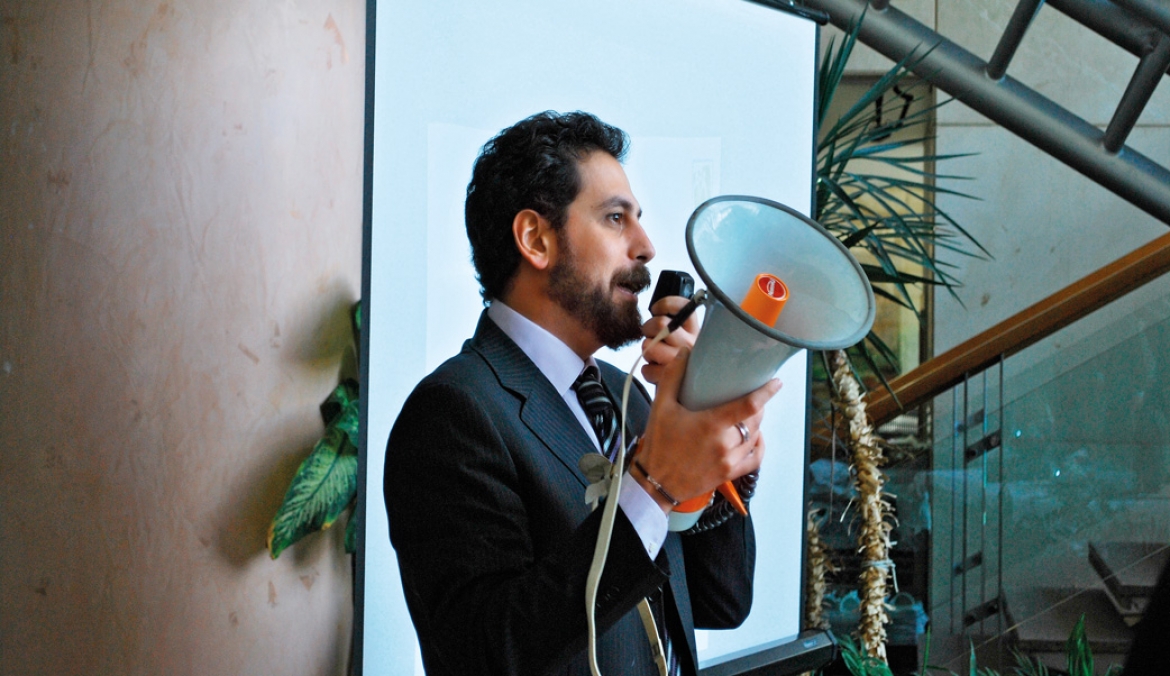
Behind his well-trimmed beard and two fierce brown eyes, Jad Sakr hides the mind of a warrior and the heart of a child.
This Political Sciences graduate could not care less about being politically correct in condemning a society that is gradually shifting away from humanity.
For the past seven years, Sakr has been touring the world, moving back and forth between his natAive country Lebanon and the four corners of the world.
He was not on exotic holidays, nor on fancy business trips, but he was living in regions of the world that needed his help. And that also helped him discover himself.
After volunteering with a Human Rights Organization in India working primarily on prisoner’s rights, he joined the National Democratic Institute in Beirut, before working as a long-term election observer in the South of Jordan.
In 2011, he integrated the International Committee of the Red Cross.
Since then, he has taken on assignments in Goma, the Democratic Republic of Congo, Kirkuk and Mosul in Iraq and Darfur, Sudan. During that time, Sakr has worked and shared powerful moments with political prisoners, security detainees, refugees, internally displaced people, families of missing persons and other victims of armed conflicts.
Today, Jad Sakr is back in his homeland working in the development and humanitarian fields with the same passion as ever.
He brings with him tons of stories from around the world, stories that makes us think twice about our choice of life. And this is what he has to say about it.
Why do you do what you do?
The reasons are many. Of course, there is the immense satisfaction one gets from helping others, be it by working on long term developmental programs that seek to improve their lives or by immediately alleviating their pain and suffering in times of war of other humanitarian disasters.
But there are also – even more – selfish reasons; I genuinely enjoy being in the field, working with communities, listening to their stories, and sharing, to the extent that is possible, their experiences. I also believe mobility is extremely enriching in that it allows for both a better understanding of the world in its diversity and most importantly, oneself.
Do you consider your job “a job” in its widely used meaning?
I think it is important for aid workers to remind themselves from time to time that it actually is a job. This allows them to better deal with certain professional frustrations and to accept the fact that they do not have all the solutions, which ironically allows them to be more efficient.
But to answer your question, I certainly enjoy my work and would continue doing it even if
I won the lottery tomorrow. I would perhaps be pickier about the destinations I go to, focus on certain causes rather than others, or promote certain values more actively, but I would generally stay in my field.
If you had to choose one quality that every aid worker should have, what would it be?
Empathy, certainly…not in some kind of packaged form and not in the way people are trained on…but rather a genuine willingness and ability to put oneself in another’s shoes.
What did you find most difficult about working in Lebanon?
Whether in Lebanon or abroad, I have sometimes questioned the added value of my involvement; especially at times when I felt powerless in the face of systemic flaws and deeply rooted problems. In Lebanon in particular,
I realized that I had a tendency to take things more to heart and found it more difficult to maintain a healthy emotional distance from the issues at hand.
What are the biggest challenges one can face as an expatriate humanitarian?
The first one is the fast pace associated with humanitarian assignments. Practically, one has to quickly adapt to a new environment, understand its complexities, build relationships and get invested in the work to be done. By the time one feels comfortable, empowered, and supported enough, one already has to start disengaging; leaving what had pretty much become one’s life behind… only to do it all over again.
The second one is the stress related to security considerations and the ensuing confinement.
Most international organizations nowadays are struggling to obtain necessary security guarantees from both increasingly radicalized groups and nationalistic governments that often fail to make the distinction between combatants and civilians. As a result, aid workers are sometimes viewed as “legitimate targets,” which forces organizations to take restrictive measures such as self-imposed limitations of movement or mandated curfews.
Lastly, the nomadic lifestyle of the aid workers makes it very difficult for them to build and maintain romantic relationships and find a common ground between one’s personal and professional lives.
Do you feel people’s recognition for what you do? Do you expect it?
On more than one occasion, I have been asked by beneficiaries themselves, be it community members, refuges, detainees or others, what got into me for choosing this job or why I would leave the comfort of my home and travel halfway around the world to try and help complete strangers. So, I know for a fact that they appreciate our efforts and are aware of the sacrifices we sometimes have to make, and that is recognition enough.
I also feel that aid workers generally have tremendous respect for their peers and the work that they do, and are somehow brought together by a sense of solidarity that I do not think is present in most other professions.
When it comes to regular people, and based on the many discussions I have had on the subject, I believe that if nothing else, a majority of them are fascinated by the development and humanitarian fields. Some are even impressed by what we do while most are encouraging. And of course, you always have those who cannot understand this type of work or relate to it, or even those who think aid workers are naïve idealists or hopeless romantics.
Generally, I think we still live in world where personal wealth is glorified and associated with a successful and fruitful career. So, to answer your question, I do not seek recognition or expect it more than the next person, but I do struggle with the notion that CEOs, tech gurus, pseudo-activists who think they have left a mark on the world by posting comments on Facebook, or others, are hailed as heroes, while some people actually spend a lifetime trying to make a difference and go unnoticed.
Is it worth it?
That is a tough one. Honestly, I do not see myself enjoying another field of work as much as I enjoy this one but I am trying to slowly but surely find a system that will allow me to reconcile my hunger for adventures and constantly renewed challenges with my need for stability and a sense of normalcy.
Signature Boutique
Lebanon, in your inbox

HOMEland Magazine
We firmly believe that the internet should be available and accessible to anyone, and are committed to providing a website that is accessible to the widest possible audience, regardless of circumstance and ability.
To fulfill this, we aim to adhere as strictly as possible to the World Wide Web Consortium’s (W3C) Web Content Accessibility Guidelines 2.1 (WCAG 2.1) at the AA level. These guidelines explain how to make web content accessible to people with a wide array of disabilities. Complying with those guidelines helps us ensure that the website is accessible to all people: blind people, people with motor impairments, visual impairment, cognitive disabilities, and more.
This website utilizes various technologies that are meant to make it as accessible as possible at all times. We utilize an accessibility interface that allows persons with specific disabilities to adjust the website’s UI (user interface) and design it to their personal needs.
Additionally, the website utilizes an AI-based application that runs in the background and optimizes its accessibility level constantly. This application remediates the website’s HTML, adapts Its functionality and behavior for screen-readers used by the blind users, and for keyboard functions used by individuals with motor impairments.
If you’ve found a malfunction or have ideas for improvement, we’ll be happy to hear from you. You can reach out to the website’s operators by using the following email
Our website implements the ARIA attributes (Accessible Rich Internet Applications) technique, alongside various different behavioral changes, to ensure blind users visiting with screen-readers are able to read, comprehend, and enjoy the website’s functions. As soon as a user with a screen-reader enters your site, they immediately receive a prompt to enter the Screen-Reader Profile so they can browse and operate your site effectively. Here’s how our website covers some of the most important screen-reader requirements, alongside console screenshots of code examples:
Screen-reader optimization: we run a background process that learns the website’s components from top to bottom, to ensure ongoing compliance even when updating the website. In this process, we provide screen-readers with meaningful data using the ARIA set of attributes. For example, we provide accurate form labels; descriptions for actionable icons (social media icons, search icons, cart icons, etc.); validation guidance for form inputs; element roles such as buttons, menus, modal dialogues (popups), and others. Additionally, the background process scans all the website’s images and provides an accurate and meaningful image-object-recognition-based description as an ALT (alternate text) tag for images that are not described. It will also extract texts that are embedded within the image, using an OCR (optical character recognition) technology. To turn on screen-reader adjustments at any time, users need only to press the Alt+1 keyboard combination. Screen-reader users also get automatic announcements to turn the Screen-reader mode on as soon as they enter the website.
These adjustments are compatible with all popular screen readers, including JAWS and NVDA.
Keyboard navigation optimization: The background process also adjusts the website’s HTML, and adds various behaviors using JavaScript code to make the website operable by the keyboard. This includes the ability to navigate the website using the Tab and Shift+Tab keys, operate dropdowns with the arrow keys, close them with Esc, trigger buttons and links using the Enter key, navigate between radio and checkbox elements using the arrow keys, and fill them in with the Spacebar or Enter key.Additionally, keyboard users will find quick-navigation and content-skip menus, available at any time by clicking Alt+1, or as the first elements of the site while navigating with the keyboard. The background process also handles triggered popups by moving the keyboard focus towards them as soon as they appear, and not allow the focus drift outside it.
Users can also use shortcuts such as “M” (menus), “H” (headings), “F” (forms), “B” (buttons), and “G” (graphics) to jump to specific elements.
We aim to support the widest array of browsers and assistive technologies as possible, so our users can choose the best fitting tools for them, with as few limitations as possible. Therefore, we have worked very hard to be able to support all major systems that comprise over 95% of the user market share including Google Chrome, Mozilla Firefox, Apple Safari, Opera and Microsoft Edge, JAWS and NVDA (screen readers).
Despite our very best efforts to allow anybody to adjust the website to their needs. There may still be pages or sections that are not fully accessible, are in the process of becoming accessible, or are lacking an adequate technological solution to make them accessible. Still, we are continually improving our accessibility, adding, updating and improving its options and features, and developing and adopting new technologies. All this is meant to reach the optimal level of accessibility, following technological advancements. For any assistance, please reach out to
