


HOMEland
Coming Soon
HOMEland Events & Collaborations
Coming Soon
 Signature Boutique


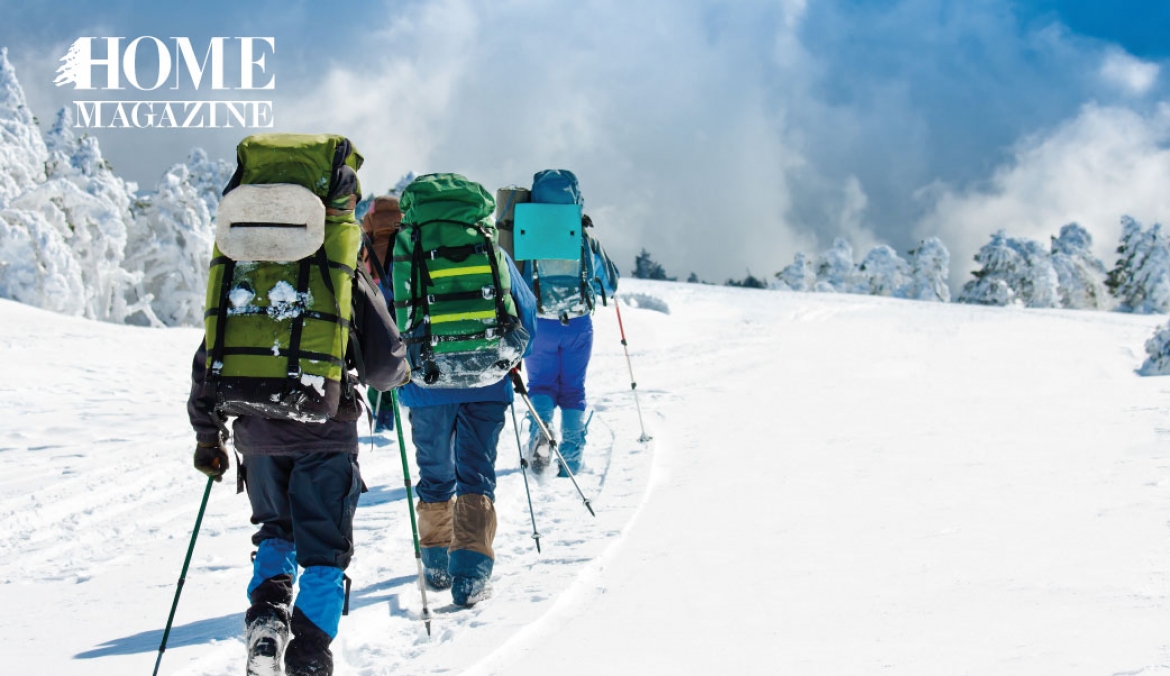
Just picture yourself walking on a blanket of freshly fallen snow and the air feels so fresh you want to inhale for as long as possible. The only sound, other than the gentle crunching of snow made by your feet, is the chirping of birds above.
Enjoying a spectacular snow-covered terrain while getting a superb workout is what attracts many people to take up snowshoeing. What actually started thousands of years ago as a mode of transportation has evolved into a popular winter activity and is now gaining momentum at plenty of ski spots throughout Lebanon. Snowshoeing is a fantastic alpine activity, which is relatively inexpensive. You only need snowshoes, appropriate footwear and clothing and a pair of poles (optional) to give you better balance. It’s a brilliant workout that lets you burn more calories than walking or running at the same speed (you can burn up to 1000 calories per hour). As with many sports you can go easy or hard and it allows you to explore many trails that you may not ski in due to trees or low-snow conditions.
As the saying goes, “If you can walk, you can snowshoe”. Snowshoeing is far less technical than skiing and most people can master it in minutes. Lebanese ski instructor and snowshoeing guide Charles Richa has been organizing walks for several years now. He regularly takes groups of 25 for walks in Zaarour, Faraya and The Cedars. His tours last around two hours, with a combination of uphill, leveled and downhill trekking. “I always have two instructors for my guided walks,” explains Richa. “One of us is at the front and the other at the back so we can keep track of everyone.” Richa charges $3 a person (excluding the snowshoe rental which can range from $7 to $20 depending on the condition – whether old or new). Richa makes sure walkers pack light. “I tell people to carry some water and a light snack and leave everything else in the bus.”
“If you can walk, you can snowshoe.”
Fady Salameh, owner of Fadi Sport stores also organizes snowshoeing tours. He claims that in Lebanon walking in snowshoes is not new, it goes back hundreds of years but as a recreation it really took off five years ago. Today there is a huge demand he says. “There’s a real boom now, I get groups ranging from the scouts, corporations, and families booking tours with me all winter.” Salameh usually takes his groups to snowy hideaways far away from popular ski spots, where walkers can enjoy panoramic views and peaceful settings. “I take my walkers to Sannine, the Faraya Cross or Sad Chabrouh,” he says.
Fady Salameh, owner of Fadi Sport stores also organizes snowshoeing tours. He claims that in Lebanon walking in snowshoes is not new, it goes back hundreds of years but as a recreation it really took off five years ago. Today there is a huge demand he says. “There’s a real boom now, I get groups ranging from the scouts, corporations, and families booking tours with me all winter.” Salameh usually takes his groups to snowy hideaways far away from popular ski spots, where walkers can enjoy panoramic views and peaceful settings. “I take my walkers to Sannine, the Faraya Cross or Sad Chabrouh,” he says.
Most sporting goods stores in Lebanon sell the snowshoes which retail anywhere from $150 up to $500. The stores are also happy to rent them for a day at a fee of $10.
The beauty of snowshoeing is that it can basically be done anywhere where thick snow is present and no marked trails are needed. It’s recommended not to go alone to ensure safety. Try to go in pairs or get a local guide to show you the best trails. There are also plenty of established hiking groups in Lebanon that organize showshoeing trips most weekends during the snow season.
 Signature Boutique
Lebanon, in your inbox

HOMEland Magazine
We firmly believe that the internet should be available and accessible to anyone, and are committed to providing a website that is accessible to the widest possible audience, regardless of circumstance and ability.
To fulfill this, we aim to adhere as strictly as possible to the World Wide Web Consortium’s (W3C) Web Content Accessibility Guidelines 2.1 (WCAG 2.1) at the AA level. These guidelines explain how to make web content accessible to people with a wide array of disabilities. Complying with those guidelines helps us ensure that the website is accessible to all people: blind people, people with motor impairments, visual impairment, cognitive disabilities, and more.
This website utilizes various technologies that are meant to make it as accessible as possible at all times. We utilize an accessibility interface that allows persons with specific disabilities to adjust the website’s UI (user interface) and design it to their personal needs.
Additionally, the website utilizes an AI-based application that runs in the background and optimizes its accessibility level constantly. This application remediates the website’s HTML, adapts Its functionality and behavior for screen-readers used by the blind users, and for keyboard functions used by individuals with motor impairments.
If you’ve found a malfunction or have ideas for improvement, we’ll be happy to hear from you. You can reach out to the website’s operators by using the following email
Our website implements the ARIA attributes (Accessible Rich Internet Applications) technique, alongside various different behavioral changes, to ensure blind users visiting with screen-readers are able to read, comprehend, and enjoy the website’s functions. As soon as a user with a screen-reader enters your site, they immediately receive a prompt to enter the Screen-Reader Profile so they can browse and operate your site effectively. Here’s how our website covers some of the most important screen-reader requirements, alongside console screenshots of code examples:
Screen-reader optimization: we run a background process that learns the website’s components from top to bottom, to ensure ongoing compliance even when updating the website. In this process, we provide screen-readers with meaningful data using the ARIA set of attributes. For example, we provide accurate form labels; descriptions for actionable icons (social media icons, search icons, cart icons, etc.); validation guidance for form inputs; element roles such as buttons, menus, modal dialogues (popups), and others. Additionally, the background process scans all the website’s images and provides an accurate and meaningful image-object-recognition-based description as an ALT (alternate text) tag for images that are not described. It will also extract texts that are embedded within the image, using an OCR (optical character recognition) technology. To turn on screen-reader adjustments at any time, users need only to press the Alt+1 keyboard combination. Screen-reader users also get automatic announcements to turn the Screen-reader mode on as soon as they enter the website.
These adjustments are compatible with all popular screen readers, including JAWS and NVDA.
Keyboard navigation optimization: The background process also adjusts the website’s HTML, and adds various behaviors using JavaScript code to make the website operable by the keyboard. This includes the ability to navigate the website using the Tab and Shift+Tab keys, operate dropdowns with the arrow keys, close them with Esc, trigger buttons and links using the Enter key, navigate between radio and checkbox elements using the arrow keys, and fill them in with the Spacebar or Enter key.Additionally, keyboard users will find quick-navigation and content-skip menus, available at any time by clicking Alt+1, or as the first elements of the site while navigating with the keyboard. The background process also handles triggered popups by moving the keyboard focus towards them as soon as they appear, and not allow the focus drift outside it.
Users can also use shortcuts such as “M” (menus), “H” (headings), “F” (forms), “B” (buttons), and “G” (graphics) to jump to specific elements.
We aim to support the widest array of browsers and assistive technologies as possible, so our users can choose the best fitting tools for them, with as few limitations as possible. Therefore, we have worked very hard to be able to support all major systems that comprise over 95% of the user market share including Google Chrome, Mozilla Firefox, Apple Safari, Opera and Microsoft Edge, JAWS and NVDA (screen readers).
Despite our very best efforts to allow anybody to adjust the website to their needs. There may still be pages or sections that are not fully accessible, are in the process of becoming accessible, or are lacking an adequate technological solution to make them accessible. Still, we are continually improving our accessibility, adding, updating and improving its options and features, and developing and adopting new technologies. All this is meant to reach the optimal level of accessibility, following technological advancements. For any assistance, please reach out to
