
HOMEland THEMES
Coming Soon
HOMEland Events & Collaborations
Coming Soon
 Signature Boutique

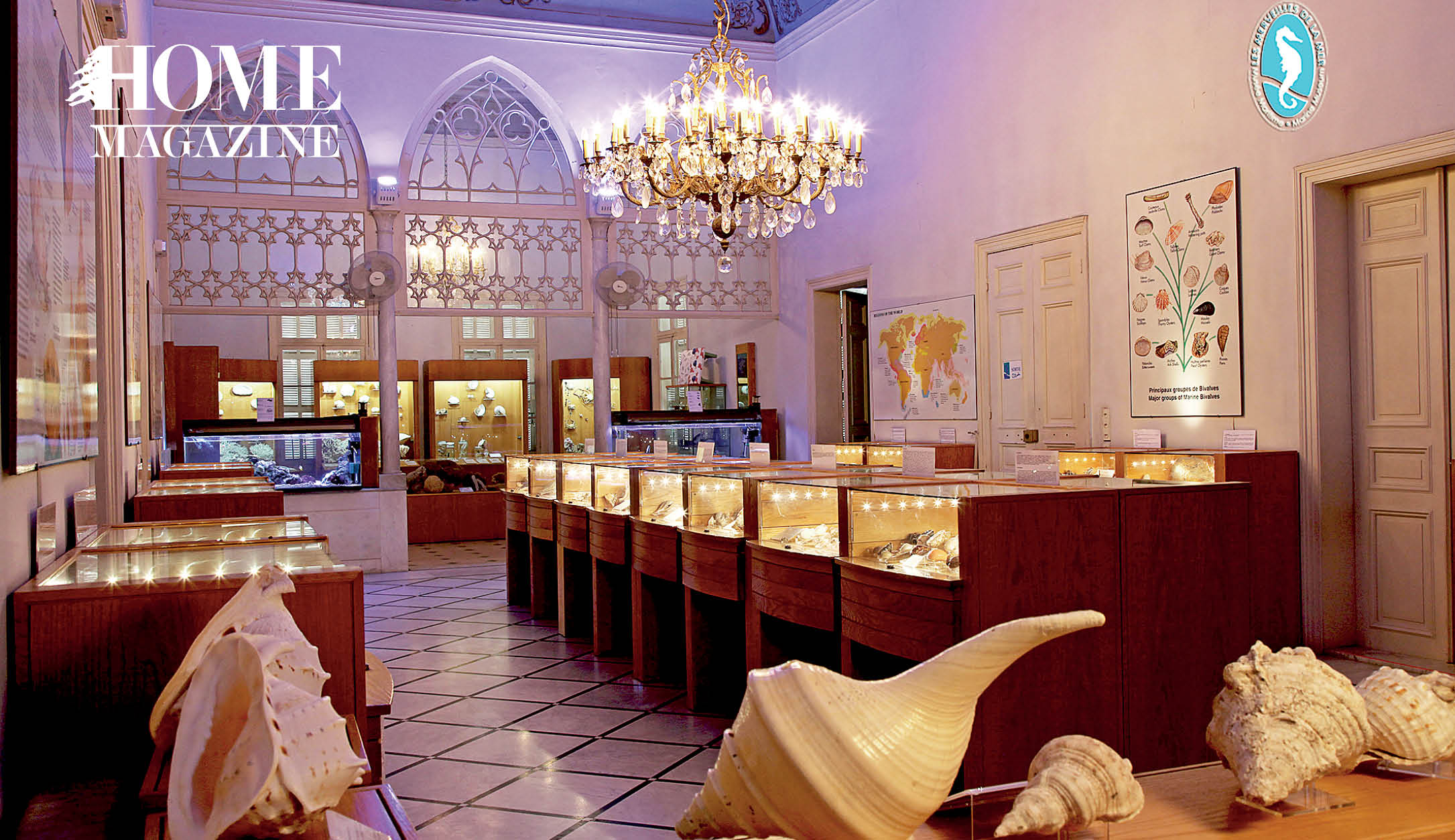
Les Merveilles de la Mer showcases the wonders of the ocean. It’s the perfect place to take your kids.
Teaching youngsters the value and beauty of the ocean
Driving on the main road of Jdeidet al-Metn, one can see the red tiles of a traditional Lebanese house. Stopping to admire this beautiful 19th-century house with its arcades and surrounding garden will lead you to discover what lies behind the doors of the Yazbeck family house. The Wonders of the Sea, also known as Les Merveilles de la Mer, is an initiative started by Janine Yazbeck in 1996. From a young age she collected seashells, a hobby that led to her studying oceanography. In 1982, she exhibited her seashells for a month and a half. Despite the war, schools were invited, and the feedback was positive.
The Wonders of the Sea aims to show children the richness of marine life. The museum is an “engine of transmission,” which tries to give visitors a little more knowledge of what lies under the waters just a few meters away.
It has become a regular destination for school trips, illuminating the precious nature of the seas and making it something the children can interact with. Visitors almost always show their appreciation with a keen desire to find out more.
The visit
Before starting the tour, groups are invited to watch a short video on marine life, with commentary by Janine. The explanations change, according to the age range, the purpose of the visit and
the interest of the visitors. You then wander around the rooms that display diverse marine species and equipment.
The visit begins with the shell collection, where you get to identify and distinguish different shells from around the world. You then enter the aquarium and see creatures such as an octopus, starfish, seahorse and variety of fishes. The invertebrates, such as sponge, coral, starfish and sea urchins, are displayed in a third part of the house.
Finally, the visitor is shown antique marine equipment that illustrates how deep-sea diving used to be done, along with different instruments used for marine purposes.
Most of the children that visit the museum leave with a different attitude toward the sea. They learn about the diversity of marine species, but also acknowledge the importance of keeping the seas clean, in order to protect its residents. They also learn that when you go fishing, anything you will not – or cannot – eat has to be put back in the sea. It is important that future generations respect the ocean and the best way to achieve this is through education and exposure. Les Merveilles de la Mer is doing its best to inspire
today’s children to look after their planet.
Spotlight on the backstage of the Wonders
When you visit the museum, you don’t get to see everything.
The management of living species requires meticulous upkeep to ensure their wellbeing: water treatment, feeding, health care, monitoring and cleaning are all vital.
An extremely small team looks after the museum. Janine and Andrée inspect all the aquariums on daily basis, clean the glass and check the water temperature. They offer a “Menu à la carte” depending on the species, since each one has a particular diet and biological rhythm.
Information
The museum is open a on daily basis
Monday to Friday
from 9 a.m. until 1 p.m.
Saturdays and Sundays from
3 p.m. until 7 p.m.
Groups can schedule an appointment at the following numbers:
+961(0)1-891-548
& +961(0)3-626-069
Entrance fees are
8,000LL for adults
6,000LL for children
Signature Boutique 

HOMEland Magazine
We firmly believe that the internet should be available and accessible to anyone, and are committed to providing a website that is accessible to the widest possible audience, regardless of circumstance and ability.
To fulfill this, we aim to adhere as strictly as possible to the World Wide Web Consortium’s (W3C) Web Content Accessibility Guidelines 2.1 (WCAG 2.1) at the AA level. These guidelines explain how to make web content accessible to people with a wide array of disabilities. Complying with those guidelines helps us ensure that the website is accessible to all people: blind people, people with motor impairments, visual impairment, cognitive disabilities, and more.
This website utilizes various technologies that are meant to make it as accessible as possible at all times. We utilize an accessibility interface that allows persons with specific disabilities to adjust the website’s UI (user interface) and design it to their personal needs.
Additionally, the website utilizes an AI-based application that runs in the background and optimizes its accessibility level constantly. This application remediates the website’s HTML, adapts Its functionality and behavior for screen-readers used by the blind users, and for keyboard functions used by individuals with motor impairments.
If you’ve found a malfunction or have ideas for improvement, we’ll be happy to hear from you. You can reach out to the website’s operators by using the following email
Our website implements the ARIA attributes (Accessible Rich Internet Applications) technique, alongside various different behavioral changes, to ensure blind users visiting with screen-readers are able to read, comprehend, and enjoy the website’s functions. As soon as a user with a screen-reader enters your site, they immediately receive a prompt to enter the Screen-Reader Profile so they can browse and operate your site effectively. Here’s how our website covers some of the most important screen-reader requirements, alongside console screenshots of code examples:
Screen-reader optimization: we run a background process that learns the website’s components from top to bottom, to ensure ongoing compliance even when updating the website. In this process, we provide screen-readers with meaningful data using the ARIA set of attributes. For example, we provide accurate form labels; descriptions for actionable icons (social media icons, search icons, cart icons, etc.); validation guidance for form inputs; element roles such as buttons, menus, modal dialogues (popups), and others. Additionally, the background process scans all the website’s images and provides an accurate and meaningful image-object-recognition-based description as an ALT (alternate text) tag for images that are not described. It will also extract texts that are embedded within the image, using an OCR (optical character recognition) technology. To turn on screen-reader adjustments at any time, users need only to press the Alt+1 keyboard combination. Screen-reader users also get automatic announcements to turn the Screen-reader mode on as soon as they enter the website.
These adjustments are compatible with all popular screen readers, including JAWS and NVDA.
Keyboard navigation optimization: The background process also adjusts the website’s HTML, and adds various behaviors using JavaScript code to make the website operable by the keyboard. This includes the ability to navigate the website using the Tab and Shift+Tab keys, operate dropdowns with the arrow keys, close them with Esc, trigger buttons and links using the Enter key, navigate between radio and checkbox elements using the arrow keys, and fill them in with the Spacebar or Enter key.Additionally, keyboard users will find quick-navigation and content-skip menus, available at any time by clicking Alt+1, or as the first elements of the site while navigating with the keyboard. The background process also handles triggered popups by moving the keyboard focus towards them as soon as they appear, and not allow the focus drift outside it.
Users can also use shortcuts such as “M” (menus), “H” (headings), “F” (forms), “B” (buttons), and “G” (graphics) to jump to specific elements.
We aim to support the widest array of browsers and assistive technologies as possible, so our users can choose the best fitting tools for them, with as few limitations as possible. Therefore, we have worked very hard to be able to support all major systems that comprise over 95% of the user market share including Google Chrome, Mozilla Firefox, Apple Safari, Opera and Microsoft Edge, JAWS and NVDA (screen readers).
Despite our very best efforts to allow anybody to adjust the website to their needs. There may still be pages or sections that are not fully accessible, are in the process of becoming accessible, or are lacking an adequate technological solution to make them accessible. Still, we are continually improving our accessibility, adding, updating and improving its options and features, and developing and adopting new technologies. All this is meant to reach the optimal level of accessibility, following technological advancements. For any assistance, please reach out to