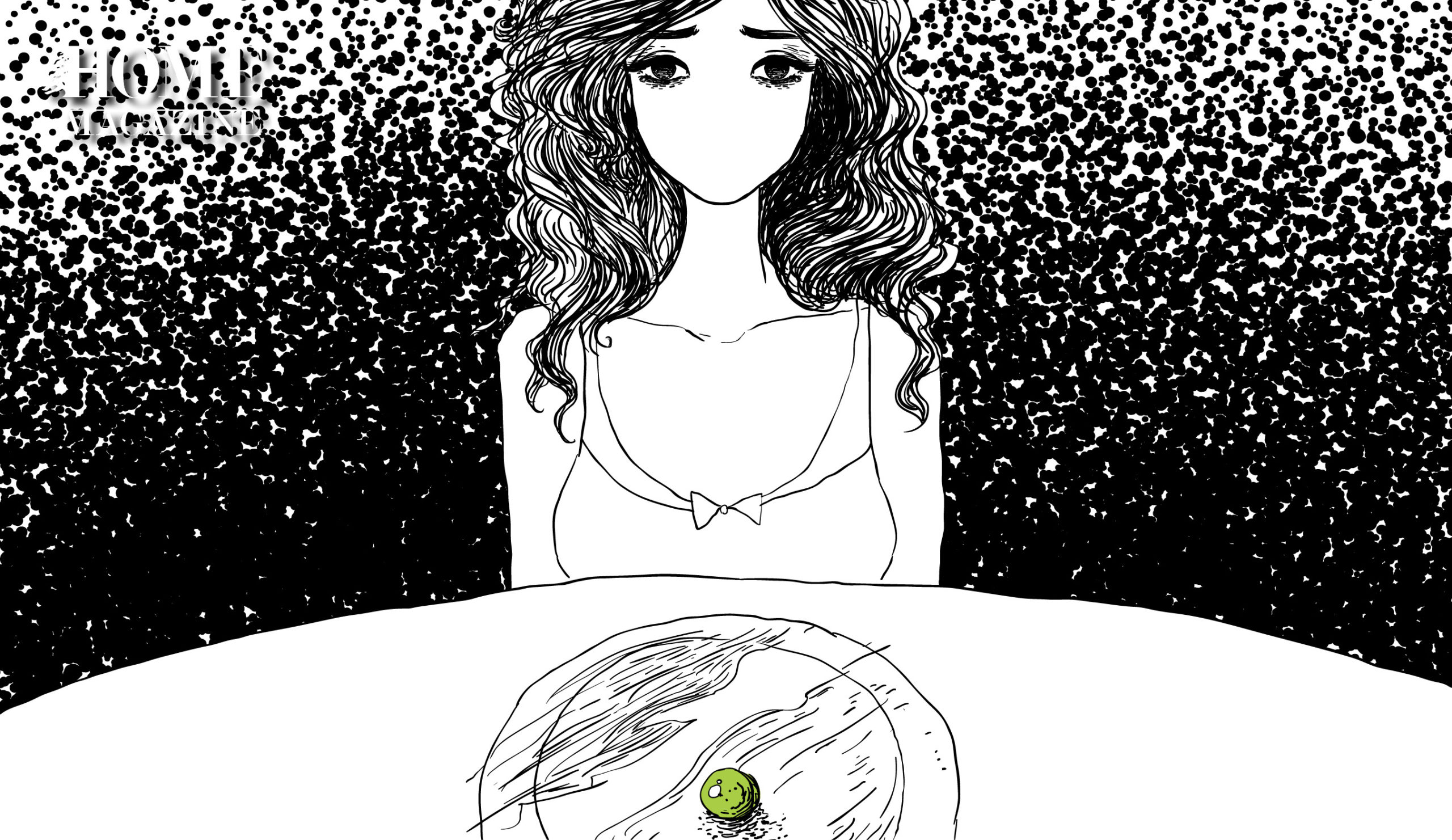
Maybe I will be enough if I could just lose weight.
An apple a day keeps the doctor away, so we have all often been told. Vitamin C boosts the immune system, phenols reduce cholesterol. Twenty-two grams of complex carbohydrates. No fat, sodium, or tooth decay. Most importantly, an apple a day is the perfect way to lose weight.
Baby weight, chocolate weight. Lonely midnight tear-drenched, therapeutic ice cream weight. Anxiety weight, stress weight. I-did-not-sign-up-for-this-life weight. Fill-the-void-in-my-gut, my time, my heart weight. Maybe-I-will-be-enough-if-I-could-just-lose-this weight.
The facts: By the ages of nine and ten, almost half of all children state that they would like to be thinner. By then, as well, almost half of all girls are already on a diet. By college, that statistic rises to 91 percent.
Of those, a quarter will develop some sort of eating disorder. Anorexia nervosa, bulimia, binge eating disorder, among others. These diseases do and will affect millions of boys and girls around the world.* Some will get help, some will struggle with food forever, some will die — all because they took the term “an apple a day” literally.
An apple a day is a misleading term some victims will take literally.
Swapping lunch dates for coffee dates, dinner dates for drinks. Ignoring hunger pangs, heart pangs, living on coffee and pills. Running on treadmills in a race to their death while the media and society cheer on. Starving, smoking, binging, purging.
Then it becomes an eating disorder.
“We may someday raise children to be happy, not perfect.”
An eating disorder is a term used to describe someone with distorted attitudes and behaviors related to eating, weight, and body image. It is a mental illness with severe mental and physical complications, that can affect people of all age, race, gender, ethnic, and socioeconomic groups.
And it exists in Lebanon.
A person who has anorexia nervosa does not eat enough. On the other end of the spectrum is binge eating, where a person eats too much. A person with bulimia purges after eating; someone with othorexia only eats healthily. Eating disorders manifest in various ways.
Whatever it looks like, an eating disorder is an eating disorder. It is a disease, not a bad habit, or a lack or excess of self-control. It is not about being thin, or about food, and it is not a choice; no person chooses it, just like no person chooses diabetes or cancer.
I have known girls and boys, wonderful humans struggling with eating disorders. They are painful and lethal. Those who have them are, literally, fighting their brains for their lives. Treatment and medication help, but not enough — not yet at least. That is why awareness is so crucial. No one should have to fight alone.
For those suffering and those who love them, I wrote a novel called The Girls at 17 Swann Street.

It is the story of a young girl’s descent into anorexia and her fight for recovery and her life. Her name is Anna. She dances. She is married to her best friend.
But anorexia sneakily takes it all away over time:
Her fat, her hair, her body heat, her ability to concentrate, her period, her personality, her relationships, her dreams, the features of her face. It almost costs her her life, until she finds herself in a treatment center with other girls at 17 Swann Street.
The story is fictional, but the suffering and courage in it are real. I wrote it with the hope that it might give even at least one person insight or comfort. So if it sounds familiar, to you or someone you know, please, please say something.
Contact a therapist or doctor. Call an eating disorder hotline. Help is available online and via text as well if you prefer. Talk to that someone you love. Talk to that someone who loves you. It will be difficult, but it just might save a life.
The dream is that with time, it might change the way our whole society thinks. That eating disorders may no longer be misunderstood and taboo. That we may someday raise children to be happy, not perfect. To be able to eat an apple a day, but also, from time to time, a slice of cake.
*Source: The National Eating Disorder Association of America.
https://www.nationaleatingdisorders.org/
HOMEland Magazine
We firmly believe that the internet should be available and accessible to anyone, and are committed to providing a website that is accessible to the widest possible audience, regardless of circumstance and ability.
To fulfill this, we aim to adhere as strictly as possible to the World Wide Web Consortium’s (W3C) Web Content Accessibility Guidelines 2.1 (WCAG 2.1) at the AA level. These guidelines explain how to make web content accessible to people with a wide array of disabilities. Complying with those guidelines helps us ensure that the website is accessible to all people: blind people, people with motor impairments, visual impairment, cognitive disabilities, and more.
This website utilizes various technologies that are meant to make it as accessible as possible at all times. We utilize an accessibility interface that allows persons with specific disabilities to adjust the website’s UI (user interface) and design it to their personal needs.
Additionally, the website utilizes an AI-based application that runs in the background and optimizes its accessibility level constantly. This application remediates the website’s HTML, adapts Its functionality and behavior for screen-readers used by the blind users, and for keyboard functions used by individuals with motor impairments.
If you’ve found a malfunction or have ideas for improvement, we’ll be happy to hear from you. You can reach out to the website’s operators by using the following email
Our website implements the ARIA attributes (Accessible Rich Internet Applications) technique, alongside various different behavioral changes, to ensure blind users visiting with screen-readers are able to read, comprehend, and enjoy the website’s functions. As soon as a user with a screen-reader enters your site, they immediately receive a prompt to enter the Screen-Reader Profile so they can browse and operate your site effectively. Here’s how our website covers some of the most important screen-reader requirements, alongside console screenshots of code examples:
Screen-reader optimization: we run a background process that learns the website’s components from top to bottom, to ensure ongoing compliance even when updating the website. In this process, we provide screen-readers with meaningful data using the ARIA set of attributes. For example, we provide accurate form labels; descriptions for actionable icons (social media icons, search icons, cart icons, etc.); validation guidance for form inputs; element roles such as buttons, menus, modal dialogues (popups), and others. Additionally, the background process scans all the website’s images and provides an accurate and meaningful image-object-recognition-based description as an ALT (alternate text) tag for images that are not described. It will also extract texts that are embedded within the image, using an OCR (optical character recognition) technology. To turn on screen-reader adjustments at any time, users need only to press the Alt+1 keyboard combination. Screen-reader users also get automatic announcements to turn the Screen-reader mode on as soon as they enter the website.
These adjustments are compatible with all popular screen readers, including JAWS and NVDA.
Keyboard navigation optimization: The background process also adjusts the website’s HTML, and adds various behaviors using JavaScript code to make the website operable by the keyboard. This includes the ability to navigate the website using the Tab and Shift+Tab keys, operate dropdowns with the arrow keys, close them with Esc, trigger buttons and links using the Enter key, navigate between radio and checkbox elements using the arrow keys, and fill them in with the Spacebar or Enter key.Additionally, keyboard users will find quick-navigation and content-skip menus, available at any time by clicking Alt+1, or as the first elements of the site while navigating with the keyboard. The background process also handles triggered popups by moving the keyboard focus towards them as soon as they appear, and not allow the focus drift outside it.
Users can also use shortcuts such as “M” (menus), “H” (headings), “F” (forms), “B” (buttons), and “G” (graphics) to jump to specific elements.
We aim to support the widest array of browsers and assistive technologies as possible, so our users can choose the best fitting tools for them, with as few limitations as possible. Therefore, we have worked very hard to be able to support all major systems that comprise over 95% of the user market share including Google Chrome, Mozilla Firefox, Apple Safari, Opera and Microsoft Edge, JAWS and NVDA (screen readers).
Despite our very best efforts to allow anybody to adjust the website to their needs. There may still be pages or sections that are not fully accessible, are in the process of becoming accessible, or are lacking an adequate technological solution to make them accessible. Still, we are continually improving our accessibility, adding, updating and improving its options and features, and developing and adopting new technologies. All this is meant to reach the optimal level of accessibility, following technological advancements. For any assistance, please reach out to