
HOMEland
Coming Soon
HOMEland Events & Collaborations
Coming Soon
 Signature Boutique


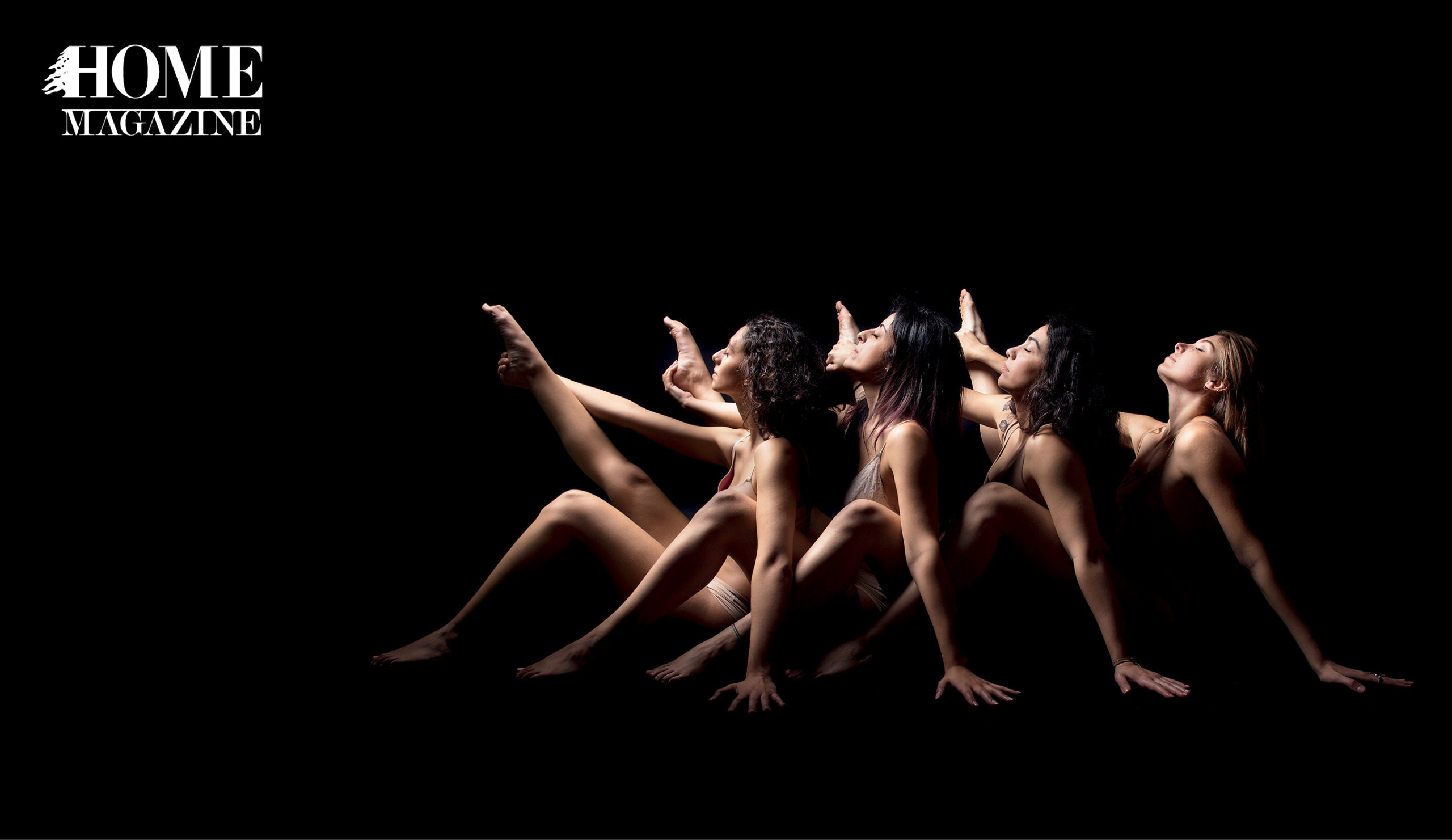
Part yoga student, part flamenco dancer, and all-around bewitching person, Yalda Younes has studied her crafts in India and Spain, and now has a flourishing business and creative practice as a yoga teacher and performer here in Beirut.
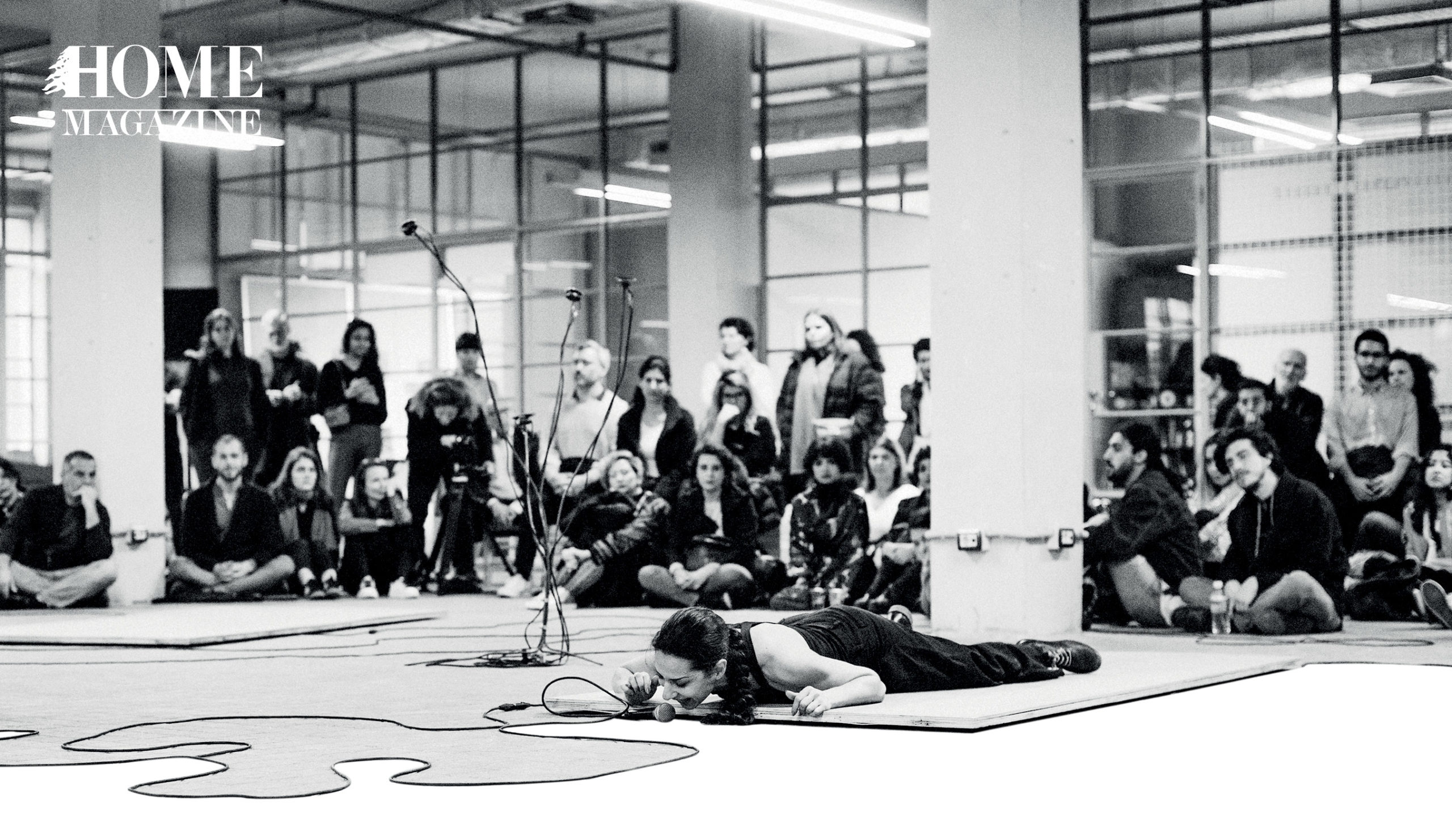
Her most recent dance performance, “A Universe Not Made for Us,” is a collaboration with her husband, the internationally renowned musician and composer, Khyam Allami. In addition to performances in France, Tunisia, and Jordan, the duo performed the piece in March at Beirut’s center for contemporary arts, Ashkal Alwan. I watched the performance with a hundred others as Younes’ body shook, paused, tapped, folded, rose, and collapsed alongside Allami’s sonic landscape of oud, electronics, and percussion. Sounds ranged from abrasive noise-music, like nails on a chalk-board, to a deep, comforting groan, like putting your ear against the core of the earth.
Younes also took up a microphone at one point, adapting flamenco songs into punk-style screaming and unsettling whispers. Redefining their respective disciplines of flamenco dance and Arabic music, they sought to address the contemporary historical moment which Younes described as being marked by “chronic depression and massive political failures.” The artists describe “A Universe Not Made for Us” as a reflection on order, chaos, and interruptions, all marked by “a haunting and inescapable yearning for stillness.” For those interested in yoga philosophy, this focus on stillness in Younes and Allami’s description strikes a chord.
According to Patanjali’s Yoga Sutras, an ancient and foundational yogic text, yoga is “the stilling of the activities of the mind.” As a collection of teachings, yoga is oriented toward precisely that, achieving stillness. So, what is stillness? How does it relate to the global historical condition? And what are the challenges of seeking stillness in Beirut? I asked Younes to help us explore these questions.
One does not have to be a yogi to be interested in stillness. In moments of pressure, loss, or joy, many wish that time would stand still and give us a break from the non-stop movement of life. To yearn for stillness is common, but to experience it is rare. As much as one may long for it, few have the tools to reach it. This might be especially true in a city like Beirut, which is known, loved, and hated for its incessant action. The world of yoga offers a science for achieving stillness as a way of easing human suffering, and it’s that science that Younes shares with the inhabitants of this city through her teaching practice, and which was invoked in “A Universe Not Made for Us.”
Younes’ artistic, physical, and spiritual crafts are unified in her person. Having come across flamenco and yoga randomly, each have integrated, nourished and guided her life in their own ways at specific moments. She emphasized that she is unattached to either her yoga or dance practices, and remains open to wherever these transformations will take her next. When asked what she offers the world through dance and yoga respectively, she answers, “The world is offering me far more than what I am offering it with my artistic or teaching practices!” Here, through detachment and focus on change in herself and the way she interacts with the world, rather than focus on change in the outside world, Younes shows more than simple humility. Her comments reflect the teachings of yogic philosophy, which emphasize that, in the ever-changing world of cause and effect in which human life takes place, attachment is one of the biggest distortions of reality and sources of human suffering. In yoga, you can only work on yourself and your relationship to your surroundings, and you can hold onto nothing. Everything is constantly changing. Everything will pass into something else.
As a creature of habit, yoga teaches that everything you do is conditioned, and thus, through constant self-study, practice, and reflection, one’s conditioning can change. In the words of the yoga teacher in whose lineage Yalda has been trained, Sri Tirumalai Krishnamacharya, “yoga is a process of transforming old samskaras (habits/ conditioning) into new and more positive ones.” Patanjali’s Yoga Sutras outlines eight major “limbs,” on the path or “tree” of ashtanga yoga. These range from moral attitudes toward the self and others, to physical discipline to breathing exercises, and to concentration and meditation. Each limb of the yogic tree is meant to help replace habits that cause suffering with ones that lead to a more positive physical, mental, and emotional state, and which prepare for the experience of yoga: stilling the movement of the mind. It is in that stillness that the human being, who is enmeshed in the world of change, can key into something eternal, and it is only here that confusion makes room for clarity and the vicious cycle of suffering can slow or cease. Otherwise, we experience life as an uninterrupted chain of ups and downs, loss and gain, pleasure and pain.
“Beirut is harakeh. Movement. Beirut doesn’t stop. It’s always too much and we always want more. Is it more difficult to seek stillness here than elsewhere?”
In Younes’ recent dance piece, stillness is a “haunting” human desire, suggesting something elusive, maybe even unattainable. In the yoga that she teaches, however, it often seems like a tangible goal. Is there something paradoxical in the way that stillness surfaces in her work? When asked what stillness meant to her, she clarified this tension between its elusive and emanant dimensions.
“Stillness is important to me because I see it as the original source of everything, the starting and ending point of every creation, without the confusion of all the moments in between,” says Younes. “I don’t see it as a goal or a set target to be achieved, but more of a hovering horizon, like a mental window that offers an infinite perspective. I see stillness as being the opposite not only of agitation and confusion but also of stagnation and rigidity. It is a fluid, constantly renewed openness to the (inner and outer) world.”
In her thought and action, stillness becomes the dissipating ground of creation itself — the receding point where all things begin and end. As the opposite of not only agitation but also stagnation, stillness transcends them both. A being in a state of stillness neither stubbornly holds nor haphazardly changes its form. Stillness heralds a renewable openness that opposes the infertile states of rigidity and confusion.
So, what does this existential stillness have to do with the urban environment in which we live? Beirut is harakeh. Movement. Beirut doesn’t stop. It’s always too much and we always want more. Is it more difficult to seek stillness here than elsewhere? In response to this question, Younes gives a strong no:
“I think it’s difficult pretty much everywhere in the universe, although being around nature surely facilitates contemplation and internal calm,” says Younes. “Unfortunately, Beirut is one of the cities where the visual, sonic, and olfactory pollution are very high and still on the rise. The mediatic, political, and marketing pollutions further contribute to more misery: tension, anxiety, numbness, agitation, craving, and deprivation of the most basic needs.”
She emphasizes, however, that all of this is “a microcosm for the rest of the world.” Here, Younes’s description of Beirut not only speaks to the specific challenges of seeking stillness-as-openness in this city we call HOME, it also gives further substance to the historical and global condition of chaos and depression that Younes and Allami spoke to in “A Universe Not Made for Us.” They imagined their piece as “a microcosm of organized chaos, random interruptions, illusions of order,” i.e. a microcosm of the world.
“The whole of humanity should feel responsible for the whole planet”
This city is connected to and reflective of the larger world, which cannot be split into separate parts. In Younes’ view, the whole of humanity should feel responsible for the whole planet:
“How can history and politics be anything other than global?” asks Younes. “It is all governed by the law of cause and effect. Our biggest foolishness is seeing things in isolation, with a lack of perspective and understanding of the whole. This is why we are still very far away from ensuring a safe, decent, and agreeable quality of life for all humans on the planet.”
Politically, this gives us a theoretical problem and solution, where spatial compartmentalization should be corrected with a more holistic vision of the world, but the question remains: How to find stillness in a place like Beirut, a place like the world? How to access openness and creativity when our environment seems to constantly propel us into freezing or frenzy?
Many give up on Lebanon, setting their sights on moving abroad as a sort of escape from all that plagues this city. If the state of Beirut is the state of the world, however, then escape is at best a temporary and at worst an apolitical solution. Younes acknowledges her good fortune as someone who has the luxury of living a decent life in Beirut, and for now, she remains faithful to the city, preferring not to pick-up and fly somewhere else, “where things naturally feel better.”
Instead, she sees “the loneliness experienced in this roaring chaos as an interesting reset point for a good yoga practice.” Is it an easy practice? No. “Making time and space for it requires effort, will, energy, and consistency, but without discipline and self-inquiry there can be no progress on any level,” says Younes. This all stands to reason. If the universe wasn’t made for us then why should it be easy to create ourselves within it?
 Signature Boutique
Lebanon, in your inbox
HOMEland Magazine
We firmly believe that the internet should be available and accessible to anyone, and are committed to providing a website that is accessible to the widest possible audience, regardless of circumstance and ability.
To fulfill this, we aim to adhere as strictly as possible to the World Wide Web Consortium’s (W3C) Web Content Accessibility Guidelines 2.1 (WCAG 2.1) at the AA level. These guidelines explain how to make web content accessible to people with a wide array of disabilities. Complying with those guidelines helps us ensure that the website is accessible to all people: blind people, people with motor impairments, visual impairment, cognitive disabilities, and more.
This website utilizes various technologies that are meant to make it as accessible as possible at all times. We utilize an accessibility interface that allows persons with specific disabilities to adjust the website’s UI (user interface) and design it to their personal needs.
Additionally, the website utilizes an AI-based application that runs in the background and optimizes its accessibility level constantly. This application remediates the website’s HTML, adapts Its functionality and behavior for screen-readers used by the blind users, and for keyboard functions used by individuals with motor impairments.
If you’ve found a malfunction or have ideas for improvement, we’ll be happy to hear from you. You can reach out to the website’s operators by using the following email
Our website implements the ARIA attributes (Accessible Rich Internet Applications) technique, alongside various different behavioral changes, to ensure blind users visiting with screen-readers are able to read, comprehend, and enjoy the website’s functions. As soon as a user with a screen-reader enters your site, they immediately receive a prompt to enter the Screen-Reader Profile so they can browse and operate your site effectively. Here’s how our website covers some of the most important screen-reader requirements, alongside console screenshots of code examples:
Screen-reader optimization: we run a background process that learns the website’s components from top to bottom, to ensure ongoing compliance even when updating the website. In this process, we provide screen-readers with meaningful data using the ARIA set of attributes. For example, we provide accurate form labels; descriptions for actionable icons (social media icons, search icons, cart icons, etc.); validation guidance for form inputs; element roles such as buttons, menus, modal dialogues (popups), and others. Additionally, the background process scans all the website’s images and provides an accurate and meaningful image-object-recognition-based description as an ALT (alternate text) tag for images that are not described. It will also extract texts that are embedded within the image, using an OCR (optical character recognition) technology. To turn on screen-reader adjustments at any time, users need only to press the Alt+1 keyboard combination. Screen-reader users also get automatic announcements to turn the Screen-reader mode on as soon as they enter the website.
These adjustments are compatible with all popular screen readers, including JAWS and NVDA.
Keyboard navigation optimization: The background process also adjusts the website’s HTML, and adds various behaviors using JavaScript code to make the website operable by the keyboard. This includes the ability to navigate the website using the Tab and Shift+Tab keys, operate dropdowns with the arrow keys, close them with Esc, trigger buttons and links using the Enter key, navigate between radio and checkbox elements using the arrow keys, and fill them in with the Spacebar or Enter key.Additionally, keyboard users will find quick-navigation and content-skip menus, available at any time by clicking Alt+1, or as the first elements of the site while navigating with the keyboard. The background process also handles triggered popups by moving the keyboard focus towards them as soon as they appear, and not allow the focus drift outside it.
Users can also use shortcuts such as “M” (menus), “H” (headings), “F” (forms), “B” (buttons), and “G” (graphics) to jump to specific elements.
We aim to support the widest array of browsers and assistive technologies as possible, so our users can choose the best fitting tools for them, with as few limitations as possible. Therefore, we have worked very hard to be able to support all major systems that comprise over 95% of the user market share including Google Chrome, Mozilla Firefox, Apple Safari, Opera and Microsoft Edge, JAWS and NVDA (screen readers).
Despite our very best efforts to allow anybody to adjust the website to their needs. There may still be pages or sections that are not fully accessible, are in the process of becoming accessible, or are lacking an adequate technological solution to make them accessible. Still, we are continually improving our accessibility, adding, updating and improving its options and features, and developing and adopting new technologies. All this is meant to reach the optimal level of accessibility, following technological advancements. For any assistance, please reach out to
