Article by: Maie El-Hage
In the quiet elegance of his Belle Vue apartment, Wissam Melhem opens up about his artistic journey. Recounting his early illustrations, this designer-turned-artist discusses how his work has always been about social and cultural commentary. Now at his artistic peak, Melhem is enjoying the expressiveness and artistic freedoms of his action-painting on large canvases. The gestural freedoms he enjoys are not without design; his work can be dubbed as “observational experimentation” or “improvisation,” as he creates elegant sketches before translating them onto the larger canvases. In this studio visit, Wissam shares the evolution of his artistic process.
Wissam began exploring the themes of memes and political commentary in art in mid-2018 with his own series of “enta mesh sarsour.” Starting out with 45 x 45cm illustrations, he held his first exhibition at Be Happy at Saifi, a store in the heart of Beirut. The shift to create art objects from these illustrations was Wissam’s first step as an emerging artist. During the opening at Be Happy, the artist painted a large artwork on the wall live during the event.
He would eventually take his work further, after receiving positive feedback from his peers. Melhem reflected on his illustrations as a product of “clear lines” and “contained colors”; he approached his first canvas where he intended to “free the lines” and “free the colors.” He succeeded and hasn’t stopped painting since.

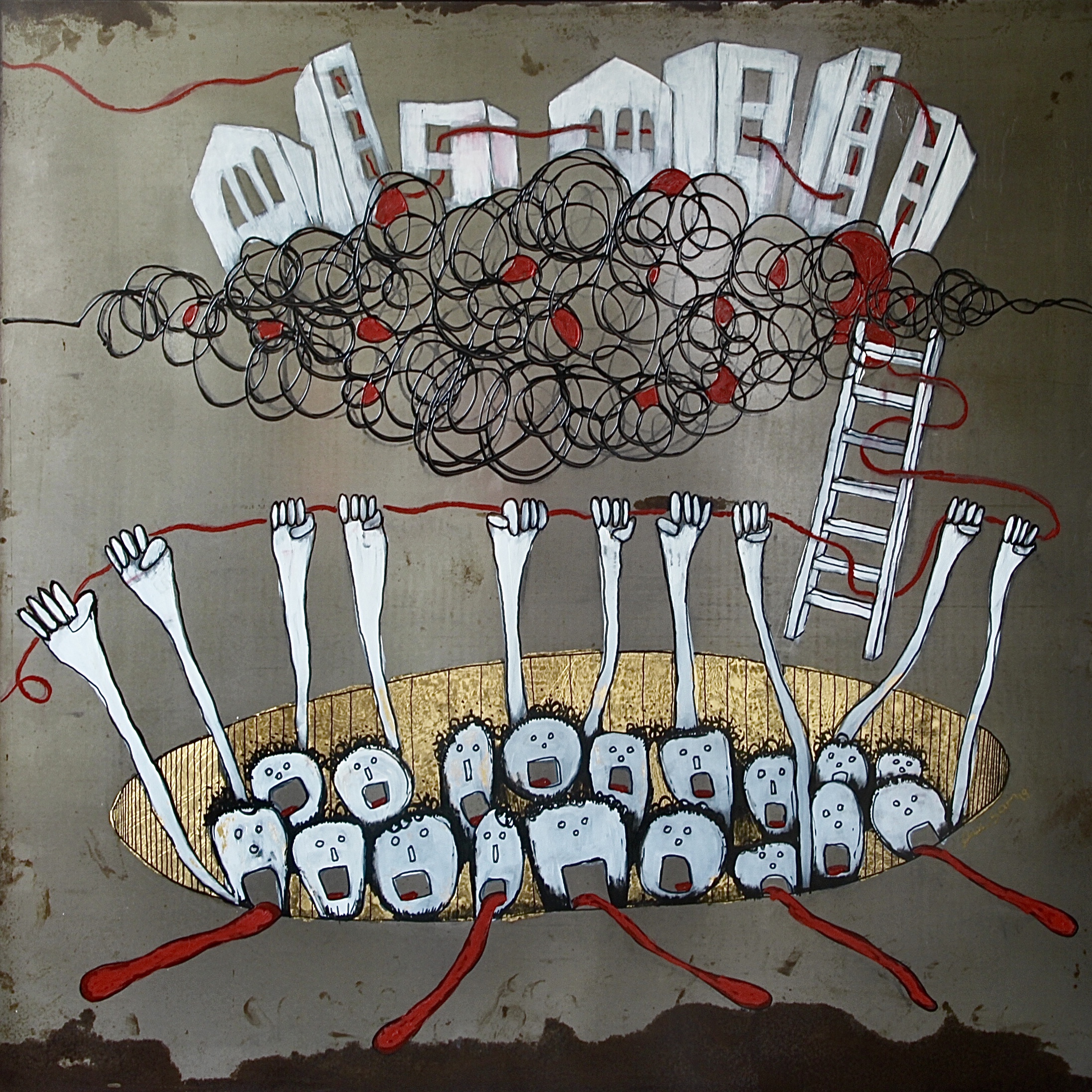
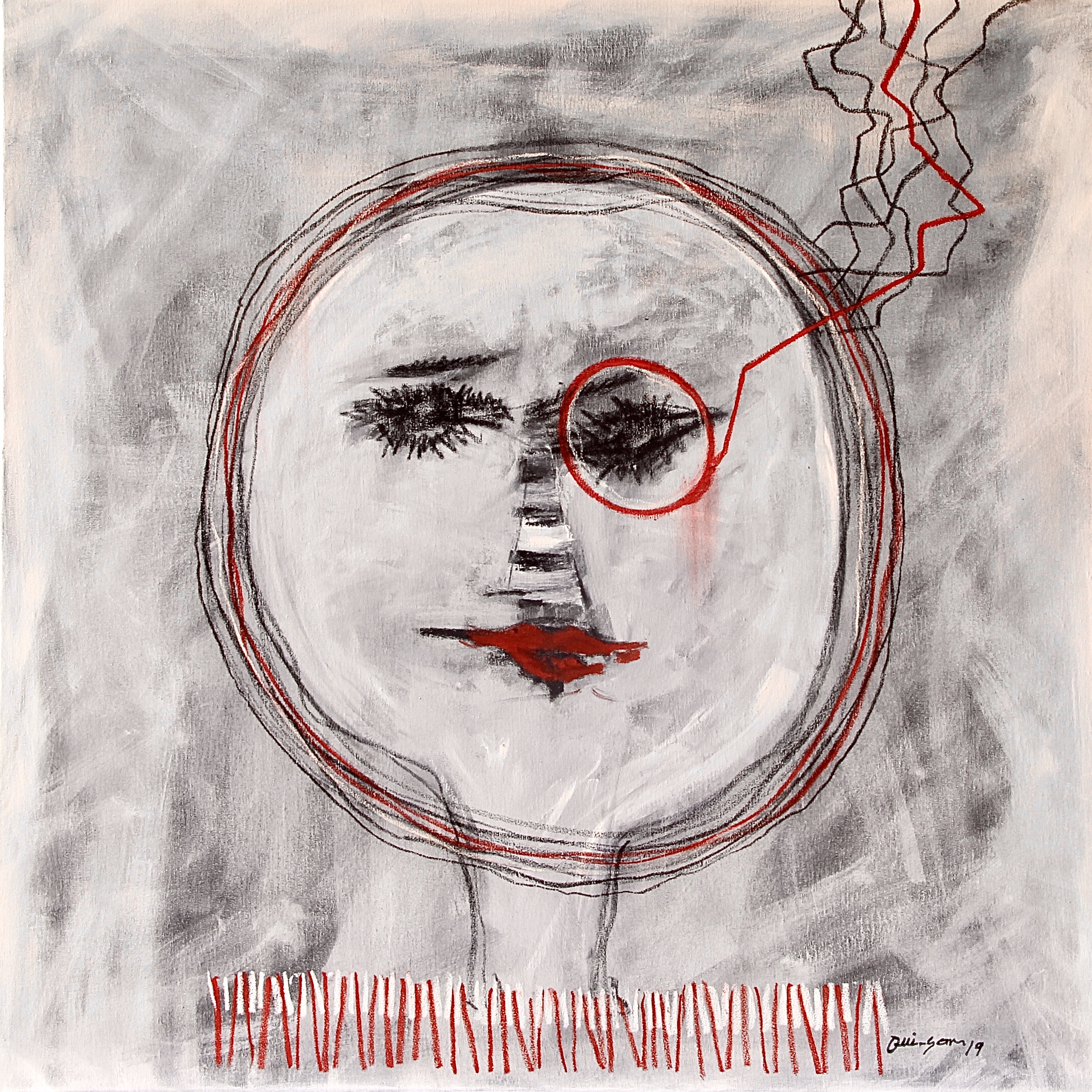
Melhem creates large scale paintings of 1 x 1m and 2 x 1m on both canvas and steel, launching his series “Emancipation,” which he began in 2019. He uses acrylics, oil, pastels and charcoal, and sometimes gold leaf. After creating many sketches, Wissam improvises on the canvas, experimenting with the materials, colors and textures. In many ways, Wissam is a storyteller, and the outcome of his artistic process is a piece that is the protagonist of his stories.
“Emancipation” was born in Beirut in 2019. Eventually, the country was heading for a big change.
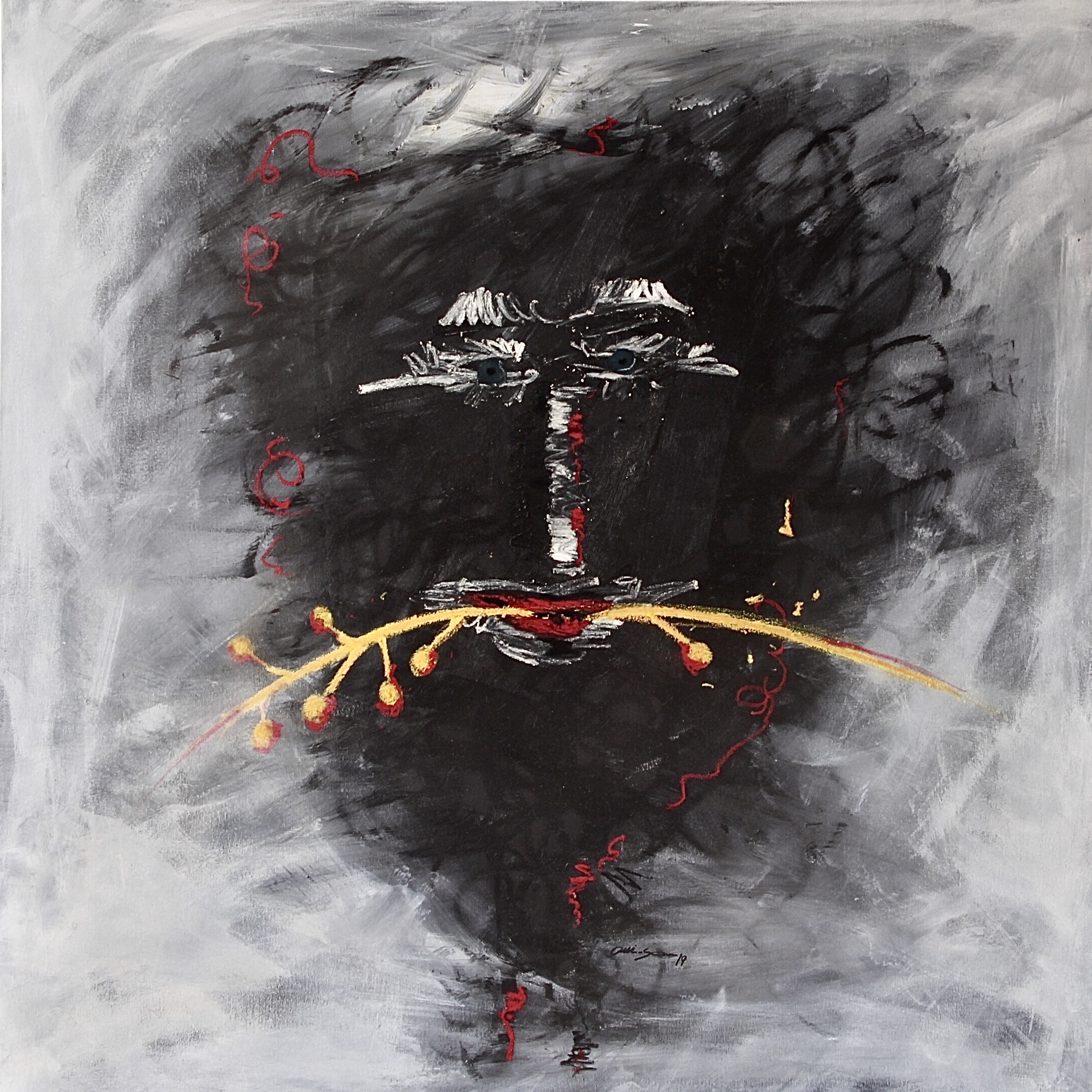
“I had something else on the canvas that day. It was a sketch, a croquis,” the artist relates. “It was the 17th of October (2019). I was painting. I looked at the television and I saw the news.” Images of burning tires and fires, ubiquitous on the news and social media, eventually re-appeared on Wissam’s canvas as a face emerging from smog. “This black image was always in front of me, until the first few days of the revolution passed. Eventually hope appeared, hope for a better future for Lebanon. Consequently, I added the gold line as a symbol for this hope.”
Melhem continues to create works for “Emancipation” in these challenging times. His experience as a Lebanese citizen, and as a designer and educator, finds a voice in his artwork. The main imagies that appears are figural (whether individuals or groups of people) and urban (the city). Melhem is commenting on both the individual and collective experiences, as well as the relations between the ruling class and the people. The work is multi-faceted; social and cultural references continue to emerge. The messages of the artworks are open to interpretation, and the viewer can either enjoy them on an intellectual level or appreciate the aesthetics of the design aspect. In this sense, the work is transcultural and can be appreciated beyond its local context.
Melhem has many sources of inspiration for his art. Immersing himself in research, he discovered the works of the American artist Jean-Michel Basquiat (1960 – 1988). Basquiat also used his art to voice his thoughts and feelings towards his contemporary context, and his work has been described as inventive and impactful, and employing both design and gesture. Melhem also finds inspiration from his architectural training and practice. His style can be best described as Neo-Expressionist, but in a contemporary context. Additionally, there are tendencies towards Symbolism in his choices of recurrent imagery and archetypes.
Melhem’s work sets out to appeal to the wider Lebanese public, at HOME and abroad, in addition to the global community. His is the story of an artist at HOME with a vision of hope.
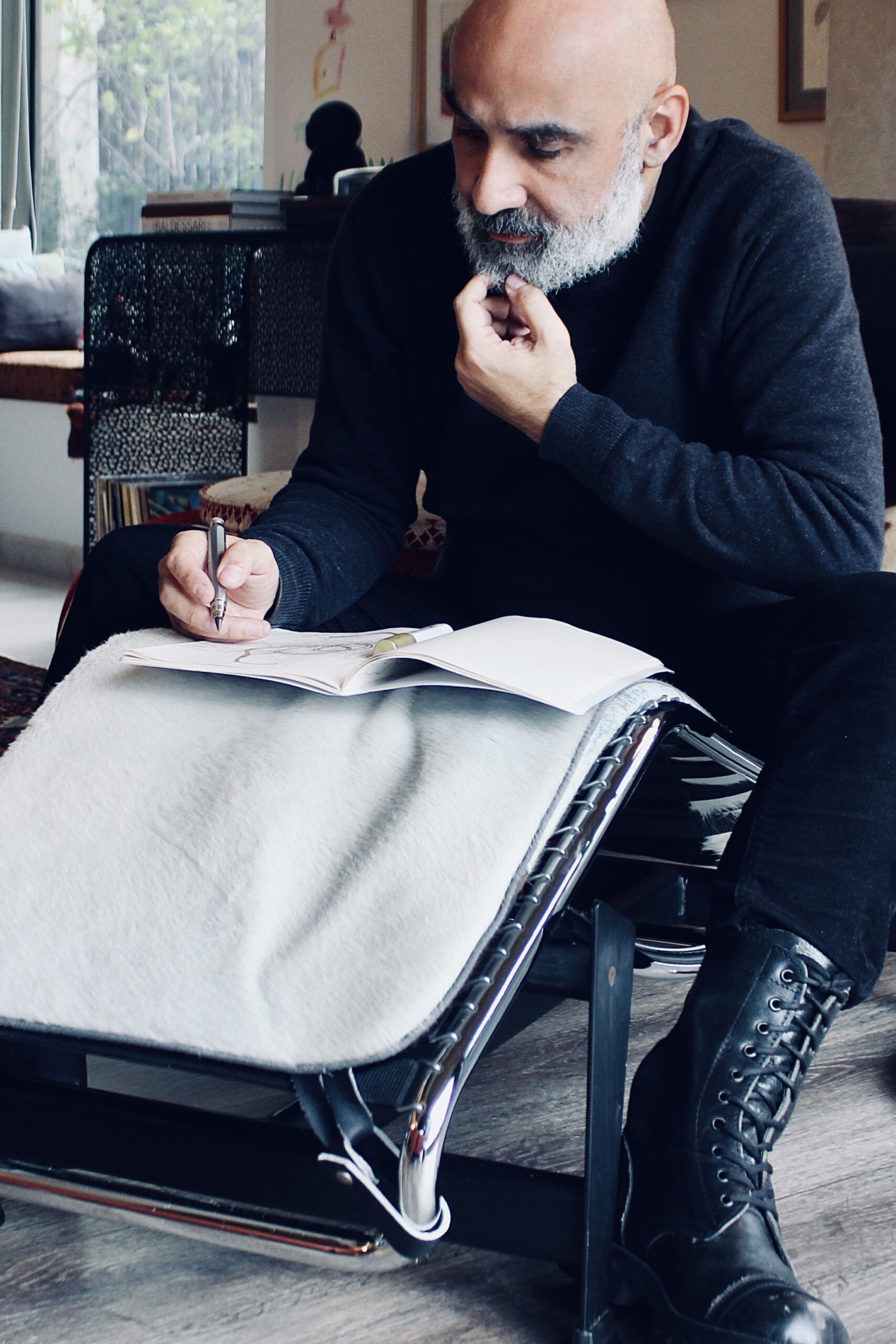
Wissam Melhem will be exhibiting his series “Emancipation” for the first time at Art on 56th Gallery in Gemmayze, Beirut. The opening is scheduled for June 19, 2020.
HOMEland Magazine
We firmly believe that the internet should be available and accessible to anyone, and are committed to providing a website that is accessible to the widest possible audience, regardless of circumstance and ability.
To fulfill this, we aim to adhere as strictly as possible to the World Wide Web Consortium’s (W3C) Web Content Accessibility Guidelines 2.1 (WCAG 2.1) at the AA level. These guidelines explain how to make web content accessible to people with a wide array of disabilities. Complying with those guidelines helps us ensure that the website is accessible to all people: blind people, people with motor impairments, visual impairment, cognitive disabilities, and more.
This website utilizes various technologies that are meant to make it as accessible as possible at all times. We utilize an accessibility interface that allows persons with specific disabilities to adjust the website’s UI (user interface) and design it to their personal needs.
Additionally, the website utilizes an AI-based application that runs in the background and optimizes its accessibility level constantly. This application remediates the website’s HTML, adapts Its functionality and behavior for screen-readers used by the blind users, and for keyboard functions used by individuals with motor impairments.
If you’ve found a malfunction or have ideas for improvement, we’ll be happy to hear from you. You can reach out to the website’s operators by using the following email
Our website implements the ARIA attributes (Accessible Rich Internet Applications) technique, alongside various different behavioral changes, to ensure blind users visiting with screen-readers are able to read, comprehend, and enjoy the website’s functions. As soon as a user with a screen-reader enters your site, they immediately receive a prompt to enter the Screen-Reader Profile so they can browse and operate your site effectively. Here’s how our website covers some of the most important screen-reader requirements, alongside console screenshots of code examples:
Screen-reader optimization: we run a background process that learns the website’s components from top to bottom, to ensure ongoing compliance even when updating the website. In this process, we provide screen-readers with meaningful data using the ARIA set of attributes. For example, we provide accurate form labels; descriptions for actionable icons (social media icons, search icons, cart icons, etc.); validation guidance for form inputs; element roles such as buttons, menus, modal dialogues (popups), and others. Additionally, the background process scans all the website’s images and provides an accurate and meaningful image-object-recognition-based description as an ALT (alternate text) tag for images that are not described. It will also extract texts that are embedded within the image, using an OCR (optical character recognition) technology. To turn on screen-reader adjustments at any time, users need only to press the Alt+1 keyboard combination. Screen-reader users also get automatic announcements to turn the Screen-reader mode on as soon as they enter the website.
These adjustments are compatible with all popular screen readers, including JAWS and NVDA.
Keyboard navigation optimization: The background process also adjusts the website’s HTML, and adds various behaviors using JavaScript code to make the website operable by the keyboard. This includes the ability to navigate the website using the Tab and Shift+Tab keys, operate dropdowns with the arrow keys, close them with Esc, trigger buttons and links using the Enter key, navigate between radio and checkbox elements using the arrow keys, and fill them in with the Spacebar or Enter key.Additionally, keyboard users will find quick-navigation and content-skip menus, available at any time by clicking Alt+1, or as the first elements of the site while navigating with the keyboard. The background process also handles triggered popups by moving the keyboard focus towards them as soon as they appear, and not allow the focus drift outside it.
Users can also use shortcuts such as “M” (menus), “H” (headings), “F” (forms), “B” (buttons), and “G” (graphics) to jump to specific elements.
We aim to support the widest array of browsers and assistive technologies as possible, so our users can choose the best fitting tools for them, with as few limitations as possible. Therefore, we have worked very hard to be able to support all major systems that comprise over 95% of the user market share including Google Chrome, Mozilla Firefox, Apple Safari, Opera and Microsoft Edge, JAWS and NVDA (screen readers).
Despite our very best efforts to allow anybody to adjust the website to their needs. There may still be pages or sections that are not fully accessible, are in the process of becoming accessible, or are lacking an adequate technological solution to make them accessible. Still, we are continually improving our accessibility, adding, updating and improving its options and features, and developing and adopting new technologies. All this is meant to reach the optimal level of accessibility, following technological advancements. For any assistance, please reach out to