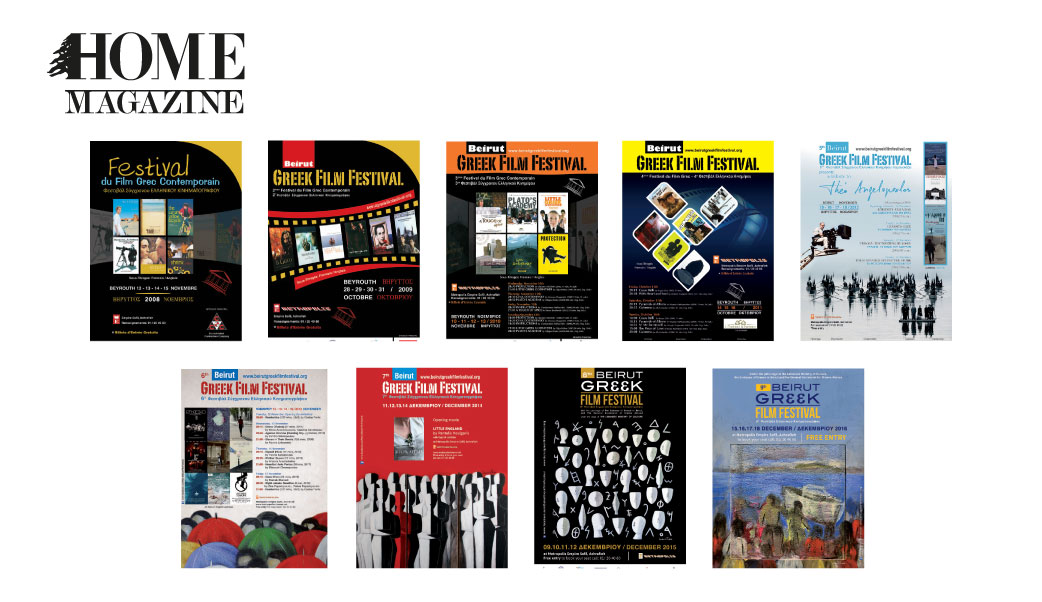
The League of Lebanese Graduates from Greek Universities (LLGGU) announces the 10th edition of Beirut Greek Film Festival.
Article by: Paula Nassif
Dr Georges Scheib, president of the LLGGU, is putting the final touches on the 10th edition of the event that has become an annual reminder of cultural bonds between Lebanon and Greece. The festival will take place in November 2017 at Metropolis Empire Sofil – cinema and will feature an exciting new project.
How it all began
Dr Georges Scheib is a well-known orthodontist who studied in Greece and developed a passion for the Hellenic culture and specifically the art of cinema. On a visit to Paris, he was inspired by an advert for a Greek film festival and decided to export the idea to LebanMn as well. The festival is a chance for Lebanese audiences to embrace the Greek culture through Greek movies – a concept that is already happening in many countries around the world. Back in 2007, Scheib proposed the project to the Greek Ambassador, H.E. Panos Kalogeropoulos, who greatly appreciated the initiative and offered his immediate support.
The Ministry of Culture in Lebanon quickly joined the team and became a solid partner giving its patronage together with the Greek Embassy in making the festival come to life every year.
Today, Beirut Greek Film Festival is also under the aegis of the General Secretariat for Greeks Abroad of the Greek Ministry of Foreign Affairs. In partnership with the Greek Community of Beirut, and with the valuable support of the sponsors, the league has successfully achieved its goal for the past 10 years.

The selection of the movies
Every year, the Greek Film Center (GFC) proposes to the Festival a list of movies, which Dr Scheib and the organizing committee view carefully before they select the ones that will be featured in the festival. The panel makes sure that the selection includes a variety of themes and genres.
What makes the 10th edition special to the founder?
Georges Scheib tells us that Beirut Greek Film Festival is his “baby” that has been “nurtured” and grew over 10 years. Today Dr Scheib is proud of the overall accomplishments of the Beirut Greek Film Festival, as he has witnessed the appreciation and attachment of the Lebanese audiences to the event. Dr Scheib describes the Lebanese public as loyal and open to the Greek culture; without their appreciation throughout the years, there wouldn’t have been a 10th edition.

Lebanese-Greek bonds
Beirut Greek Film Festival keeps on proving over the years its ability in strengthening the cultural bonds between the two countries but also, and most importantly, the emotional bonds. The Lebanese public is welcoming the Hellenic culture. Greek directors have also built a strong attachment to their presence in Lebanon. Take Tasos Boulmetis, for example, the director of “A Touch of Spice” (screened in 2010). Boulmetis, who had the opportunity to meet the Lebanese spectators, speaks of the overwhelming enthusiasm they showed for his movie, which made him eagerly accept that his last work, “Mythopathy” be showcased in the premiere of last year’s Festival edition.
A new project
The LLGGU and the organizing committee of the Festival is announcing a short movie competition that will allow young movie makers from Greece and Lebanon to compete for the chance to win financial support to realize their work. Two winning short movies, one from each country, will be selected by a jury of experts and will receive a cash prize. Around 12 of the many competing projects will be screened during the three days of the Festival. Every movie addict and all the fans of cinema who have a passion for the film industry are eligible to participate in this exciting competition.

HOMEland Magazine
We firmly believe that the internet should be available and accessible to anyone, and are committed to providing a website that is accessible to the widest possible audience, regardless of circumstance and ability.
To fulfill this, we aim to adhere as strictly as possible to the World Wide Web Consortium’s (W3C) Web Content Accessibility Guidelines 2.1 (WCAG 2.1) at the AA level. These guidelines explain how to make web content accessible to people with a wide array of disabilities. Complying with those guidelines helps us ensure that the website is accessible to all people: blind people, people with motor impairments, visual impairment, cognitive disabilities, and more.
This website utilizes various technologies that are meant to make it as accessible as possible at all times. We utilize an accessibility interface that allows persons with specific disabilities to adjust the website’s UI (user interface) and design it to their personal needs.
Additionally, the website utilizes an AI-based application that runs in the background and optimizes its accessibility level constantly. This application remediates the website’s HTML, adapts Its functionality and behavior for screen-readers used by the blind users, and for keyboard functions used by individuals with motor impairments.
If you’ve found a malfunction or have ideas for improvement, we’ll be happy to hear from you. You can reach out to the website’s operators by using the following email
Our website implements the ARIA attributes (Accessible Rich Internet Applications) technique, alongside various different behavioral changes, to ensure blind users visiting with screen-readers are able to read, comprehend, and enjoy the website’s functions. As soon as a user with a screen-reader enters your site, they immediately receive a prompt to enter the Screen-Reader Profile so they can browse and operate your site effectively. Here’s how our website covers some of the most important screen-reader requirements, alongside console screenshots of code examples:
Screen-reader optimization: we run a background process that learns the website’s components from top to bottom, to ensure ongoing compliance even when updating the website. In this process, we provide screen-readers with meaningful data using the ARIA set of attributes. For example, we provide accurate form labels; descriptions for actionable icons (social media icons, search icons, cart icons, etc.); validation guidance for form inputs; element roles such as buttons, menus, modal dialogues (popups), and others. Additionally, the background process scans all the website’s images and provides an accurate and meaningful image-object-recognition-based description as an ALT (alternate text) tag for images that are not described. It will also extract texts that are embedded within the image, using an OCR (optical character recognition) technology. To turn on screen-reader adjustments at any time, users need only to press the Alt+1 keyboard combination. Screen-reader users also get automatic announcements to turn the Screen-reader mode on as soon as they enter the website.
These adjustments are compatible with all popular screen readers, including JAWS and NVDA.
Keyboard navigation optimization: The background process also adjusts the website’s HTML, and adds various behaviors using JavaScript code to make the website operable by the keyboard. This includes the ability to navigate the website using the Tab and Shift+Tab keys, operate dropdowns with the arrow keys, close them with Esc, trigger buttons and links using the Enter key, navigate between radio and checkbox elements using the arrow keys, and fill them in with the Spacebar or Enter key.Additionally, keyboard users will find quick-navigation and content-skip menus, available at any time by clicking Alt+1, or as the first elements of the site while navigating with the keyboard. The background process also handles triggered popups by moving the keyboard focus towards them as soon as they appear, and not allow the focus drift outside it.
Users can also use shortcuts such as “M” (menus), “H” (headings), “F” (forms), “B” (buttons), and “G” (graphics) to jump to specific elements.
We aim to support the widest array of browsers and assistive technologies as possible, so our users can choose the best fitting tools for them, with as few limitations as possible. Therefore, we have worked very hard to be able to support all major systems that comprise over 95% of the user market share including Google Chrome, Mozilla Firefox, Apple Safari, Opera and Microsoft Edge, JAWS and NVDA (screen readers).
Despite our very best efforts to allow anybody to adjust the website to their needs. There may still be pages or sections that are not fully accessible, are in the process of becoming accessible, or are lacking an adequate technological solution to make them accessible. Still, we are continually improving our accessibility, adding, updating and improving its options and features, and developing and adopting new technologies. All this is meant to reach the optimal level of accessibility, following technological advancements. For any assistance, please reach out to