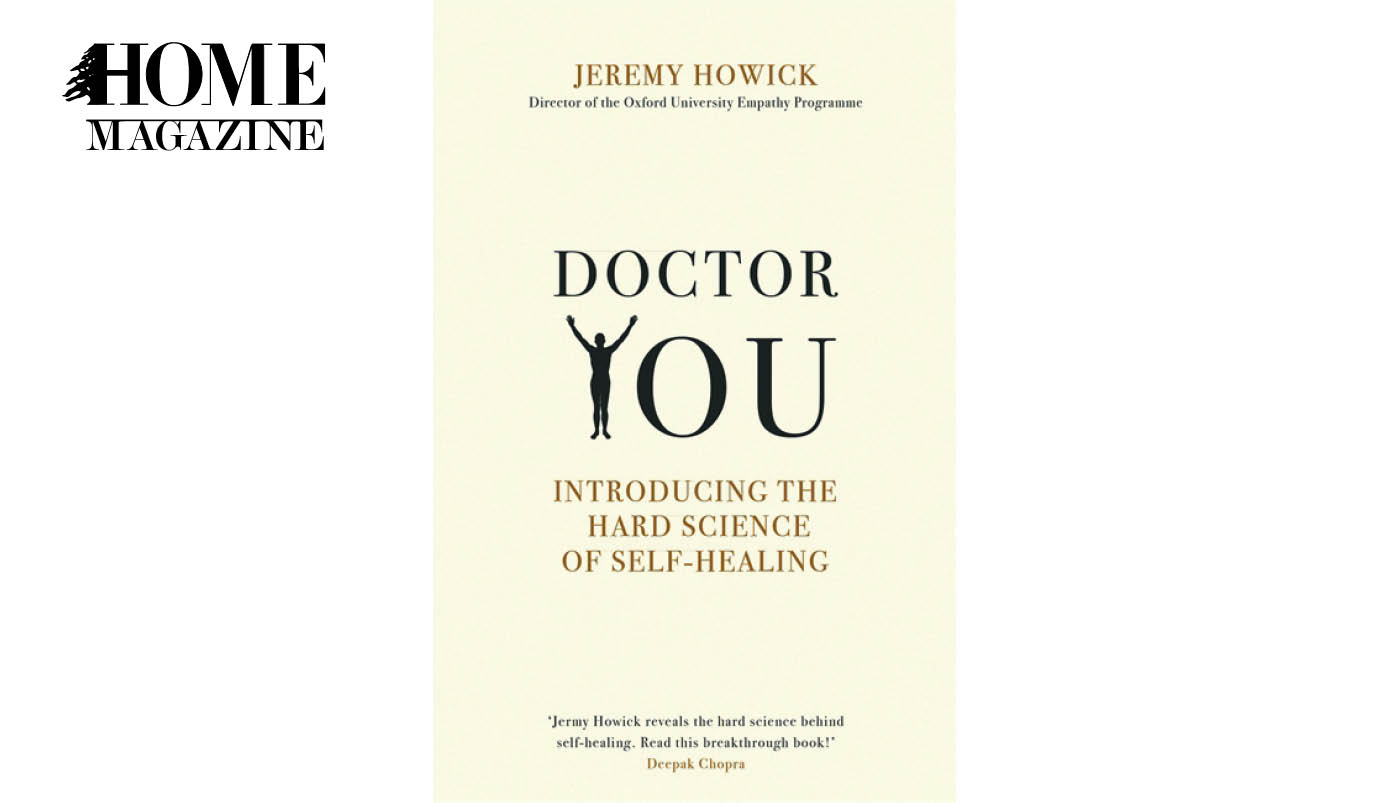
Jeremy Howick says we don’t always need medicine to get well, a lesson he learned from a cup of tea.
Article by: Niamh Fleming-Farrell
This is a story about how an allergy to a cat altered the course of a young man’s life. It begins with a cup of ginger tea.
In the early 1990s, Jeremy Howick, a competitive rower, hoped to win a spot on the Canadian national rowing team. He had been on the team at the prestigious Dartmouth College, where he graduated with a bachelor’s degree in engineering in 1992. Then he went back to his native Montreal (his great grandparents immigrated to Canada from Lebanon) with aspirations of being an investment banker.
But first, he focused on making the team.
Developing an allergy to his mother’s cat while living at HOME created a big problem. Howick was anxious about taking medication to treat it lest he inadvertently ingest any banned substance that would trip him up in a mandatory drug test for national team members.
Desperate for relief, Howick took his mother’s advice and went to see an herbal doctor she knew.
“We talked about my symptoms, the stress of being ill and the hyper-competitiveness of top-level rowing. After an hour of talking, I felt very calm and she gave me her prescription,” Howick wrote in the preface to his recently published book, “Doctor You.” “She told me to keep my head and neck warm, and to drink ginger tea twice per day.”
Not quite convinced, but willing to try the undemanding regime, Howick wore a scarf and drank some tea. Miraculously, it did the trick. And Howick competed for Canada in the 1994 World Rowing Championships.
But back to that cup of tea.
“What was it about the ginger tea? Was it a placebo? If it was, how do we test that?” These questions put Howick on a different life path, he told HOME magazine. Investment banking was soon shelved. He found himself moving to England to pursue a graduate degree in philosophy at the University of Oxford, then to the London School of Economics, where he earned a doctorate in the philosophy of medicine. Later, he became a researcher at Oxford University.
“Doctors can affect your illness just by the way they communicate.”
In the past decade, Howick conducted numerous studies on the impact of placebos and doctor attitudes in patient care, and published more than 75 academic papers. However, his “aim has always been to share what I’ve learned with the biggest audience possible,” and his latest publication, “Doctor You,” does just that.
“Doctor You” was published in October and promptly went to No. 1 in its category on Amazon. The popular science book wants “you, the reader, to be the protagonist,” Howick said.
It addresses “the hard science of self-healing,” said Howick. “What I want to get people thinking about is how our bodies are way more resilient than most people think … and that the doctor doesn’t need to give you a pill to have an effect. Doctors can affect your illness just by the way they communicate without giving you any pills,” he said. Studies indicate a doctor’s positive attitude positively impacts the prospects of the patient getting well again, and vice versa.

The overmedication problem
Howick hasn’t abandoned traditional medicine, but he does emphasize how as a society we’ve become overly dependent on pills and surgeries to solve our ailments.
“Instead of taking a rest, and a glass of water, we take Ibuprofen.”
“The overmedication problem is reaching astronomical proportions,” he said, mentioning the rise of antibiotic resistant superbugs, the rapidity with which most people will turn to aspirin to treat a headache — “instead of taking a rest and a glass of water, we take Ibuprofen” – and the treatment of viral infections, such as the common cold and flu, with antibiotic drugs, which simply have no effect.
“Bed rest cures the cold and flu,” he emphasized. “Half the elderly takes at least five medications a day,” Howick continued, adding that some trials have shown that by removing some of these medications, some patients do better. He referenced the growing opioid dependence in the U.S., saying, “Prescription painkillers kill more people than heroin and opium combined in the United States.”
Even when surgery seems necessary, Howick explained that, in some cases, a placebo surgery can avoid the need for the real thing. By making a small incision at the point of the problem, a doctor can trigger the patient’s brain response that remedies the problem.
In “Doctor You,” Howick shows that “many more conservative things can be as effective or cheaper (than prescription drugs) without the side effects or the costs. It contains chapters on your “inner healer” and on accessing the body’s “inner pharmacy.” Each chapter ends with exercises readers can use to help them learn how to treat themselves.
Lebanon needs to relax
When asked if he had any suggestions of particular interest to the Lebanese audience, he said, “We need to learn how to relax.”
“When you’re about to fight a wolf, it’s not in your body interest to start repairing itself at that moment.”
Lebanon, in spite of all its charms, gives us “a lot of reasons to be stressed out,” he said. “Under stress the body doesn’t rebuild itself or recover as well as it does when we’re relaxed.”
“When you’re stressed the fight or flight response is activated … (for example) when you’re about to fight a wolf, it’s not in your body’s interest to start repairing itself at that moment,” he said. “You don’t have to look at studies to know this is true, you feel it in your own body … it’s so obvious. … It’s just common sense.”
“You can’t get better evidence”
“What’s different about my book is that it is evidence based,” said Howick. “Everything I say is based on a system of randomized controlled trials — you can’t get better than that.”
For more info: http://amzn.to/2EW1DZ0.
Link to the book, Amazon UK page: https://www.amazon.co.uk/Doctor-You-Revealing-science-self-healing-ebook/dp/B01M1GZCR0/ref=tmm_kin_swatch_0?_encoding=UTF8&qid=&sr=
Kindle link:
Audiobook link:
Social media links:
- Twitter: @jeremyhowick, https://twitter.com/JeremyHowick
- Facebook: https://www.facebook.com/DrJeremyHowick/?ref=bookmarks
- LinkedIn: https://www.linkedin.com/in/jeremy-howick-6b138043
- Google+: https://plus.google.com/u/0/104014401309522265834
- Instagram: https://www.instagram.com/jeremyhowick/?hl=en
- Website: http://www.jeremyhowick.com



HOMEland THEMES
Coming Soon
HOMEland Events & Collaborations
Coming Soon
 Signature Boutique