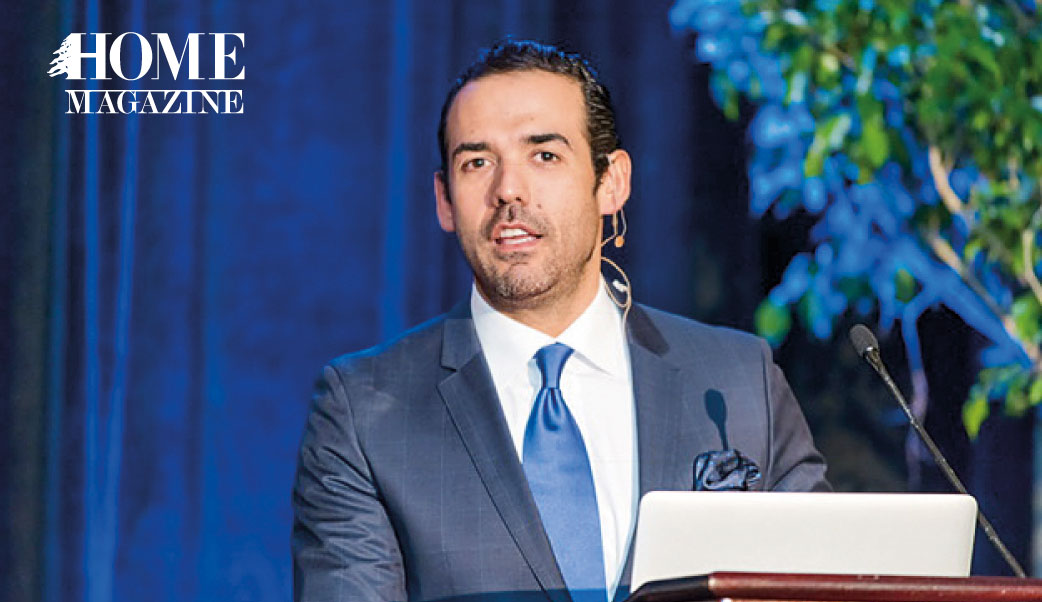
A journey of success will have ups and downs along the way. It needs determination, persistence, and belief. Doctor Gaby Moawad spoke to HOME about his inspiring journey.
A decision worth making
It all started when Dr. Gaby took the right decision. He was born in 1976 in Zgharta. After graduating from high school, he went on to study medicine at the Lebanese University, and completed a residency in Obstetrics and Gynecology at Balamand University. When the war broke out in 2006, he decided it was time for him to leave. “I didn’t want to bury my dreams in a cloudy future and I didn’t want my kids to experience such a turmoil,” he said.
It was a frantic time for Moawad as he tried to prepare for his new life in the US. “In just three months, I passed the required exams and I applied to The George Washington University (GW),” explains Moawad, “It was the toughest decision I ever took, and sometimes the toughest decision and the right one are the same”. Having already completed four years of residency in Lebanon, Dr. Moawad then repeated the whole process again at GW. “If you can dream it, you can do it, and giving up on your goals for one setback is like slashing your other three tires because you had a flat tire,” he adds. On a personal level, making the decision to redo his residency was only a mind obstacle. “The biggest obstacles in our lives are the barriers our mind creates, taking such decision was very hard because it was choosing whether to walk away from my dreams or try harder”. After making this decision, he had to prove himself right. “I’m not talented, I’m not a genius and not a special person. I’m simply a hard worker,” he admits. For him, that makes all the difference. Success needs perseverance, hard work and determination. Dr. Gaby Moawad is board-certified in Obstetrics and Gynecology. He completed an American Association of Laparoscopic Gynecologists (AAGL) fellowship in minimally invasive gynecologic surgery (MIGS), and he is also an Assistant Professor of Obstetrics & Gynecology at The George Washington University. He turned the “robotic gynecologic surgery” program at GW to one of the most successful programs in the US. For him, the place is not a key factor for success. Success depends on the person and not the place. “The only benefit America gave me was a bigger platform and more access to opportunities, I’m sure I would’ve succeeded even if I stayed in Lebanon.”
“I’m not talented, I’m not a genius and not a special person. I’m simply a hard worker.”

A small secret behind the success
The loss of his father, at age 16, was a major event that impacted his life. He found himself trying to overcome his grief and trying to be strong. It gave him a problem solving attitude. “Losing someone quickly turns your world into an unfamiliar place, I couldn’t let it take me hostage, I had to find a new identity that enabled me to pursue my dreams.” You will never succeed alone, It’s always about the team,” says Dr. Gaby. He believes that success is multifactorial. His family and friends always pushed him forward, his mentors and colleagues helped showing him the way.

Giving back to HOME
His love for Lebanon never faded, and giving back to the country was always a cardinal principle that he follows. In the pursuit of giving back, Moawad is currently working on to bring a surgical mission to Lebanon. This project will gather international surgeons who will come to Lebanon to help underserved and underprivileged women to get access to the highest standards of surgical care; “Access to healthcare is a human right, and should be for all, independent of their backgrounds, ethnicity, financial or social status.”
“When you reach the top, always remember to send the elevator back.”
A heartfelt advice
Dr. Gaby’s message to the Lebanese youth: “Focus on your dreams and remember that hard-work is the key to success”. He also asks them to love their country: “A person without a country is like someone without an identity.” And make sure you give back and keep in mind that “When you reach the top, always remember to send the elevator back.”

HOMEland Magazine
We firmly believe that the internet should be available and accessible to anyone, and are committed to providing a website that is accessible to the widest possible audience, regardless of circumstance and ability.
To fulfill this, we aim to adhere as strictly as possible to the World Wide Web Consortium’s (W3C) Web Content Accessibility Guidelines 2.1 (WCAG 2.1) at the AA level. These guidelines explain how to make web content accessible to people with a wide array of disabilities. Complying with those guidelines helps us ensure that the website is accessible to all people: blind people, people with motor impairments, visual impairment, cognitive disabilities, and more.
This website utilizes various technologies that are meant to make it as accessible as possible at all times. We utilize an accessibility interface that allows persons with specific disabilities to adjust the website’s UI (user interface) and design it to their personal needs.
Additionally, the website utilizes an AI-based application that runs in the background and optimizes its accessibility level constantly. This application remediates the website’s HTML, adapts Its functionality and behavior for screen-readers used by the blind users, and for keyboard functions used by individuals with motor impairments.
If you’ve found a malfunction or have ideas for improvement, we’ll be happy to hear from you. You can reach out to the website’s operators by using the following email
Our website implements the ARIA attributes (Accessible Rich Internet Applications) technique, alongside various different behavioral changes, to ensure blind users visiting with screen-readers are able to read, comprehend, and enjoy the website’s functions. As soon as a user with a screen-reader enters your site, they immediately receive a prompt to enter the Screen-Reader Profile so they can browse and operate your site effectively. Here’s how our website covers some of the most important screen-reader requirements, alongside console screenshots of code examples:
Screen-reader optimization: we run a background process that learns the website’s components from top to bottom, to ensure ongoing compliance even when updating the website. In this process, we provide screen-readers with meaningful data using the ARIA set of attributes. For example, we provide accurate form labels; descriptions for actionable icons (social media icons, search icons, cart icons, etc.); validation guidance for form inputs; element roles such as buttons, menus, modal dialogues (popups), and others. Additionally, the background process scans all the website’s images and provides an accurate and meaningful image-object-recognition-based description as an ALT (alternate text) tag for images that are not described. It will also extract texts that are embedded within the image, using an OCR (optical character recognition) technology. To turn on screen-reader adjustments at any time, users need only to press the Alt+1 keyboard combination. Screen-reader users also get automatic announcements to turn the Screen-reader mode on as soon as they enter the website.
These adjustments are compatible with all popular screen readers, including JAWS and NVDA.
Keyboard navigation optimization: The background process also adjusts the website’s HTML, and adds various behaviors using JavaScript code to make the website operable by the keyboard. This includes the ability to navigate the website using the Tab and Shift+Tab keys, operate dropdowns with the arrow keys, close them with Esc, trigger buttons and links using the Enter key, navigate between radio and checkbox elements using the arrow keys, and fill them in with the Spacebar or Enter key.Additionally, keyboard users will find quick-navigation and content-skip menus, available at any time by clicking Alt+1, or as the first elements of the site while navigating with the keyboard. The background process also handles triggered popups by moving the keyboard focus towards them as soon as they appear, and not allow the focus drift outside it.
Users can also use shortcuts such as “M” (menus), “H” (headings), “F” (forms), “B” (buttons), and “G” (graphics) to jump to specific elements.
We aim to support the widest array of browsers and assistive technologies as possible, so our users can choose the best fitting tools for them, with as few limitations as possible. Therefore, we have worked very hard to be able to support all major systems that comprise over 95% of the user market share including Google Chrome, Mozilla Firefox, Apple Safari, Opera and Microsoft Edge, JAWS and NVDA (screen readers).
Despite our very best efforts to allow anybody to adjust the website to their needs. There may still be pages or sections that are not fully accessible, are in the process of becoming accessible, or are lacking an adequate technological solution to make them accessible. Still, we are continually improving our accessibility, adding, updating and improving its options and features, and developing and adopting new technologies. All this is meant to reach the optimal level of accessibility, following technological advancements. For any assistance, please reach out to