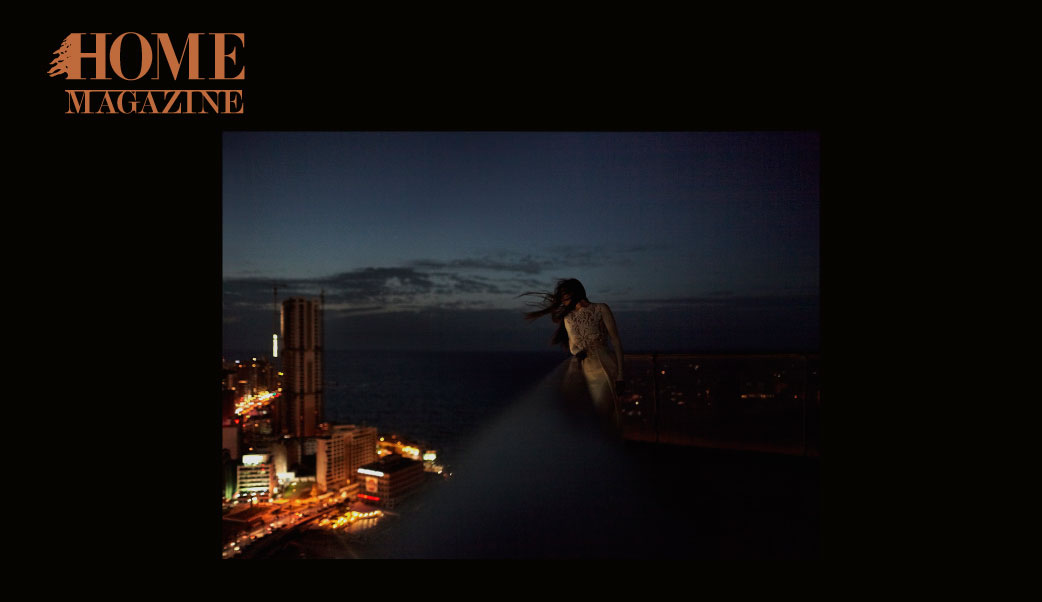
For part of this year’s Beirut Art Fair, the house of ELIE SAAB presented UNLIGHT/SUNLIGHT, a photo exhibition byaward-winning France-based visual artist Evangelia Kranioti, capturing the aesthetic dialogue between Beirut’s architecture and landscapes and the female figure, in a charming duality where past meets present and light meets dark.
Kranioti was awarded both the Special Prize of the Photography Jury at the 30th Hyères International Festival of Fashion and Photography for her extended maritime photographic journey, travelling extensively by sea, in view of her Greek origins and attachment to the sea, to chronicle the lives of sailors through her lens. She is the first ever recipient of the newly established Elie Saab Grant for Photography within the festival, which includes artistic residency in Beirut.
Kranioti studied piano at the National Conservatory of Athens and the Greek-born artist went on to pursue her degree in law just before earning her BA in Visual Arts & Prints, followed by an MA in Editorial Design from the École Nationale Supérieure des Arts Décoratifs of Paris.
“As an art enthusiast, Elie Saab is passionate about design in all its forms: from fashion and sculpture to architecture and photography,” MENA Communications Manager at ELIE SAAB Rafif Safadi told HOME. “The house of ELIE SAAB is proud to support upcoming talent through the International Festival of Fashion and Photography in Hyères.”
The House does not interfere with the choice of jury, since it acts as a sponsor and partner and not as part of the jury. The House gets to solely determine the winner of the ELIE SAAB prize winner based on a number of established criteria. And building on his vision of Beirut as a city of rich cultural heritage that never ceases to inspire his work, Saab chose to incorporate artistic residency into the self-titled grant.
“Mr. Saab is passionate about exploring this culture not only through fashion but also across different mediums of art and by inviting different artists to the city, he hopes to broaden the public’s horizons and perceptions of Beirut,” Safadi explained.
Following her win, Kranioti, the first ever recipient of the ELIE SAAB grant, visited Beirut to work on an exceptional photographic series whereby she was able to revive the city’s abandoned buildings and architectural structures by infusing each of them with a beautifully articulated female silhouette adorned with Saab’s mesmerizing creations.

“I wanted to create a story between fashion and fiction, with the city and the female figure as the main protagonists,” she noted. “I also wanted to explore the contrast between past/present, light/ shadow, and the vision of women in abandoned, unexpected places.
Kranioti’s flow of inspiration began on her way from the airport to the city. While observing the urban landscape from the car window, she was instantly struck by blocks of flats and their long tarpaulins blowing in the wind from the balconies on the first densely populated district she encountered.
“There was something cinematographic and epic about this arrangement, bringing to mind a series of futuristic visions from Blade Runner to Mad Max. But there was also something very feminine about it; almost like a fantasy of the city, of extraordinary gowns suspended from verandas, of women waiting for the afternoon to fall,” she observed.
But it is precisely Beirut’s modern architecture that still exudes the subtle scent of its past which provided Kranioti with a unique backdrop for her UNLIGHT/SUNLIGHT photographic scenarios, as she got to experiment with haute couture dresses in an outdoor documentary photography style that wouldn’t have been navigable elsewhere.
“Once I got familiar with the city’s landmarks, decided to work within symbolic zones and buildings bearing a certain history. This involved a lot of exploring mainly abandoned places,” her interview for the Light of Now reads. Yet it was the legendary Holiday Inn, a monumental landmark of the Lebanese civil war, that marked her the most since she set foot inside it.

“Beirut proved sumptuous in its duality; between presence and absence, light and darkness,” Kranioti wrote. “A Mediterranean landscape of science fiction which I cannot say whether the remains dated from the past or the future.”
“Beirut proved sumptuous in its duality; between presence and absence, light and darkness”
And with her subtle eye for detail and curious sense of adventure, she was able to paint the city in both its attachment and denial of the past, all while illustrating its fervent desire to move ahead, in her large -scale photographs that constituted a visually compelling and critically acclaimed staple of the Beirut Art Fair.
“A few kilometers north or south of this land, conflicts are always lurking. While Beirut dances defying the abyss, like an elegant figure moving straight forward inside the din of history,” her description beautifully concludes.
“Beirut dances defying the abyss, like an elegant figure moving straight forward inside the din of history”
As she proceeds to travel the world in quest for more art and inspiration to come, Beirut remains a minuscule “kaleidoscope full of contrasts” to her that, despite its 10,452 square kilometer surface, fits perfectly for one to experience the world.
HOMEland THEMES
Coming Soon
HOMEland Events & Collaborations
Coming Soon
 Signature Boutique