
HOMEland THEMES
Coming Soon
HOMEland Events & Collaborations
Coming Soon
 Signature Boutique

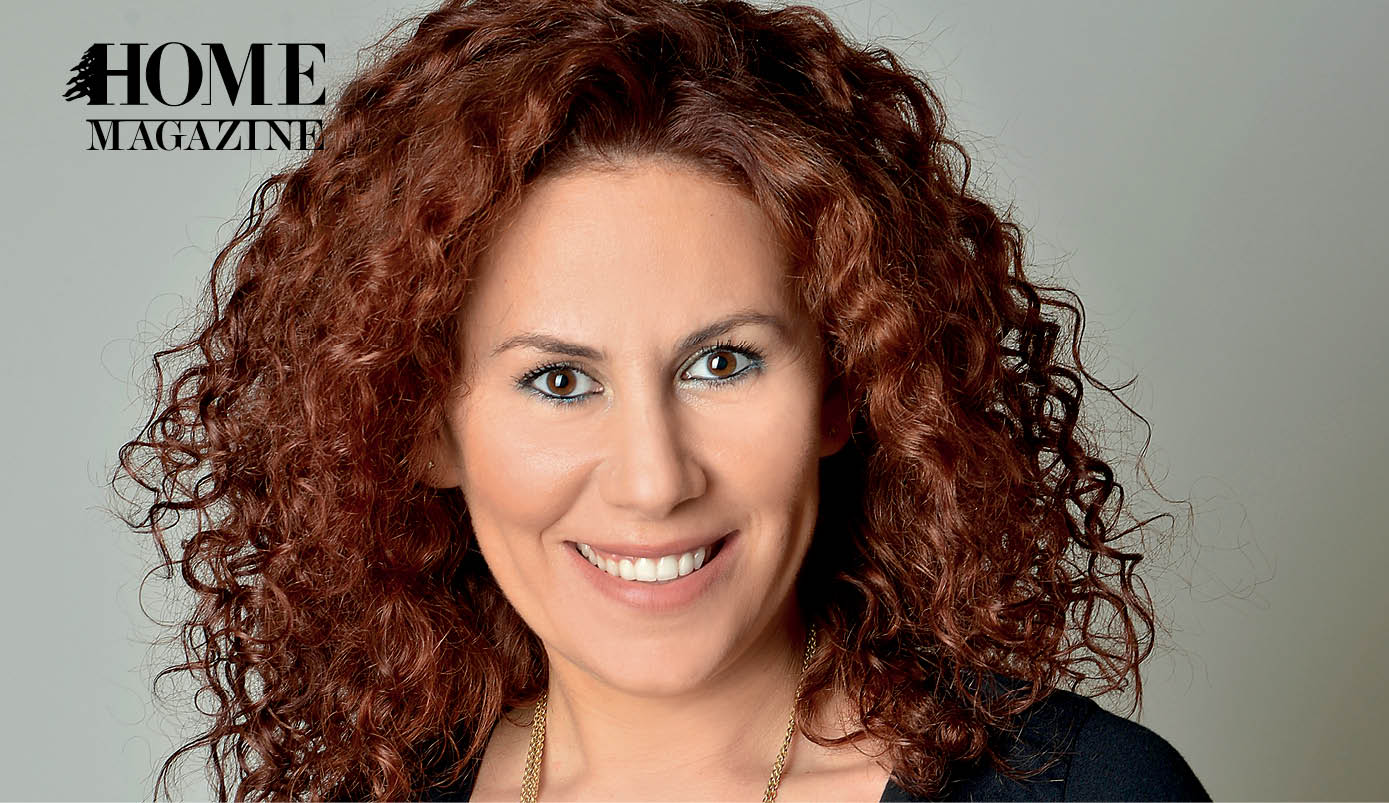
Elsa Yazbek Charabati blended a love of languages and travel into a successful career as a journalist and educator.
Photo by: Colette Tabet
Lebanese journalist Elsa Yazbek Charabati started her TV career at the young age of 20 and has forged a distinguished path in the field with passion and dedication ever since. In a heartfelt chat with HOME, she revisited key professional milestones, weighed in on the current state of Lebanese media and unveiled compelling layers of her personality.
Television, travel and tastefulness
While still a university student, Charabati joined Future TV as a French news bulletin presenter, where she worked for 10 years, prior to moving to MTV. “I served as anchor, reporter and editor-in-chief of the French news back then, and had the opportunity to interview highly influential figures, such as French President Jacques Chirac, whom I interviewed at the Élysée Palace in 2000 when I was only 21. It was just a year after I had interviewed Prince Albert II de Monaco at the Monaco Palace,” she told HOME.
Besides the French bulletin, she also presented francophone programs like ‘Trait d’Union,” shedding light on the link between France and Lebanon, and “De Chez Nous,” a series of daily short episodes airing before the prime-time news that showcased exceptional Lebanese French-speakers, one portrait at a time.
Following her shift to MTV, the dynamic journalist Charabati channeled her passion for travel and adventure into a one-off travel segment titled “Voyage Voyage,” which has been going strong for five years on MTV Alive. “The idea was conceived by me from A to Z. I love travelling and people were always asking me about places to visit and things to do. So, I decided to turn this into a dynamic segment where I talk about my own trips and interview guests who went on interesting adventures,” she explained.
Another staple of her TV career is “Bi Kell Fakher,” a documentary-style show, composed of special episodes, where she conducts in-depth interviews with internationally successful personalities of Lebanese origin. “This program started four years ago, and is all about being Lebanese and proud to be. It traces the success stories of key figures whom people would love to get to know more. It has featured French-Lebanese writer Amin Maalouf, fashion designer Elie Saab and Patriarch Bechara Boutros al Rahi.”
As a person who has always been passionate about reading and culture, Charabati covers the Salon du Livre yearly in intensive day-to-day coverage, dubbed “Ensemble au Salon,” where she chats with writers, publishers, educators and artists during the event. “For me, culture should not be presented in a boring way. I always like to transform it into something interesting, and to make sure to read every book I talk about, for the writers to feel valued and for the conversation to be deeper,” she explained.
Professionalism, passion and principles
Charabati’s hybrid academic background – as both a journalist and translator – was a key factor in her success. She holds a master’s degree in translation from Université Saint-Joseph, where she also serves as director of the interpretation department, and a master’s degree in journalism from the Lebanese University, in partnership with Paris-Sorbonne University and the Centre de formation et de perfectionnement des journalistes.
“I love my students and I don’t want them to fall into the trap of plastic surgery and stereotypes.”
“I fuse the two in my work,” she said.
Her love for languages and culture knows no boundaries. She has mastered Arabic, English, French and Spanish, speaks Japanese, and works as a correspondent for Radio Exterior de España. “I love traveling and use my languages to explore new cultures. I also love writing, and publish articles in both print and online press,” she noted.
And while this senior journalist said she always seeks top quality content and images, and is very picky with everything she does, she believes passion to be her most valuable quality as a journalist. “I am so passionate about the things I do and I cannot hide it; one cannot do journalism without it, because it’s a difficult field,” she explained.
“Professionalism is also very important because it makes people trust you and come to you, but unfortunately many journalists lack it today.”
Journalism needs important content; no one should be on TV just to fill airtime, she said. “Every second on TV is valuable. People trust you because you are here to give them objective, top quality information. You have to give them what they deserve. You can’t do boring stuff, of course. And while content can very well be entertaining, it also needs have substance.”
The red-headed presenter also values femininity. But she urges women, and notably female journalists, to be subtle, yet strong. “If you don’t have principles, you can’t be a journalist. You must be ethical while enjoying your freedom of speech,” she added.
“The media environment in Lebanon has changed because of budget cuts, resulting from an ongoing financial crisis,” Charabati said. “The challenge is to stand by your standards and refuse compromise ethics and quality, no matter what.”
Charabati said she strives to inculcate these values into her students today. She teaches translation, public speaking, copywriting and current affairs at USJ. She looks up to local and international TV presenters such as Nehmat Azoury, Claire Chazal, Laurent Delahousse and Oprah Winfrey.
“I love my students, and I don’t want them to fall into the trap of plastic surgery and stereotypes. I see in them the passion I used to have as a media student and I always like to nurture it,” she noted.
Meanwhile, the seasoned journalist and TV anchor is working on new travel segments and special episodes with more influential figures in Lebanon and the diaspora. She said she is always looking to promote Lebanese education and culture through her work. “I travel the world, but Lebanon remains my true HOME,” she said.
For more info:
http://mtv.com.lb/Programs/Voyage_Voyage
http://mtv.com.lb/en/Programs/Bi_Kell_Fakher
http://mtv.com.lb/en/Programs/Salon_du_Livre
Signature Boutique 

HOMEland Magazine
We firmly believe that the internet should be available and accessible to anyone, and are committed to providing a website that is accessible to the widest possible audience, regardless of circumstance and ability.
To fulfill this, we aim to adhere as strictly as possible to the World Wide Web Consortium’s (W3C) Web Content Accessibility Guidelines 2.1 (WCAG 2.1) at the AA level. These guidelines explain how to make web content accessible to people with a wide array of disabilities. Complying with those guidelines helps us ensure that the website is accessible to all people: blind people, people with motor impairments, visual impairment, cognitive disabilities, and more.
This website utilizes various technologies that are meant to make it as accessible as possible at all times. We utilize an accessibility interface that allows persons with specific disabilities to adjust the website’s UI (user interface) and design it to their personal needs.
Additionally, the website utilizes an AI-based application that runs in the background and optimizes its accessibility level constantly. This application remediates the website’s HTML, adapts Its functionality and behavior for screen-readers used by the blind users, and for keyboard functions used by individuals with motor impairments.
If you’ve found a malfunction or have ideas for improvement, we’ll be happy to hear from you. You can reach out to the website’s operators by using the following email
Our website implements the ARIA attributes (Accessible Rich Internet Applications) technique, alongside various different behavioral changes, to ensure blind users visiting with screen-readers are able to read, comprehend, and enjoy the website’s functions. As soon as a user with a screen-reader enters your site, they immediately receive a prompt to enter the Screen-Reader Profile so they can browse and operate your site effectively. Here’s how our website covers some of the most important screen-reader requirements, alongside console screenshots of code examples:
Screen-reader optimization: we run a background process that learns the website’s components from top to bottom, to ensure ongoing compliance even when updating the website. In this process, we provide screen-readers with meaningful data using the ARIA set of attributes. For example, we provide accurate form labels; descriptions for actionable icons (social media icons, search icons, cart icons, etc.); validation guidance for form inputs; element roles such as buttons, menus, modal dialogues (popups), and others. Additionally, the background process scans all the website’s images and provides an accurate and meaningful image-object-recognition-based description as an ALT (alternate text) tag for images that are not described. It will also extract texts that are embedded within the image, using an OCR (optical character recognition) technology. To turn on screen-reader adjustments at any time, users need only to press the Alt+1 keyboard combination. Screen-reader users also get automatic announcements to turn the Screen-reader mode on as soon as they enter the website.
These adjustments are compatible with all popular screen readers, including JAWS and NVDA.
Keyboard navigation optimization: The background process also adjusts the website’s HTML, and adds various behaviors using JavaScript code to make the website operable by the keyboard. This includes the ability to navigate the website using the Tab and Shift+Tab keys, operate dropdowns with the arrow keys, close them with Esc, trigger buttons and links using the Enter key, navigate between radio and checkbox elements using the arrow keys, and fill them in with the Spacebar or Enter key.Additionally, keyboard users will find quick-navigation and content-skip menus, available at any time by clicking Alt+1, or as the first elements of the site while navigating with the keyboard. The background process also handles triggered popups by moving the keyboard focus towards them as soon as they appear, and not allow the focus drift outside it.
Users can also use shortcuts such as “M” (menus), “H” (headings), “F” (forms), “B” (buttons), and “G” (graphics) to jump to specific elements.
We aim to support the widest array of browsers and assistive technologies as possible, so our users can choose the best fitting tools for them, with as few limitations as possible. Therefore, we have worked very hard to be able to support all major systems that comprise over 95% of the user market share including Google Chrome, Mozilla Firefox, Apple Safari, Opera and Microsoft Edge, JAWS and NVDA (screen readers).
Despite our very best efforts to allow anybody to adjust the website to their needs. There may still be pages or sections that are not fully accessible, are in the process of becoming accessible, or are lacking an adequate technological solution to make them accessible. Still, we are continually improving our accessibility, adding, updating and improving its options and features, and developing and adopting new technologies. All this is meant to reach the optimal level of accessibility, following technological advancements. For any assistance, please reach out to