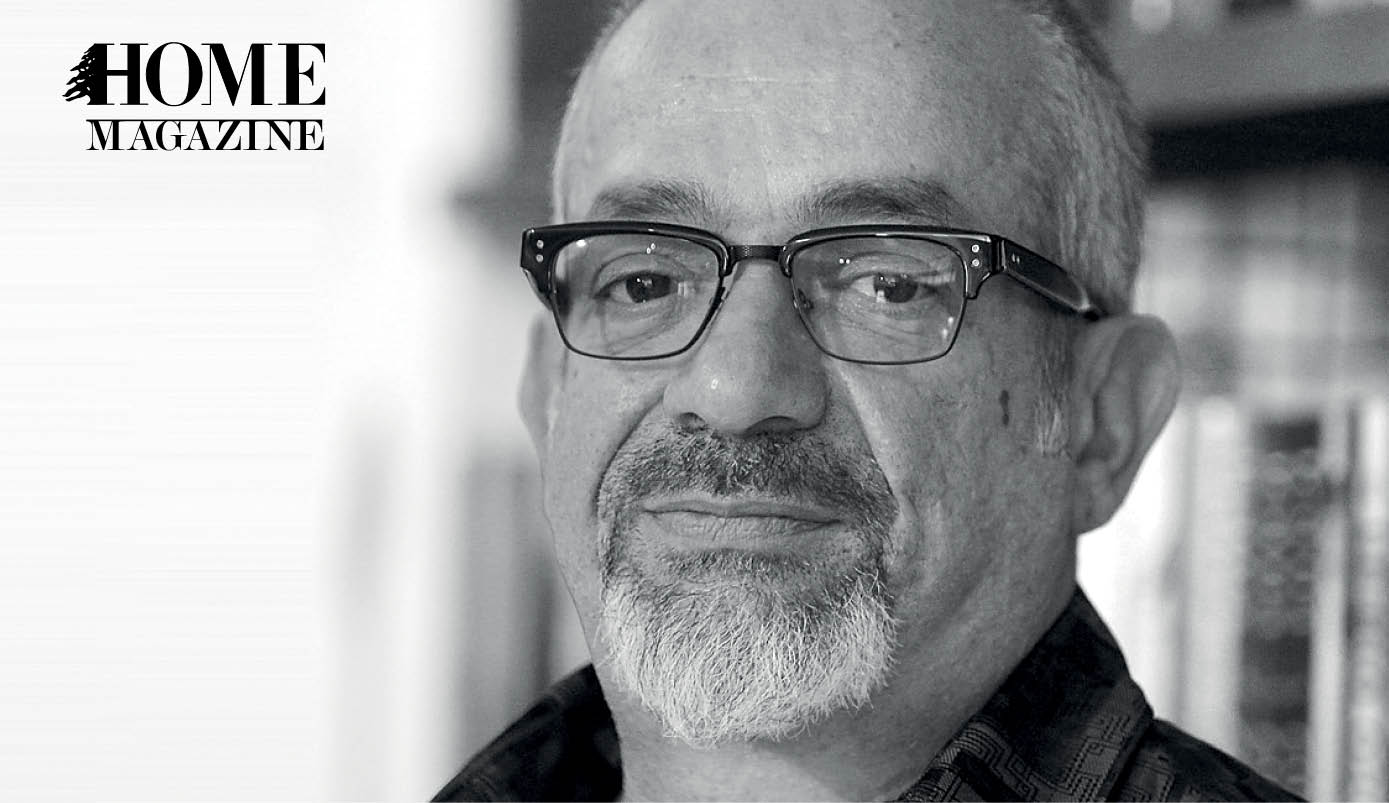
Lebanese-American author and painter Rabih Alameddine inspires a necessity for isolation, a quiet nook by the window overlooking damp winter afternoons in Beirut with the solitary comfort of a gas-lit radiator at your feet in his award-winning novel “An Unnecessary Woman.”
A decrepit 72-year-old woman with blue-dyed hair named Aaliya Saleh is our heroine in this novel, the top fiction winner of the Arab American National Museum’s 2015 Book Awards and a finalist for the U.S. National Book Critics Award. Aaliya seems to embody Beirut. She’s Lebanon incarnate, a vessel which Alameddine uses to describe his own longing for his HOMEland.
Aaliya’s narratives, ink-stained memories and regrets, thread graciously throughout the 291 pages. She invites us to observe her life, sense her tragedies and laugh with her as she expresses her innermost delusions and realities of past and present Lebanon. Flitting from one thought to another, she allows us to tour her soul, her spirit, her HOME.

Aaliya is an entity unto herself, independent from everything, existing for no one. Her aged, withered appearance, her fearfulness and resilience, her vibrancy and ability to scoff at herself, her composure, her desire to be special and diverse—all these traits seem to mirror qualities of Lebanon itself.
Lebanon has been likened to a phoenix rising from the ashes; its culture, heritage, and unity withstanding a painful history. Part of Lebanon’s exquisite charm is the fact that it has endured so much hardship, yet always returns with fervor. Aaliya epitomizes this notion. “The age rings” of her inner self, just as those of Lebanon, “refuse to be forgotten.”
Aaliya translates books into Arabic, but not books originally written in English or French. Instead, they are translations of translations. Thirty-seven translations in 50 years, her life’s work, are in sealed boxes in her Beirut apartment, unseen by anyone.
“Aaliya is Lebanon incarnate, a vessel which Alameddine uses to describe his own longing for his HOMEland.”
Poetry, art, music, philosophy and literature feed her lonely soul, sustaining Aaliya in her melancholia. Aaliya sutures one memory into another, knitting a lifelong reverie of despair and loneliness. She humorously succumbs to Beirut’s flaws, and readers feel her angst in company’s presence, gulp back sobs at her despondent tales of old friends.
Alameddine weaves this elderly woman’s story over just a few days, but little happens in the way of a typical climax.
“Beirut and its denizens are famously and infamously unpredictable. Every day is an adventure.” Aaliya goes for walks as her brittle joints ache, sips her tea and ponders which book to translate next as January first approaches.
When the fate of Aliya’s beloved translations is revealed, there’s an epiphany, a strikingly obvious ending that you somehow didn’t anticipate.
Friendship in unlikely sources, opportunities to have her work “mean something,” and one final attempt to break free from her shell. In the end, the protagonist herself is a phoenix rising from the ashes. From her deteriorating body to her uncontrollable emotions, she transforms into a new being, content in her ordinariness.
“No matter where I’ve been or how long I’ve been away,” she says, “my soul begins to tingle whenever I approach my HOME.”
HOMEland Magazine
We firmly believe that the internet should be available and accessible to anyone, and are committed to providing a website that is accessible to the widest possible audience, regardless of circumstance and ability.
To fulfill this, we aim to adhere as strictly as possible to the World Wide Web Consortium’s (W3C) Web Content Accessibility Guidelines 2.1 (WCAG 2.1) at the AA level. These guidelines explain how to make web content accessible to people with a wide array of disabilities. Complying with those guidelines helps us ensure that the website is accessible to all people: blind people, people with motor impairments, visual impairment, cognitive disabilities, and more.
This website utilizes various technologies that are meant to make it as accessible as possible at all times. We utilize an accessibility interface that allows persons with specific disabilities to adjust the website’s UI (user interface) and design it to their personal needs.
Additionally, the website utilizes an AI-based application that runs in the background and optimizes its accessibility level constantly. This application remediates the website’s HTML, adapts Its functionality and behavior for screen-readers used by the blind users, and for keyboard functions used by individuals with motor impairments.
If you’ve found a malfunction or have ideas for improvement, we’ll be happy to hear from you. You can reach out to the website’s operators by using the following email
Our website implements the ARIA attributes (Accessible Rich Internet Applications) technique, alongside various different behavioral changes, to ensure blind users visiting with screen-readers are able to read, comprehend, and enjoy the website’s functions. As soon as a user with a screen-reader enters your site, they immediately receive a prompt to enter the Screen-Reader Profile so they can browse and operate your site effectively. Here’s how our website covers some of the most important screen-reader requirements, alongside console screenshots of code examples:
Screen-reader optimization: we run a background process that learns the website’s components from top to bottom, to ensure ongoing compliance even when updating the website. In this process, we provide screen-readers with meaningful data using the ARIA set of attributes. For example, we provide accurate form labels; descriptions for actionable icons (social media icons, search icons, cart icons, etc.); validation guidance for form inputs; element roles such as buttons, menus, modal dialogues (popups), and others. Additionally, the background process scans all the website’s images and provides an accurate and meaningful image-object-recognition-based description as an ALT (alternate text) tag for images that are not described. It will also extract texts that are embedded within the image, using an OCR (optical character recognition) technology. To turn on screen-reader adjustments at any time, users need only to press the Alt+1 keyboard combination. Screen-reader users also get automatic announcements to turn the Screen-reader mode on as soon as they enter the website.
These adjustments are compatible with all popular screen readers, including JAWS and NVDA.
Keyboard navigation optimization: The background process also adjusts the website’s HTML, and adds various behaviors using JavaScript code to make the website operable by the keyboard. This includes the ability to navigate the website using the Tab and Shift+Tab keys, operate dropdowns with the arrow keys, close them with Esc, trigger buttons and links using the Enter key, navigate between radio and checkbox elements using the arrow keys, and fill them in with the Spacebar or Enter key.Additionally, keyboard users will find quick-navigation and content-skip menus, available at any time by clicking Alt+1, or as the first elements of the site while navigating with the keyboard. The background process also handles triggered popups by moving the keyboard focus towards them as soon as they appear, and not allow the focus drift outside it.
Users can also use shortcuts such as “M” (menus), “H” (headings), “F” (forms), “B” (buttons), and “G” (graphics) to jump to specific elements.
We aim to support the widest array of browsers and assistive technologies as possible, so our users can choose the best fitting tools for them, with as few limitations as possible. Therefore, we have worked very hard to be able to support all major systems that comprise over 95% of the user market share including Google Chrome, Mozilla Firefox, Apple Safari, Opera and Microsoft Edge, JAWS and NVDA (screen readers).
Despite our very best efforts to allow anybody to adjust the website to their needs. There may still be pages or sections that are not fully accessible, are in the process of becoming accessible, or are lacking an adequate technological solution to make them accessible. Still, we are continually improving our accessibility, adding, updating and improving its options and features, and developing and adopting new technologies. All this is meant to reach the optimal level of accessibility, following technological advancements. For any assistance, please reach out to