

HOMEland THEMES
Coming Soon
HOMEland Events & Collaborations
Coming Soon
 Signature Boutique

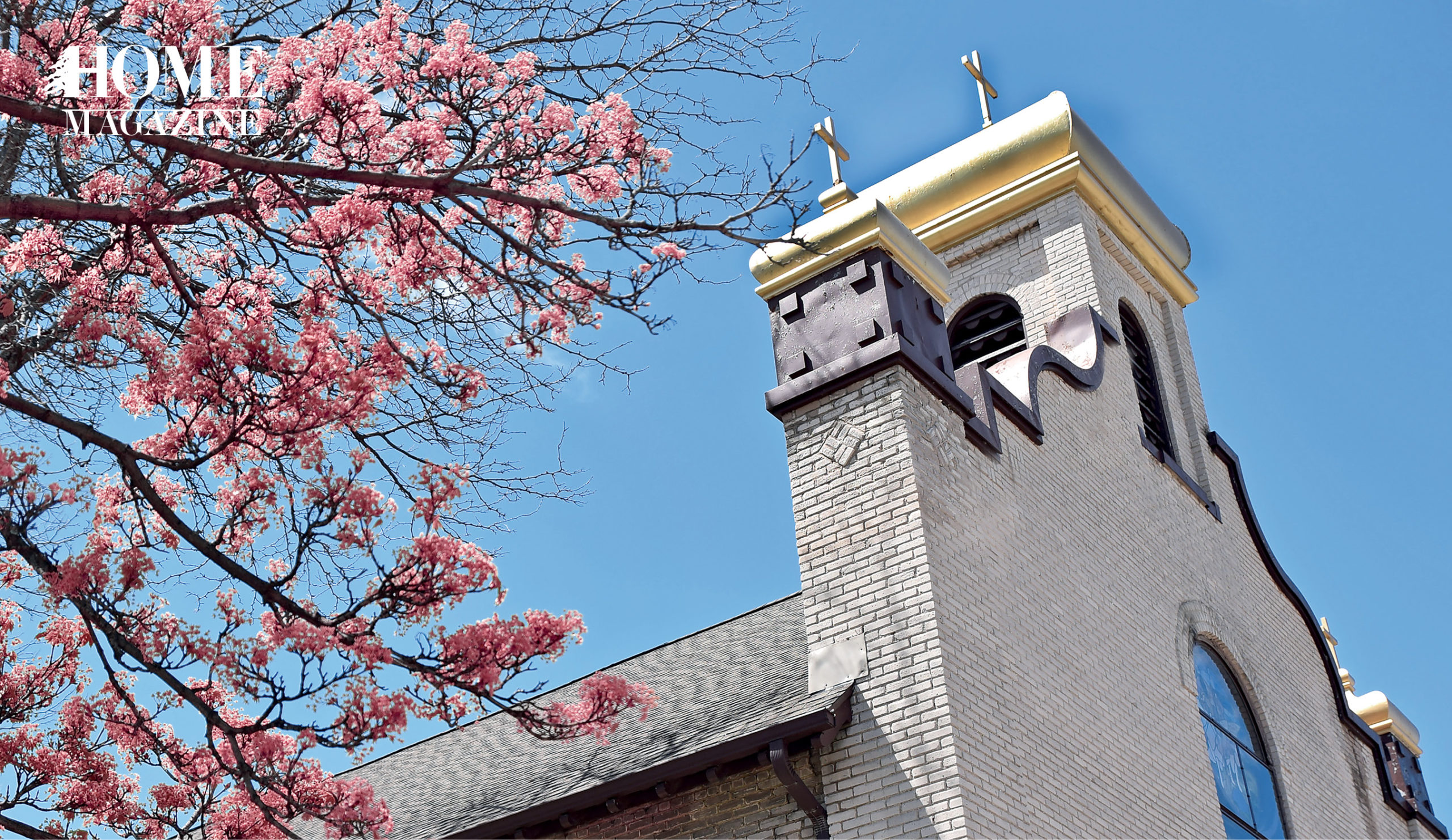
Photo by Meredith Cavaleri
It’s 10:30 a.m. The Divine Liturgy. The Sunday service at Melkite Church seems like that of any other place of worship in the world until I leaned in more closely.
The four dozen or so attendees — young families, elders, millennials — every age demographic thoroughly represented — stood in unison, one community unified in a single hymn that carried loud and proud through the historic but-ever-humble St. George Melkite Church, a true-to-its-roots neighborhood faith center in Milwaukee, Wisconsin.
And then, something changed. A first-time drop-in would be lost. The words are floating through the air, but sounds and meaning now independent and detached from one another.
This isn’t English anymore.
And yet, the flock doesn’t miss a beat, purring through each word just as they had every other prayer so far.
With a language barrier, the actual words may be indiscernible, but a Sunday school devotee may be able to pick up on the rhythm, cadence and repetitions at play. Anyone who’s even been to mass even once before has heard it, just more likely in their own native tongue.
It’s the Our Father or The Lord’s Prayer. But it’s not in English; rather, it’s in Arabic.
It’s what sets St. George’s apart from its Milwaukee counterparts, if not nearly all Christian churches in the state of Wisconsin — and even the United States writ large. Thanks to more than 100-year history of serving the local Lebanese Christian community — as well as descendants from Syria, Palestine, and Jordan — the Arabic portions of mass are routine at St. George’s, and just one aspect of what makes it a unique establishment.
The church traces its origins all the way back to late-19th century citizens of Ain Bourdai, a village roughly 95 kilometers northeast of Beirut. When Chicago held the World’s Fair in 1893, a group from the village made the trek across the globe — some stayed, permanently.
It’s not long before some of these immigrants fractured off, leaving Chicago for its neighbor city of Milwaukee, and began a new community of Lebanese and fellow Middle Easterners. Naturally, the church followed them there, too. By 1916, St. George’s was erected, standing to serve its predominantly Middle Eastern Melkite Catholic community.
It still stands today.
“My wife and I — we’re both Lebanese — we were looking for a church after we got married,” Said Audi, a local parishioner, says. “And it’s been our HOME for 16 years now … There’s a lot of grace in this church. It’s small, but we do a lot.”
Audi says this as he works his way through his potluck platter, a regular occurrence after Sunday mass in the church’s basement. It’s well attended, with at least two-thirds of the Divine Liturgy attendees streaming straight from service to the shared meal. He gets up to shake hands, hug friends, and give well-wishes. The rest of the parish seems just as friendly.
His claim of a small but active community isn’t unfounded either. On average, St. George’s collection basket for church donations (a practice known among Christians as tithe) garners over $1,000 a week — a strong show of support for a church whose active members might only fill up a few pages in an address book.
But it isn’t surprising either. St. George’s has existed for more than 100 years, serving as the HOME for the Milwaukee chapter of the American Syrian-Lebanese Club for nearly its entire existence; it is one of the longest running active clubs in Wisconsin.
Through the American Syrian-Lebanese Club, community members work together on various fundraising projects, offering money for both initiatives back HOME in Lebanon and Syria, but also for local efforts such as St. Jude Children’s Research Hospital, of which American Syrian-Lebanese is a founding sponsor. This is proof that, for over a century, St. George Melkite Church has stood proud — in its own unique kind of way.
Signature Boutique 

HOMEland Magazine
We firmly believe that the internet should be available and accessible to anyone, and are committed to providing a website that is accessible to the widest possible audience, regardless of circumstance and ability.
To fulfill this, we aim to adhere as strictly as possible to the World Wide Web Consortium’s (W3C) Web Content Accessibility Guidelines 2.1 (WCAG 2.1) at the AA level. These guidelines explain how to make web content accessible to people with a wide array of disabilities. Complying with those guidelines helps us ensure that the website is accessible to all people: blind people, people with motor impairments, visual impairment, cognitive disabilities, and more.
This website utilizes various technologies that are meant to make it as accessible as possible at all times. We utilize an accessibility interface that allows persons with specific disabilities to adjust the website’s UI (user interface) and design it to their personal needs.
Additionally, the website utilizes an AI-based application that runs in the background and optimizes its accessibility level constantly. This application remediates the website’s HTML, adapts Its functionality and behavior for screen-readers used by the blind users, and for keyboard functions used by individuals with motor impairments.
If you’ve found a malfunction or have ideas for improvement, we’ll be happy to hear from you. You can reach out to the website’s operators by using the following email
Our website implements the ARIA attributes (Accessible Rich Internet Applications) technique, alongside various different behavioral changes, to ensure blind users visiting with screen-readers are able to read, comprehend, and enjoy the website’s functions. As soon as a user with a screen-reader enters your site, they immediately receive a prompt to enter the Screen-Reader Profile so they can browse and operate your site effectively. Here’s how our website covers some of the most important screen-reader requirements, alongside console screenshots of code examples:
Screen-reader optimization: we run a background process that learns the website’s components from top to bottom, to ensure ongoing compliance even when updating the website. In this process, we provide screen-readers with meaningful data using the ARIA set of attributes. For example, we provide accurate form labels; descriptions for actionable icons (social media icons, search icons, cart icons, etc.); validation guidance for form inputs; element roles such as buttons, menus, modal dialogues (popups), and others. Additionally, the background process scans all the website’s images and provides an accurate and meaningful image-object-recognition-based description as an ALT (alternate text) tag for images that are not described. It will also extract texts that are embedded within the image, using an OCR (optical character recognition) technology. To turn on screen-reader adjustments at any time, users need only to press the Alt+1 keyboard combination. Screen-reader users also get automatic announcements to turn the Screen-reader mode on as soon as they enter the website.
These adjustments are compatible with all popular screen readers, including JAWS and NVDA.
Keyboard navigation optimization: The background process also adjusts the website’s HTML, and adds various behaviors using JavaScript code to make the website operable by the keyboard. This includes the ability to navigate the website using the Tab and Shift+Tab keys, operate dropdowns with the arrow keys, close them with Esc, trigger buttons and links using the Enter key, navigate between radio and checkbox elements using the arrow keys, and fill them in with the Spacebar or Enter key.Additionally, keyboard users will find quick-navigation and content-skip menus, available at any time by clicking Alt+1, or as the first elements of the site while navigating with the keyboard. The background process also handles triggered popups by moving the keyboard focus towards them as soon as they appear, and not allow the focus drift outside it.
Users can also use shortcuts such as “M” (menus), “H” (headings), “F” (forms), “B” (buttons), and “G” (graphics) to jump to specific elements.
We aim to support the widest array of browsers and assistive technologies as possible, so our users can choose the best fitting tools for them, with as few limitations as possible. Therefore, we have worked very hard to be able to support all major systems that comprise over 95% of the user market share including Google Chrome, Mozilla Firefox, Apple Safari, Opera and Microsoft Edge, JAWS and NVDA (screen readers).
Despite our very best efforts to allow anybody to adjust the website to their needs. There may still be pages or sections that are not fully accessible, are in the process of becoming accessible, or are lacking an adequate technological solution to make them accessible. Still, we are continually improving our accessibility, adding, updating and improving its options and features, and developing and adopting new technologies. All this is meant to reach the optimal level of accessibility, following technological advancements. For any assistance, please reach out to