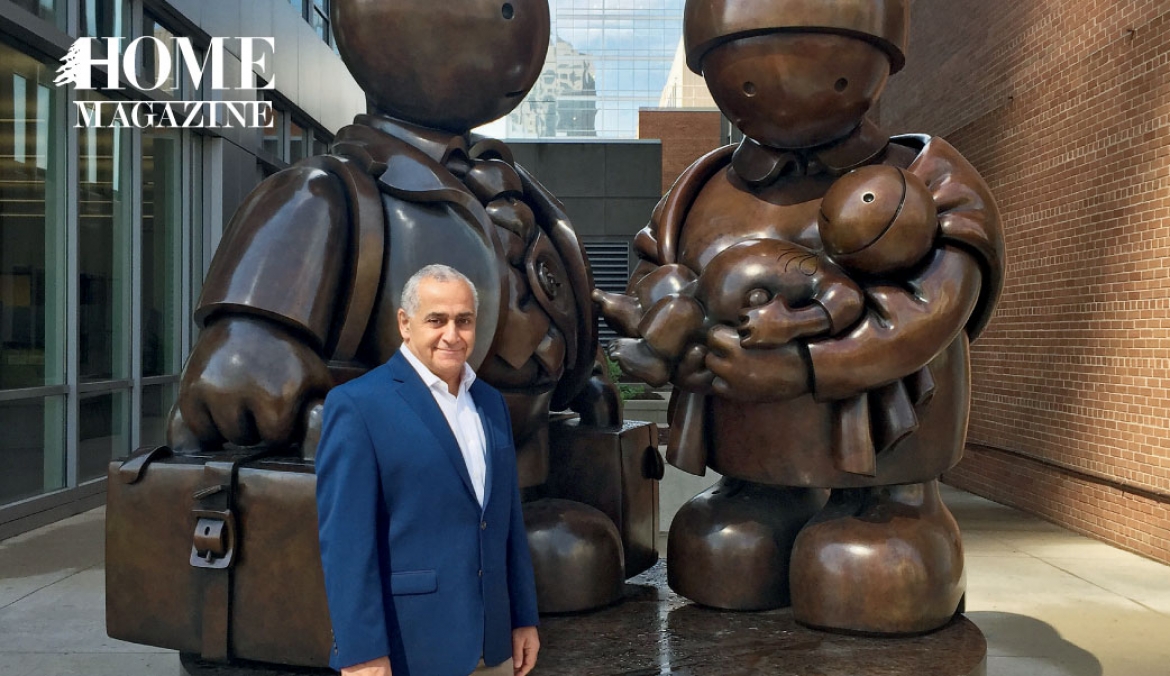
Ghassan Korban says he carries Lebanon in his heart. He’s deeply affected by both Lebanon’s nature and culture, which led him to become a public servant. He wants to make a change and enrich people’s lives.
Interviewed by Hailey Richards, a 20-year-old journalism student at Marquette University, a prominent Jesuit university located in the heart of Milwaukee, Wisconsin, where she was born and raised. Richards has a passion for writing pieces that promote diversity and inclusion.
“There isn’t a day that goes by without me thinking, ‘I wish I was doing this in Lebanon,’” said Ghassan Korban, Milwaukee’s City Commissioner. He turned his head as the light seeping through the wide windows illuminated his golden-brown skin and graying hair. Nestled in the lapel of his dark suit coat sat a pin of the official city of Milwaukee.
In a large office on the fifth floor of the Zeidler Municipal Building, in the center of the biggest city in the state of Wisconsin, sits Korban. In perhaps the highest profile job a civil engineer can attain, Korban demonstrates a work ethic he says is rooted in a passion for public service he cultivated from his Lebanese heritage. While Korban looks ahead and plans to enact a “green” environmental initiative for Milwaukee, Lebanon is on his mind.
“What I enjoy about Wisconsin is the way the environment is a large part of the residents’ lives. We have three beautiful rivers and an amazing lake (referencing Lake Michigan), and it seems everyone enjoys the environment, almost parallel to the way I enjoyed growing up in Lebanon,” said Korban. Korban said his love of the environment and the outdoors developed in the mountainous region of Dhour Choueir, where he grew up playing with his three siblings and his six cousins, who lived next door.
“I enjoyed the beautiful climate Lebanon offered. It was even more enjoyable being up in the mountains with the variety of seasons,” he said. “From beautiful springs and summers to very snowy winters—I think about it often. We would go hiking, bird hunting, skiing, and climbing pine trees. We’d shake the tree down for green pine cones that you can slice and sprinkle some salt, and enjoy,” said Korban. “I spent a lot of my time just playing outside; it was a normal way of living, just spending my whole day outside, from dawn to dusk.”
“For me, HOME means heartbreak.”
As Milwaukee’s City Commissioner
Today Korban is responsible for a variety of services to the 600,000 residents living in the fifth largest city in the United States’ Midwest, at one point managing a $420-million-dollar construction budget.
“We provide so many services to our residents daily, if not on an hourly basis,” said Korban. From garbage collecting to sweeping streets and bringing water to HOMEs, Korban is the man behind it all. “We are public servants who enrich people’s lives, so everything I do, I try to do with a servant’s heart,” he said.

His goal for Milwaukee is to enact initiatives that will promote environmental sustainability and economic soundness, while benefiting every Milwaukee resident, he said. “When you’re at the helm of a department, you are the one who sets the goals and initiatives. And one of our initiatives is to make Milwaukee a very sustainable and green city, if not the greenest city in the nation,” said Korban. To do this, Korban intends to cut pollution by encouraging multiple modes of transportation. “We are building a street car in the city of Milwaukee. It is a very challenging project, a huge undertaking. It is somewhat controversial because not everyone believes it is the right thing to do or the right thing for the city. I certainly believe it is,” said Korban. He is also pushing improvements in the allocation of storm water and other measures to avoid excessive pollution. Korban began his career working in the private sector. However, he soon realized he wanted to become a public servant. “I decided I wanted to be the guy who changed things and helped others,” he said. He worked his way up the ladder through many positions, including project engineer for an infrastructure services construction section, a district manager, and a chief construction engineer. “The nature of the work kept growing and, almost 30 years later, I am basically at the epitome,” he said.
After being appointed city commissioner by the mayor and confirmed by the Milwaukee Common Council, Korban sought to develop and strengthen the quality of services residents receive from the Public Works Department. “I wanted to compare myself to any private business, whether a grocery store, a bank, or an amusement park, where they look at every person who comes into their store as a very important customer and treat them very, very well. That’s what I wanted to do for our 600,000 people who live in the city.” In looking back on his career, Korban attributes his passion for the environment to Lebanon, and his servant’s heart to his mother and Lebanon’s culture of hospitality. “The Lebanese culture demands us to be caring and loving of one another, which is how I try to carry myself and manage any situation,” said Korban.
“I wish I was doing this in Lebanon.”
Pride in Lebanese Heritage
Since long before Korban rose through the ranks in City Hall, he has been proud of his Lebanese heritage. Leaving Lebanon was one of life’s big heartbreaks, he said. “The first time moving overseas appeared as a concept in my head was when I was 10. My aunt and uncle, and my six cousins, migrated to Australia. I didn’t understand how they could just leave. I thought we had the perfect life at the time. We had a wonderful environment surrounding us. It was devastating. It wasn’t until the Civil War, which devastated Lebanon in the seventies, that I began to think about leaving,” said Korban.

The moment when he decided that there was no way to stay was in 1982, during the Israeli invasion. Korban was 20 when he immigrated to the United States. “When I left, I was torn between not wanting to leave my country, where I was born and raised, but also looking for a great opportunity without getting sucked into the ugliness of war,” he said. Korban was able to transfer credits from what was previously known as Beirut University College to Marquette University, a prominent Jesuit university in Milwaukee, where he would eventually earn a bachelor’s and a master’s degree in civil engineering.
“Initially, it was difficult; obviously, homesickness was definitely there,” said Korban. “But I certainly surrounded myself with good friends who were a great support, then I started calling Milwaukee HOME.”
December of 1986 was a turning point, said Korban. He went back HOME after the war had taken its toll on Lebanon. “The basic provisions were just not there. At that point, I was going through the recognition that I wouldn’t be going back full time. Going back to visit is awesome, but I know I am not going back for good; I think about Lebanon every day. For me, HOME means heartbreak,” he said.
Korban said he believes it is important to maintain his roots and enjoy his Lebanese culture, while being open to new things and growth. “I think the success of an immigrant is having that balance,” said Korban.
Korban maintains the balance in his daily life through his family. “I instill in my children’s hearts the culture. I took them back HOME to see where their dad came from and the HOME I was raised in, the town, the streets I walked down, but most of all the culture of hospitality, of loving one another and family.
“You never, never forget where you came from,” said Korban.



HOMEland
Coming Soon
HOMEland Events & Collaborations
Coming Soon
 Signature Boutique