HOME Gallery represents Chrystyna Salam’s passion for art. Being a dedicated collector, her house is filled with paintings and ceramics that go right back to ancient times.
Lebanon is a far cry from Chrystyna Salam’s origins and previous HOME. She identifies herself as a refugee who fled a crisis in Ukraine and found salvation in Paris where she spent a number of years and became a prominent art gallerist. Salam specialises in Russian Constructivist art which has a specific artistic and architectural philosophy. It happened that Oussama Salam walked in to Chrystyna’s gallery where she first met him; he had the same interest in art as she did. Soon after their marriage, Salam made her first trip to Lebanon in July, 2006, but then had to make an emergency escape due to the unfortunate situation. When discussing the events that followed, Salam compared returning to Lebanon again as giving birth for the second time.
“After giving birth for the first time, you think of the pain and how difficult it was and you say -I’ll never do it again but two years later and you’re ready for your second child,” explains Salam.
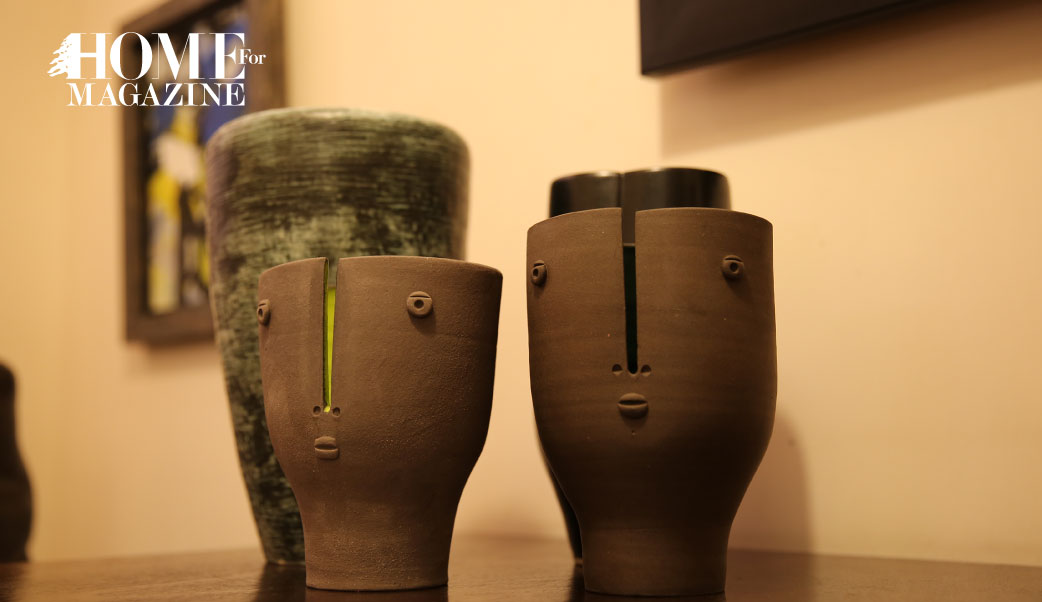
And indeed Salam was ready to return to Lebanon in 2009, and settled in and made it her HOME but this HOME is out of the ordinary. Salam transformed her place into the HOME Gallery adorned with exquisitely unique creations and exclusive collector’s items without editions. Pieces from ceramic legends like Roger Capron, Innocenti and Pol Chambost enhance the atheistic of Salam’s beautiful HOME Gallery. Every corner is the outcome of mindful selection and unique taste. Bold paintings and vibrant colours of red, white, green and black shades set the tone and give us a small insight to Salam’s lively soul.
A tour of the HOME Gallery with glimpses of history
Salam explains what makes these pieces so unique is the way that they are true reflections of history while also being timeless, irreplaceable and truly one of a kind. The mid 1950s witnessed a revolution in the perception of ceramics from a service oriented usage in to artistic and creative expression. This change was ignited in small town called Vallauris in the South of France located near Cannes. Many factories were located there, one of which was Madura, run by Susan Ramié. Most of the work produced during that period was made for utilitarian purposes.
It was when Picasso arrived in this small town he added his genius touch to the product and that inspired many ceramists to do the same which set the movement in motion.
“If you live in truth and free of all possessions, you will have no fear of death”
Salam has the ability to enchant a person with her stories and passion towards art. She has expanded into contemporary art, and meticulous ceramics statues by the likes of modern artists like Dalo, that can be seen on several tables. Salam carefully chooses elaborate works of art that celebrates life’s meaningfulness. She feels no need to cling to material possessions or attachments; instead she finds freedom and joy in providing consultancy to those interested in obtaining a collector’s item. She believes that they both deserve and have earned it. “If you live in truth and free of all possessions, you will have no fear of death” says Salam.

Art in Lebanon
An interest in 20th century art is relatively new in Lebanon according to Salam. To her, there is a “naissance” and not a renaissance occurring in Lebanon; a birth of the value of art and appreciation for it. She believes that in order to proclaim yourself as a true artist you must first prove yourself and that is done by showcasing your work in several galleries worldwide. She also believes that gallerists should promote, care for and follow up on the artists they exhibit. Salam enjoys visiting several galleries in Lebanon and is amazed by the ceramic artwork done by young artists such as Nathalie Khayat, Souraya Credos and Sandra Zeeni. She says that she loves it here because she loves all the people she has dealt with. “Lebanese are courageous and diverse in all fields and they are admirable people. In other countries you have more distinctive boundaries between careers,” says Salam. With many galleries opening in the region, there is hope for the next generation to stay.
Lebanon, in your inbox
HOMEland Magazine
We firmly believe that the internet should be available and accessible to anyone, and are committed to providing a website that is accessible to the widest possible audience, regardless of circumstance and ability.
To fulfill this, we aim to adhere as strictly as possible to the World Wide Web Consortium’s (W3C) Web Content Accessibility Guidelines 2.1 (WCAG 2.1) at the AA level. These guidelines explain how to make web content accessible to people with a wide array of disabilities. Complying with those guidelines helps us ensure that the website is accessible to all people: blind people, people with motor impairments, visual impairment, cognitive disabilities, and more.
This website utilizes various technologies that are meant to make it as accessible as possible at all times. We utilize an accessibility interface that allows persons with specific disabilities to adjust the website’s UI (user interface) and design it to their personal needs.
Additionally, the website utilizes an AI-based application that runs in the background and optimizes its accessibility level constantly. This application remediates the website’s HTML, adapts Its functionality and behavior for screen-readers used by the blind users, and for keyboard functions used by individuals with motor impairments.
If you’ve found a malfunction or have ideas for improvement, we’ll be happy to hear from you. You can reach out to the website’s operators by using the following email
Our website implements the ARIA attributes (Accessible Rich Internet Applications) technique, alongside various different behavioral changes, to ensure blind users visiting with screen-readers are able to read, comprehend, and enjoy the website’s functions. As soon as a user with a screen-reader enters your site, they immediately receive a prompt to enter the Screen-Reader Profile so they can browse and operate your site effectively. Here’s how our website covers some of the most important screen-reader requirements, alongside console screenshots of code examples:
Screen-reader optimization: we run a background process that learns the website’s components from top to bottom, to ensure ongoing compliance even when updating the website. In this process, we provide screen-readers with meaningful data using the ARIA set of attributes. For example, we provide accurate form labels; descriptions for actionable icons (social media icons, search icons, cart icons, etc.); validation guidance for form inputs; element roles such as buttons, menus, modal dialogues (popups), and others. Additionally, the background process scans all the website’s images and provides an accurate and meaningful image-object-recognition-based description as an ALT (alternate text) tag for images that are not described. It will also extract texts that are embedded within the image, using an OCR (optical character recognition) technology. To turn on screen-reader adjustments at any time, users need only to press the Alt+1 keyboard combination. Screen-reader users also get automatic announcements to turn the Screen-reader mode on as soon as they enter the website.
These adjustments are compatible with all popular screen readers, including JAWS and NVDA.
Keyboard navigation optimization: The background process also adjusts the website’s HTML, and adds various behaviors using JavaScript code to make the website operable by the keyboard. This includes the ability to navigate the website using the Tab and Shift+Tab keys, operate dropdowns with the arrow keys, close them with Esc, trigger buttons and links using the Enter key, navigate between radio and checkbox elements using the arrow keys, and fill them in with the Spacebar or Enter key.Additionally, keyboard users will find quick-navigation and content-skip menus, available at any time by clicking Alt+1, or as the first elements of the site while navigating with the keyboard. The background process also handles triggered popups by moving the keyboard focus towards them as soon as they appear, and not allow the focus drift outside it.
Users can also use shortcuts such as “M” (menus), “H” (headings), “F” (forms), “B” (buttons), and “G” (graphics) to jump to specific elements.
We aim to support the widest array of browsers and assistive technologies as possible, so our users can choose the best fitting tools for them, with as few limitations as possible. Therefore, we have worked very hard to be able to support all major systems that comprise over 95% of the user market share including Google Chrome, Mozilla Firefox, Apple Safari, Opera and Microsoft Edge, JAWS and NVDA (screen readers).
Despite our very best efforts to allow anybody to adjust the website to their needs. There may still be pages or sections that are not fully accessible, are in the process of becoming accessible, or are lacking an adequate technological solution to make them accessible. Still, we are continually improving our accessibility, adding, updating and improving its options and features, and developing and adopting new technologies. All this is meant to reach the optimal level of accessibility, following technological advancements. For any assistance, please reach out to