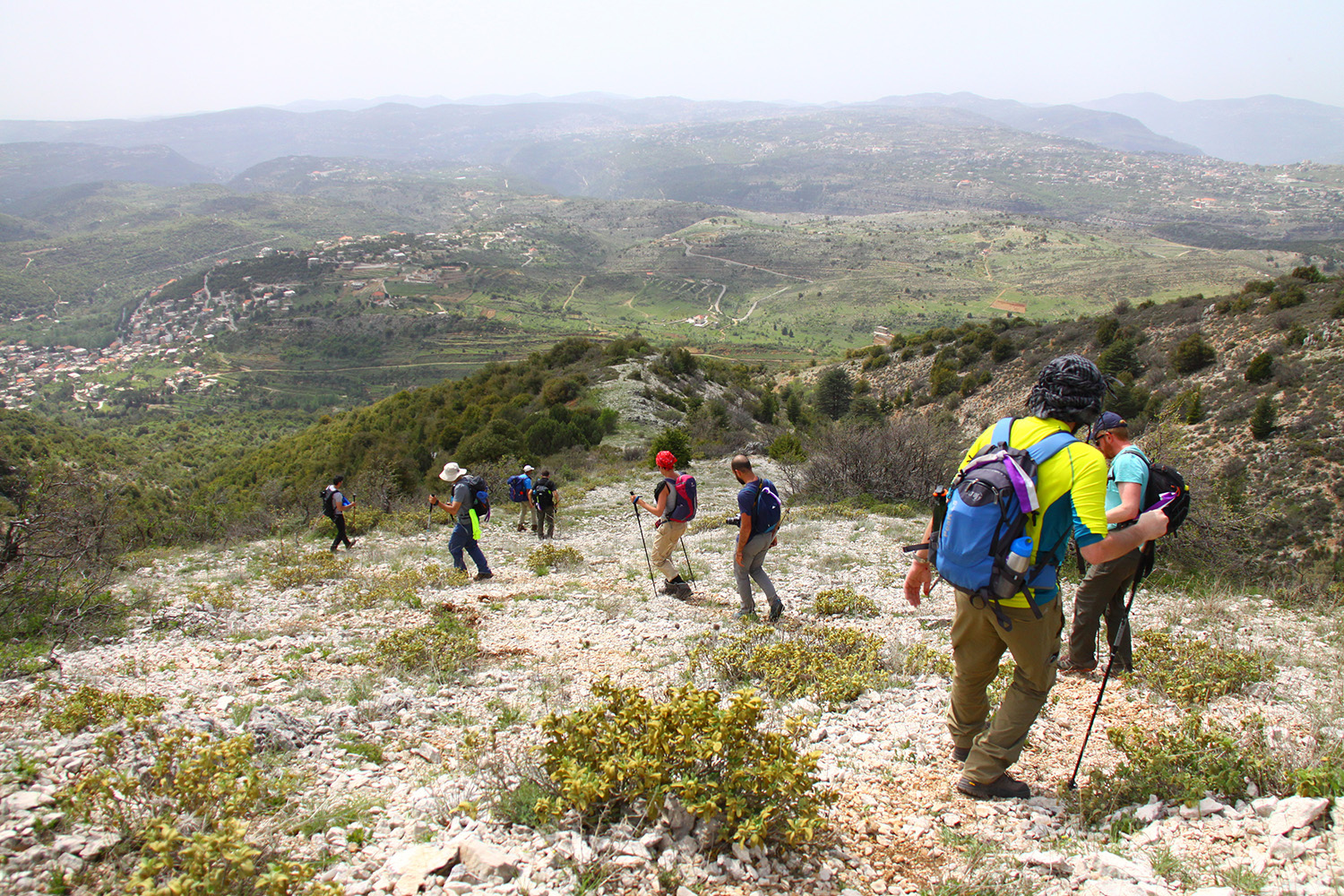
The narrow and jagged coastline of Lebanon, rising from small fishing villages up steep, green mountains, has given Lebanon its special character. It has attracted settlers, refugees and conquerors through the ages – and Ghazir, a town 27 km (17 miles) north of Beirut, has seen them all.
According to Anis Freiha’s book Names of Lebanese Villages and their Origins, the origin of the name Ghazir (Gezer) may have derived from ancient Syriac or Aramaic roots like many other place names in Lebanon. The term means an isolated or separated place, such as an island, and is consistent with the fact that Ghazir is located on a hilltop, cut off from neighboring communities by steep hills and deep gorges and ravines.

Strategic Defense Post
Ghazir has served for successive conquerors as an important strategic defense post overlooking the Bay of Jounieh and the Mediterranean Sea. Historical evidence of Phoenician forts and fortifications remains to this day. And specialists in Phoenician antiquity and traditions have identified Ghazir as an important route for an annual spring festival in honor of the god Adonis.
Ghazir was also among the preferred locations for the Romans to build observation towers, defense garrisons, and temples of worship. A courthouse was built during Ottoman times on the site of a Roman observation tower in the town center and was more recently renovated and transformed into Ghazir’s municipal building.
The defensive observational role of Ghazir continued throughout the thirteenth and fourteenth centuries when Mamluks from Egypt stationed troops in Ghazir to guard the sea route between Tabarja and the Adonis River (Nahr al-Kalb). Turkomen tribesmen made Ghazir their headquarters against tribes from the southern Mount Lebanon, and, after the Ottoman Empire defeated the Mamluks in 1516, the Ottomans granted the Assaf clan control over Kisrwan and they moved their strategic headquarters to Ghazir. In more recent times, Ghazir’s dramatic geographical location – overlooking the Bay of Jounieh, Lamartine Valley, the Roman bridge, and Casino du Liban – has made it a special tourist spot, with many hotels, restaurants, and cafés in the vicinity.
Ghazir was the HOMEtown of Emir Bachir al-Chehabi II, who was born there in 1767 and baptized by Capuchin friars based in the town.


Educational Legacy
In addition to rich archeological discoveries, Ghazir has been recognized under different political authorities for its prominent roles of leadership in local and regional affairs, in religion and church leadership, and in education, agriculture, industry and trade.
Ghazir has had a long educational legacy. Ghazir was among the early beneficiaries of nineteenth-century foreign missions and schools from Europe and America. Through their efforts, new schools were founded and indigenous ones joined in the movement for reform and renewal.
In the 1840s, under Ottoman rule, Jesuits from southern France wanted to establish an advanced educational institution in what is now Lebanon – first considering Beirut, then Sidon and Bikfaya. Ghazir became an option when a local notable offered to sell his estate to the Jesuits, and, in 1842, the land was purchased. As to the language of instruction, the Jesuits initially had supported enculturation, learning Arabic as the American missionaries had. Italian had been considered. The decision that was finally made to teach French in the college of Ghazir can be considered the turning point to assure francophone prominence in Lebanon. With the college and clerical residence in Ghazir, the town served as the focal point for the Jesuits. But, in 1870, the Jesuits bought property in Beirut that would not only lead to the transfer of teachers and students from Ghazir, but serve as the foundation for the second university in Beirut, St. Joseph University. The seminary remained in Ghazir and has an important library and research center, reading room, and a modern seminarian residence. It belongs now to the maronite church and it is under Bkerké control since 1969.

Agriculture and Industry
While the steep topography of the township precluded some forms of agriculture, Ghazir was able to produce rich harvests of grain, vegetables and fruits on its terraced hillsides, irrigated by an abundance of water from numerous springs. Silk production was a thriving industry in Ghazir from the middle of the nineteenth century through World War I. In addition, about a dozen grain mills powered by spring water comprised a major portion of the town’s industry.
In 1930, Gaston Hochar, determined that Lebanon should re-establish the fine wine industry of ancient days, established the award-winning winery of Château Musar in the cellar of an old seventeenth-century castle. While the winery is in Ghazir, the vineyards of Château Musar are located at an altitude of over 1,000 meters in the Bekaa Valley. Gaston’s son, Serge, was eulogized by Decanter magazine in 2015 as being “credited with single-handedly putting Lebanese wines on the map, and inspiring a new generation of winemakers in the country.”

Ghazir’s Armenian and Polish Connections
Ghazir, faced with different local or international crises, maintained an open-door policy, receiving refugees and facilitating their settlement.
These included a large number of Armenian orphans who were settled in an orphanage in Ghazir by Near East Relief. Two looms were introduced at the orphanage to help the girls learn to weave. For 18 months between 1924 and 1925, some 400 of these orphan girls worked in shifts to create a historical rug depicting scenes from the biblical Garden of Eden. It was given to President Coolidge of the United States in 1925 in recognition of the help given by the American people to Armenian orphans. The Armenian Orphan Rug, also called the Ghazir Rug, was kept by President Coolidge after his term was over and was returned to the White House in 1983.
Ghazir’s welcoming of refugees was repeated with Polish refugees of World War II. During that war, more than two million Poles were held captive in the Soviet territories under Stalin’s rule. In 1941, an amnesty was signed between the Russians and the Allies that led to more than 100,000 Poles being moved in 1942 from Siberia to Iran. In late 1945, the Lebanese government agreed to accept some of these Polish refugees. By the end of the year, 4,300 refugees – mostly women and children – had been evacuated to Lebanon, rising to 6,000 by 1946. From a temporary camp near Beirut, they were sent to more permanent settlements, the first of which was in Ghazir, where a Polish school was soon set up.

Hernacka-Azzi, who is believed to be the last Polish refugee from that time, still lives in Ghazir. She is a senior member of the Polish community in Lebanon and one of its key figures. Interestingly enough, this wasn’t the first connection between Ghazir and Poland. According to the historical records of the Monastery of St Anthony in Ghazir, the Polish romantic poet Juliusz Slowacki stayed there in 1837 during his Middle East travels. And he is said to have written his famous poem Anhelli there. His stay is commemorated by a plaque in Ghazir. In 2017, the Polish community of Lebanon will be commemorating the 180th anniversary of Słowacki’s stay in Lebanon and the 70th anniversary of the unveiling of the plaque dedicated to him. In keeping with this commemoration, there was a Polish community mass in Ghazir on May 1. And, on July 1, the Polish ambassador to Lebanon, Wojciech Boek, paid a visit to the newly elected mayor of Ghazir, Charles Haddad, to discuss the opportunities to establish a partnership between the embassy and the municipality.


The Municipality of Ghazir
The municipality of Ghazir today has a population of over 20,000, with around 6,000 electors. It is divided into three major parts – Ghazir el-Fawka, Central Ghazir, and Kfarhbab – and is in the Kisrwan district (qada’) of the province (muhafazat) of Mount Lebanon. The municipality is the product of decades of ongoing development and change. It provides a wide range of services that may well be unmatched by any other municipality in the country. These include a medical clinic and a dental clinic for the needy – free of charge or for a minimal, token charge.

A delegation from HOME magazine, and diplomats visiting Ghazir, just happened to witness a recent example of its achievements – a free outdoor health fair that the municipality held on May 13 in coordination with the American University of Beirut Medical Center (AUBMC) and the EMBRACE Fund. It included tests, lectures, and information on blood, heart disease, diabetes, and other chronic illnesses and their relation to mental health. Attendance was high and the response was very positive. According to Dr Faraj Saadeh, vice president of Ghazir’s municipality and coordinator of the day’s event – along with Joseph Toutounji and Dany Awaida – another full day health clinic is planned for the fall to address diseases of the upcoming flu season, vaccines, and other matters of preventive healthcare.

Historical Sites
Ghazir has managed to preserve more than 10 churches and monasteries, most of which are listed among Lebanon’s historical sites and some of which date back to the seventeenth and eighteenth centuries. The Mar Maroun Monastery, mainly Italian in style, was built over the ruins of a medieval monastery and once hosted a Maronite clerical school. And the Monastery of St Antoine Khachbaou serves as the general presidency of the Lebanese Maronite Order and is owned by them. Other historical buildings include Ghazir’s municipal building, mentioned above, the original Chihab family palace, and the Palace of Ghazir, built in 1904 during the rule of Muzafer Baqa, as the mutasarref of Mount Lebanon.

One of Ghazir’s historical buildings is the HOME of Abuna Ya’qub, a visionary nineteenth-century priest, remembered for piety and good deeds. Sister Marie Colomb, its gentle custodian, gave the HOME delegation a tour and brief history of the modest residence, which has been restored to its original form as a typical country HOME. It is reached along a narrow path carved out of the rock, through a small, dark cave with a trickling spring at its entrance. Sister Marie touched the hearts of her audience as she connected spirituality to the seriousness of rising concrete structures eating into the lush, green mountain canopy of oak and pine.

From the narrow balcony, she pointed upwards, exclaiming that, “… this is tragic, Lebanon is a holy mountain.” Ghazir’s historical legacy is strong; its views of the surrounding countryside, the mountains, and the sea are impressive. Ghazir, in fact, resembles many towns and villages in the Lebanese mountains in that increasing population and wealth has led to a major urban transformation from mainly individual family HOMEs to rising multifamily concrete structures. Despite these developments, however, Ghazir has managed to preserve the older areas of town with their winding alleys and narrow staircases, their roses, vines, and flowering trees, and the intermittent sound of trickling spring water.

For more information:
The History of Ghazir: Political, Cultural, and Social, by Antoine Butros al-Khwayri 2007, published by the municipality of Ghazir (in Arabic)
The Role of the Phoenicians in the Interaction of Mediterranean Civilizations (Papers Presented to the Archaeological Symposium at the American University of Beirut), March 1967, ed. William A Ward.
When a Refugee Fled in the Other Direction, The National, UAE, by Rym Ghazal (August 17, 2016) http://www. thenational. ae/world/ middle-east/ when-a-refugee-fled-in-the-other-direction
Article by: Dr Michel Nabti, Stanford University, PhD Political Science with focus on superpower politics and the Middle East. He used to hold an academic post at Stanford.
Photos by: Elie Nohra


HOMEland THEMES
Coming Soon
HOMEland Events & Collaborations
Coming Soon
 Signature Boutique