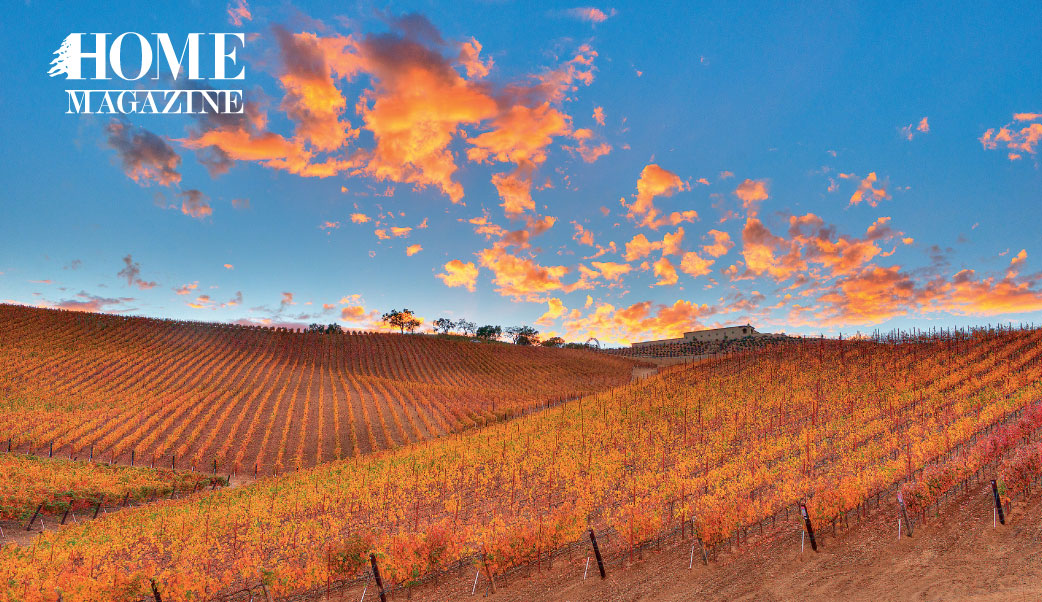
As a result of civil unrest in Lebanon in 1975, the Daou brothers immigrated to safer grounds in pursuit of their dreams. Upon their journey they discovered a passion for wine, and so their story begins…
Article by: Nyri Achadjian
Photos by: Charles Roberts
Your arrival at DAOU Mountain begins with a grand ascension along a beautiful pathway laced with olive trees. You find yourself surrounded by vines that are carpeted with grapes and softly embraced by lavender blossoms. As you get closer to the tasting room, the architecture of the winery warmly welcomes you with a magnificent bell imported from Spain. Every detail of the vicinity is an extension of Georges and Daniel Daou, two brothers who are redefining California’s wine culture. The refined Lebanese lens with which the brothers created this paradise is what sets DAOU apart from the hundreds of wineries in Paso Robles. It is a lens inspired by the “joie de vivre” of their childhood and kissed with the lips of true Californians.

Early Life
Georges and Daniel were born in Achrafieh, Lebanon to parents Joseph and Marie Daou. Their father owned the largest furniture manufacturing facility in the Middle East, Halim Daou & Fils. His first large contract was with Hotel Phoenicia in Beirut the day Georges was born, which was said to have brought the Daou family luck. On May 3, 1973, however, a young Georges (12) and Daniel (eight) were confronted by immortality when a rocket fell in front of their HOME. They were the first of their neighbors to be physically wounded in the civil war, but it was the emotional scarring that would later shape their lives. In 1975, tensions began to tighten again as civil unrest swept across their HOMEland. With minimal options to choose from, the Daous immigrated to France. In due time, they found their bearings and the brothers were able to live a carefree adolescence.
“That was the best of life,” fondly recalls Georges when remembering their time in Paris and then Cannes. Aside from frequent motorcycle rides along the countryside as teenage heartthrobs sans helmets, Daniel began to develop an exceptional ability to understand and love computers, just as Georges began to fall in love with mathematics. Upon graduating high school, the brothers each set sail in pursuit of the American Dream. They enrolled in the University of California in San Diego, a sunny beach town in Southern California that reminded them of Cannes. Georges and Daniel earned degrees in electrical engineering and computer engineering, respectively.
In 1986, the young brothers asked their parents to join them in California, and after convincing their father to pool what little funds they had left, they built a computer networking company. Together they founded Daou Systems and just 10 years later took the company public. “It was the fifth best IPO on Wall Street in 1997 with a market cap of $700 million, out of a $50,000 investment. I was 32, Georges was 36, and we retired,” remembers Daniel.

What about the Wine?
Wine had always fascinated the Daou brothers. Growing up in France, their father reveled in his love of wine every day. “I would watch him get philosophical and relax and talk about life and get deep in his thoughts. It always intrigued me, what wine did and how he enjoyed it,” Daniel explains. Often playing the role of taste tester, Daniel developed a liking for wine at a young age. He bought, tasted, and researched everything he could about making wine. “To me it was a passion, it was a dream that I always dreamt of fulfilling,” he says. But he was not ready. An eight-year journey to study winemaking and terroirs all over the world finally led to the Adelaida Hills in Paso Robles, California, where the Daous planted their flag and created the inimitable DAOU Vineyards & Winery. Georges and Daniel have shattered the taboo of working with family. While Daniel manages the vineyards and produces the wines, Georges leads the business development and marketing of the company. As a tandem team of 10 years now, they have accomplished what decades-old wineries can only dream of, including earning the highest rating ever received for Cabernet Sauvignon in the entire Central Coast of California. With two 99s, one 98, and many 97s, 96s, and 95s, DAOU continues to represent Lebanese winemakers with pride. “And we’re going for 100 this year,” Daniel adds.
“Earning the highest rating ever received for Cabernet Sauvignon in the entire Central Coast of California.”

HOME sat down with the Daou brothers to reminisce about Lebanon and the “good old days.”
What is your fondest memory of Lebanon?
Georges: The comradery, the social connections, the deep friendships, the joie de vivre of being Lebanese and enjoying life. There’s one thing for certain: despite all the economic and structural barriers, the Lebanese know how to have a good time. That’s a spirit you can never kill. I miss that.
That’s probably what I miss the most— the people.
Daniel: I have so many great memories in Lebanon. Spending Christmas in Faraya and seeing the snow fall down, that’s a memory that’s hard to shake. Most of my memories are being in the mountains, spending summers in Beit Mery, and going to visit my grandparents in the north.
Those were beautiful days and incredible memories.
“Despite all the economic and structural barriers, the Lebanese know how to have a good time.”

When was your last visit to Lebanon?
Georges: 2011. My parents passed away and I needed to put things in order.
Daniel: 2005. I had a hunch that my parents were getting older and I was afraid that they wouldn’t get a chance to go back, so I took a long trip and I brought my children as well. I loved it, I loved every bit of it. I can’t wait to go back.
What quote do you live by?
Georges: “Be true to yourself.” My philosophy on life in one word is “relationships:” with God, with others, and with yourself. The hardest one is the relationship you have with yourself.
Daniel: My dad used to always say, “Napoleon used to tell to his driver, ‘we’re late, so slow down.’” It means that sometimes when we’re in a hurry to get things done, that’s the time to compose yourself and make sure you really do the right thing the right way as opposed to letting time dictate.
Whom do you most admire?
Georges: I respect my dad and my mom both. They’re the best two human beings I’ve ever met. The sacrifices they made, the way they loved us unconditionally, earns more of my respect than any intellect in the world. Professionally, I greatly admire Steve Jobs.
Daniel: Georges has been the greatest influence on my life. And my sister, I admire her a lot too. She’s such a winner and has made so much success out of nothing. Besides that, my parents, but they’re not here.

What does family mean to you?
Georges: Family to me is the strongest word after “mother” and “father.” I believe we are all related. Family means tolerance, sacrifice, love, generosity and an attitude of unjustifiable goodwill. You are lucky when you can feel these emotions with your bloodline and even luckier when these feelings extend beyond your own. It’s a beautiful way to live.
Daniel: Our parents are the entire reason for being who we are today. My dad used to tell me, I don’t care what you do, but you have to be the best at it. That’s how my brother and I were bred. We happen to follow our passion now, but whatever we do, my brother and I, we were bred to win. Together he and I are synergistic. We’re 1+1=5. We’re that much stronger together than we are alone, and we learned that from day one. We get along, we love each other, and we’re always here for each other, and that’s been the reason for our success. There is no question that our parents are the reason we are here today. They taught us how to love unconditionally, how to keep our faith balanced with our daily lives, and how to thrive to be the best and not settle for second place.
For more info: www.daouvineyards.com
HOMEland THEMES
Coming Soon
HOMEland Events & Collaborations
Coming Soon
 Signature Boutique