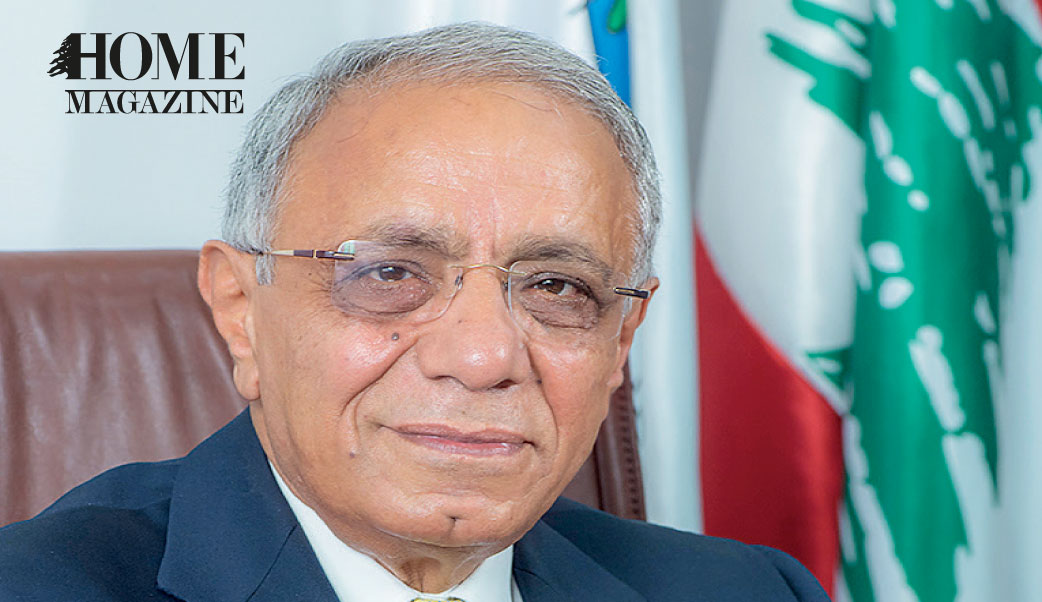
The Investment Development Authority of Lebanon (IDAL) is the national investment promotion agency aiming at promoting Lebanon as a key investment destination. IDAL provides a framework for regulating investment activities in Lebanon and provides investors with a range of incentives and business support services. Since 2005, Nabil Itani has been at the helm of IDAL as its Chairman and General Manager. Itani’s career spans over three decades of professional achievement in the architectural field, and has been actively designing, overseeing and supporting new strategies to attract investments to the country in multiple sectors. HOME sits down with Itani to better understand the investment climate in Lebanon and the mission that IDAL is entrusted with.

For our readers to better understand IDAL’s role, tell us about IDAL’s framework.
IDAL was created by the late Prime Minister Rafic Hariri to promote foreign direct investment in Lebanon. Launched in 1994, we were the first investment promotion agency in the Middle East. In 2001, Investment Law No. 360 was promulgated, which boosted the mandate of IDAL, giving it a dual role. In fact, IDAL has two mandates: first, to encourage investors to invest in Lebanon through our business support services (for both domestic Lebanese and foreigners); and second, to help promote and market for Lebanese exports.
How do investors know about you?
We use all means possible to reach out to investors, such as mainstream media, one-on-one and targeted meetings, investment missions, PR, social media, advertising and attendance at key events. Our main and primary contact point is our elaborate website (investinlebanon.gov.lb) which holds up-to-date and relevant information necessary for investors. As IDAL, our role is to guide and assist investors throughout the investment process.
Who are the investors?
There are four potential groups. The first is the local investor, who makes up the biggest share, followed by the diaspora – Lebanese living abroad. After that, we have Arabs from other countries, and finally multinational companies, who are attracted by the services and qualified personnel available in Lebanon.
Local, international, and Arab investors are key for the country, but expats also play an important role. How is IDAL encouraging expatriates to invest in their homeland?
Due to the conflict in the region, the only two main categories that invested between 2011 and 2016 were locals and expatriates. IDAL’s aim is to encourage expatriate investors not only to invest in Lebanon, but also to connect with the country through three main axes. The first axis is to encourage investors to invest in Lebanon and create partnerships with Lebanese companies. The second relies on enhancing trade between Lebanon and hosting countries. The third is based on encouraging them to adopt Lebanon as an outsourcing hub, especially so that Lebanese productive sectors may supply them with high-quality products, components and services. The economic and cultural connectivity that Lebanon has with many countries is highly important, and this is something that expatriate investors, and other investors too, can benefit from.
What are the main investment sectors?
Before 2011, it was tourism in terms of size and number of projects – this sector was worth USD 300–400 million. However, due to the regional conflicts and the travel ban on GCC citizens coming to Lebanon, it has slowed down over the last six years. Other key investment sectors are agriculture, agro-industry, information, communication, technology, and media.
You also support Lebanese exports?
Yes, IDAL also supports and promotes Lebanese goods – in particular but not limited to, agricultural and agrofood products. For this purpose, we have launched a range of programs that subsidize exports in the industrial and agricultural sectors; for instance, the Agri Plus and Agromap programs. We have also launched the MLeb (Maritime Lebanese Exports Bridge) initiative in response to the land borders closure due to the Syrian crisis. Although the aim of this initiative is to maintain our products’ presence in the traditional markets, we wanted the exporters to adapt to maritime transport so that they can extend their reach and access new markets in the Americas, Europe and Australia.
IDAL also supports the promotion of agro-food exports in regional and international markets, through increasing the competitiveness of exporters, and ensuring a wider exposure to foreign markets for agro-food products. This also includes providing companies with financial assistance to allow them to participate in international food fairs. In this regard, IDAL sponsors the following Lebanese pavilions in major exhibitions: SIAL, GULFOOD, ANUGA, FANCY FOOD SHOW and HORECA, thus contributing to improving the quality of agro-food products to meet international standards. The support is provided on a continuous basis to provide exporters with the financial and technical means to improve their production processes and access new markets.
Where do you see room for growth in Lebanon? Which sector do you think can benefit from more resources and foreign investment?
The knowledge economy is the future of Lebanon. The technology hub can play a big role here. We have the talent, the culture of entrepreneurship and an open policy. We are also able to reach others with our strong networks. Banque du Liban’s (BDL) Circular 331, which is aimed at developing a knowledge-based economy, certainly helps a lot. This has encouraged incubators and accelerators, such as UK Tech Hub and other funding incentives. There is really nothing preventing Lebanon from being a technology hub.
 What is Lebanon’s capacity to become a startup hub in the region?
This year IDAL launched a program to support new startups, to help them in doing business. This program aims to channel ideas into a business model. It may help entrepreneurs in several ways: how they can formulate a legal infrastructure, how to register their company, their trademark or their idea, and how to secure the money for business investment. I think that this program, along with many others launched by different stakeholders, will support Lebanon in becoming a startup IT hub in the region.
How would you compare Lebanon with UAE, which has become the regional commercial center?
I would say we complement them and we can both help each other. Geographically we have Europe and North Africa as close trade partners, while they have the other Arab countries and Asia, for example. We also have a major advantage, which is our extensive worldwide diaspora network.
How can we do better collectively as Lebanese to improve generally speaking, as well as economically?
First and foremost, we need to work on the brand and image of Lebanon. This is tied to our security. We also need to portray a united front – not show the world that there are conflicted parties and conflicted religious groups that are leading the country. We need our society to nurture, educate, look after and support the future generation.
IDAL AT A GLANCE: 15 YEARS OF ACHIEVEMENTS
2016 marked the 15th anniversary of the enactment of Investment Law No. 360. Since the ratification of the law in 2001, more than 50 projects have benefited from the incentives granted by IDAL, with an investment value exceeding USD 1.7 billion, generating more than 6,000 direct and 10,000 indirect work opportunities; thus, contributing to the country’s socioeconomic development and improving the attractiveness of its investment climate. Furthermore, it has supported more than 200 investment projects and met with more than 500 business people interested in running projects in Lebanon. In addition, IDAL has launched several initiatives, not only in traditional productive sectors, but also in innovative sectors, in an attempt to encourage balanced development and promote the diversification of the Lebanese economy.
For more info on the salary scales in Lebanon in 216 per industry:
http://investinlebanon.gov.lb/Content/uploads/Salary_Scales_in_Lebanon_2013.pdf

HOMEland THEMES
Coming Soon
HOMEland Events & Collaborations
Coming Soon
 Signature Boutique