Joseph Chartouny: Lebanese-Canadian Basketball Standout in Three Countries
From Fordham to the Lebanese National Team, one player's identity, grief, and grit collide on three continents' worth of hardwood.
Joseph Chartouny was on his way to a basketball game when he learned his grandfather, Antoine El-Khoury, was dying.
“I heard he was going to the hospital and that it was really bad. So I just booked a flight right away from New York. I went HOME,” Chartouny said.
That HOME for Chartouny was Montreal, Quebec.
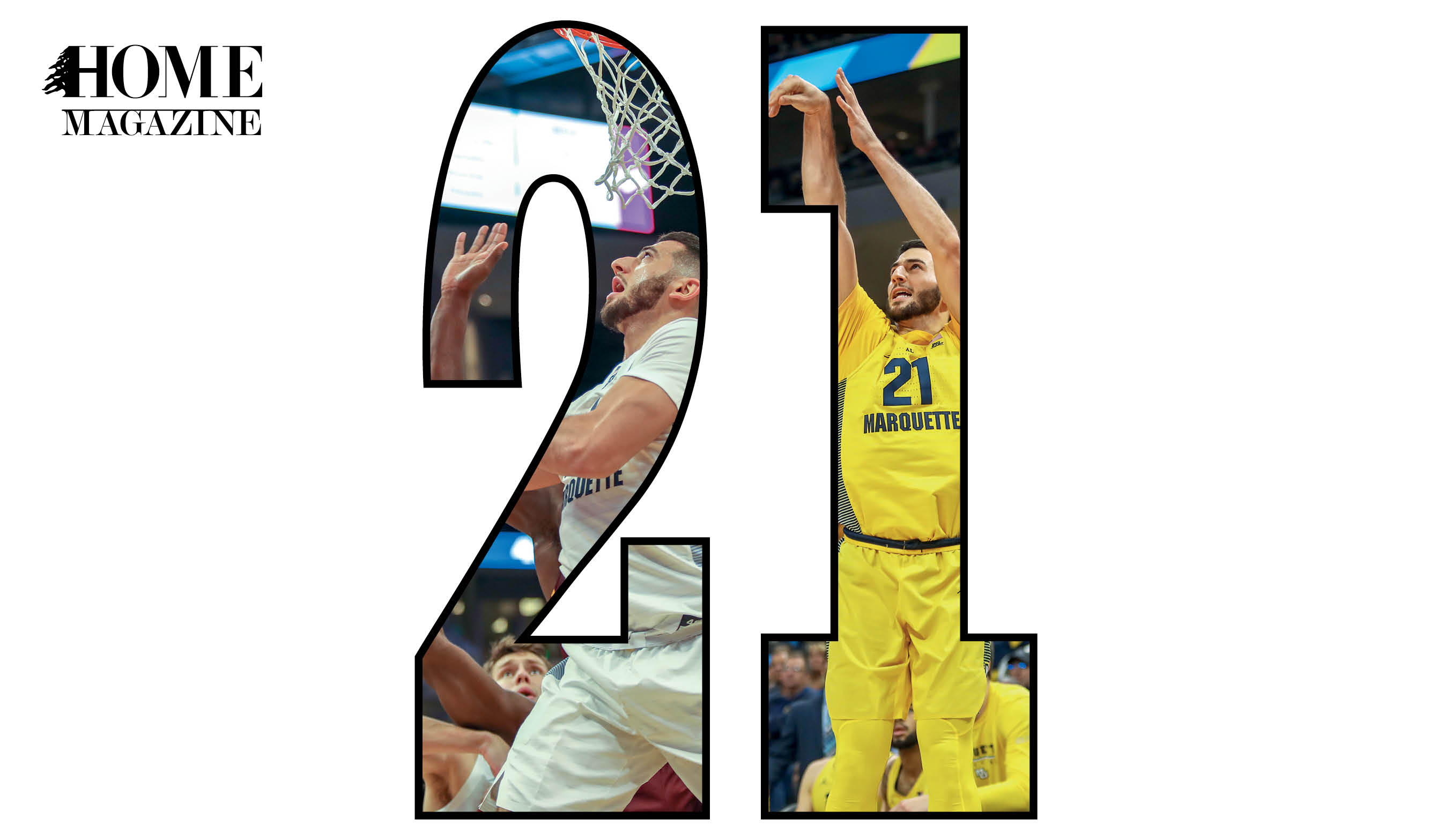
At the time, in 2017, he was 22 years old, lived in the Bronx, New York, and was playing Division 1 men’s basketball at Fordham University. Chartouny now calls Milwaukee, Wisconsin, HOME. He is a graduate student at Marquette University and a player on its competitive Division 1 men’s basketball team.
As a highly-touted Lebanese-Canadian basketball player who has played for prominent teams in three different countries, Chartouny now considers HOME court to be anywhere with a hoop.
Yet when Chartouny points to a map of Lebanon, HOME is Harissa.
He was born in Canada in 1994, four years after his Lebanese parents, Amale El-Khoury and Christian Chartouny, fled Lebanon during the last year of the Civil War. His grandparents left, too. In Montreal, they all lived together under the same roof.
Chartouny said his dual-identity can be hard to explain, especially in the United States.
“If I’m in Canada, people know I’m Lebanese,” Chartouny said. “But people in the United States think I’m Canadian.”
“Both of my parents are Lebanese. I’m Lebanese. I was born in Canada, but I’m very proud that I’m Lebanese.”
Chartouny still has plenty of family in Lebanon, and in the past four years, he’s made the trek back each summer.
The first visit was for a cousin’s wedding. The latter three were all about basketball.
“The first time that I got on the court with the Lebanese National Team – that was a really proud moment,” Chartouny said. “I was very excited. The fans were just going crazy. It was packed.”
At 21, Chartouny was one of the two youngest men to make the national team roster.
“Lebanese fans are so nice, whether you play zero minutes or you play 40 minutes,” Chartouny said. “They just love us. My first year, I didn’t even play that much. But I was going to restaurants and people would come up to me and they’d know me.”
This newfound fame shocked Chartouny.
“It is crazy because I’m not even a professional basketball player. It’s the fact that you play for the national team, you’re like a hero. A lot of kids even come and ask for your signature. It’s like here at Marquette, but 10 times more because it’s a country.”
Chartouny first played for the Lebanese National Team when he was playing at Fordham, where he led the nation in steals in his last season with 97.
“And when I first got to Fordham four years ago, I could barely speak English,” Chartouny said. He’s fluent in French and speaks Arabic at HOME.
It’s not the only time Chartouny felt atypical.
“I’m different from other players,” Chartouny said. “I like when people come to watch me play and think I’m good, but I like it more when they say I make an impact on the game.
“I want to be that guy. I don’t want to just be a passer or a rebounder or a scorer. I want people to look at me and think I’m a winner.”
Chartouny’s recipe for success is simple – maintaining a never-give-up mindset.
“I always tell people it’s winning the game of infinity,” he said. “Whatever I’m doing, I need to win. If it’s a shootaround, I need to make the most shots. If it’s a game of cards, I can’t lose. I hate to lose. Every day I try to win in whatever I’m doing.”
That winning mentality was a factor in Chartouny choosing to enroll at Marquette. He finished his undergraduate degree in business administration at Fordham in three years, giving him one season of collegiate basketball eligibility remaining.
“I want to play professionally,” Chartouny said. “Last year I realized that to give myself the best chance to do that, I had to play somewhere like Marquette with more exposure and competition.
“My goal is to play in the NBA,” Chartouny said. “If that doesn’t work out, I’ll go overseas and play in Europe or Lebanon.”
Even if it’s not for basketball-related reasons, a HOMEcoming to Lebanon is in his plans.
“I’ll definitely be back to Lebanon,” Chartouny said. “I haven’t had Lebanese food in months. I haven’t seen my family there in months. When I’m here in the U.S., I feel disconnected from it.”
Some of Chartouny’s favorite Lebanese dishes include tabbouleh and fatoush. When he was in Lebanon last summer with the national team, he’d wake up in the mountains and have kanafeh. They’d spend the day at the beach and head to practice at night.
“Sometimes we would have to practice without any lights,” Chartouny said, recalling the scheduled power outages in the country. “Can you imagine practicing without any lights?”
Gametime was a different story. The lights shone brightly in the team’s new arena, Nouhad Nawfal in Zouk Mikael. Among the more than 10,000 attendees were some familiar faces; it was the first time his family in Lebanon was able to see him play.
“I love to spend time with my family; that’s the main thing that I miss everyday – just getting to be around my family. People who really know me know how important family is to me,” he said.
However, Chartouny’s late grandfather was never able to see him play for Lebanon.
“One reason why I wanted to play with the Lebanese National Team was to honor my grandfather,” Chartouny said. “He was really proud of what I was doing.”
 Signature Boutique
Lebanon, in your inbox


HOMEland Magazine
We firmly believe that the internet should be available and accessible to anyone, and are committed to providing a website that is accessible to the widest possible audience, regardless of circumstance and ability.
To fulfill this, we aim to adhere as strictly as possible to the World Wide Web Consortium’s (W3C) Web Content Accessibility Guidelines 2.1 (WCAG 2.1) at the AA level. These guidelines explain how to make web content accessible to people with a wide array of disabilities. Complying with those guidelines helps us ensure that the website is accessible to all people: blind people, people with motor impairments, visual impairment, cognitive disabilities, and more.
This website utilizes various technologies that are meant to make it as accessible as possible at all times. We utilize an accessibility interface that allows persons with specific disabilities to adjust the website’s UI (user interface) and design it to their personal needs.
Additionally, the website utilizes an AI-based application that runs in the background and optimizes its accessibility level constantly. This application remediates the website’s HTML, adapts Its functionality and behavior for screen-readers used by the blind users, and for keyboard functions used by individuals with motor impairments.
If you’ve found a malfunction or have ideas for improvement, we’ll be happy to hear from you. You can reach out to the website’s operators by using the following email
Our website implements the ARIA attributes (Accessible Rich Internet Applications) technique, alongside various different behavioral changes, to ensure blind users visiting with screen-readers are able to read, comprehend, and enjoy the website’s functions. As soon as a user with a screen-reader enters your site, they immediately receive a prompt to enter the Screen-Reader Profile so they can browse and operate your site effectively. Here’s how our website covers some of the most important screen-reader requirements, alongside console screenshots of code examples:
Screen-reader optimization: we run a background process that learns the website’s components from top to bottom, to ensure ongoing compliance even when updating the website. In this process, we provide screen-readers with meaningful data using the ARIA set of attributes. For example, we provide accurate form labels; descriptions for actionable icons (social media icons, search icons, cart icons, etc.); validation guidance for form inputs; element roles such as buttons, menus, modal dialogues (popups), and others. Additionally, the background process scans all the website’s images and provides an accurate and meaningful image-object-recognition-based description as an ALT (alternate text) tag for images that are not described. It will also extract texts that are embedded within the image, using an OCR (optical character recognition) technology. To turn on screen-reader adjustments at any time, users need only to press the Alt+1 keyboard combination. Screen-reader users also get automatic announcements to turn the Screen-reader mode on as soon as they enter the website.
These adjustments are compatible with all popular screen readers, including JAWS and NVDA.
Keyboard navigation optimization: The background process also adjusts the website’s HTML, and adds various behaviors using JavaScript code to make the website operable by the keyboard. This includes the ability to navigate the website using the Tab and Shift+Tab keys, operate dropdowns with the arrow keys, close them with Esc, trigger buttons and links using the Enter key, navigate between radio and checkbox elements using the arrow keys, and fill them in with the Spacebar or Enter key.Additionally, keyboard users will find quick-navigation and content-skip menus, available at any time by clicking Alt+1, or as the first elements of the site while navigating with the keyboard. The background process also handles triggered popups by moving the keyboard focus towards them as soon as they appear, and not allow the focus drift outside it.
Users can also use shortcuts such as “M” (menus), “H” (headings), “F” (forms), “B” (buttons), and “G” (graphics) to jump to specific elements.
We aim to support the widest array of browsers and assistive technologies as possible, so our users can choose the best fitting tools for them, with as few limitations as possible. Therefore, we have worked very hard to be able to support all major systems that comprise over 95% of the user market share including Google Chrome, Mozilla Firefox, Apple Safari, Opera and Microsoft Edge, JAWS and NVDA (screen readers).
Despite our very best efforts to allow anybody to adjust the website to their needs. There may still be pages or sections that are not fully accessible, are in the process of becoming accessible, or are lacking an adequate technological solution to make them accessible. Still, we are continually improving our accessibility, adding, updating and improving its options and features, and developing and adopting new technologies. All this is meant to reach the optimal level of accessibility, following technological advancements. For any assistance, please reach out to