Disant ces mots, son gosier altéré
Humait un vin, d’ambre coloré,
Sentait encore la grappe parfumée
Dont fut pour nous la liqueur exprimée
Having these words in passion said
He swallowed wine like amber red;
Wine, which by its taste confessed
The grape from whence the juice was
pressed
Voltaire
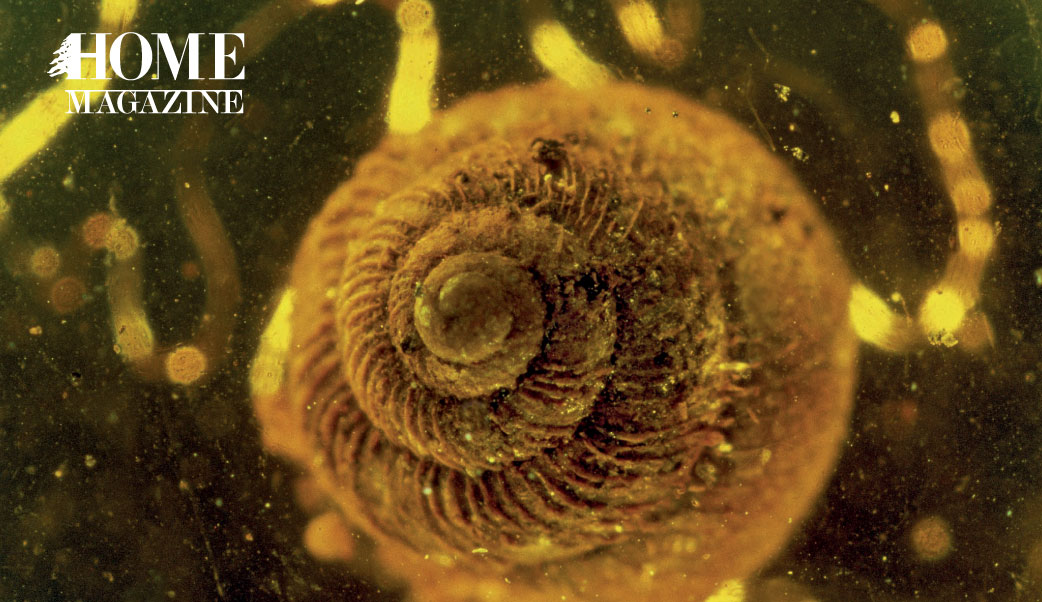
With its variety of color gradient ranging from white to dark red and its translucent texture, amber has been appreciated since the Neolithic period (some 7,000 years ago) and was used by early humans in jewelry and in decorative objects.
Photos by: Dany Azar

Amber is a fossilized tree resin hardened and preserved in the earth’s crust for millions of years. Famous as a gemstone, amber has become a color reference, located midway between gold and orange.
The beauty of this fossilized resin is far from being its only interesting feature: it has scientific importance due to the insects and microorganisms that were stuck in the resin – and thus can be studied today to uncover the mysteries of our past; of our evolution. Recently, a once-in-a-lifetime, very unusual discovery was made in a piece of amber from Myanmar destined to be made into jewelry: the tail of a 99-million-year-old dinosaur was found trapped inside. Scientists were able to identify the finest details: full sections of vertebrae, and mummified skin and feathers still with their pigmentation; thus they were able to ascertain the appearance of the dinosaur.

Amber. A time capsule, a window that takes us back to the faraway past, to the early Cretaceous – some 135 million years ago. Geographically, Lebanon was then positioned close to the equator, to the south of its current location. A dark and dense tropical forest covered the territory. Arborescent ferns, conifers and the first flowering plants grew in this forest. Fairly high temperatures and a humid climate favored the appearance of many insect species, reptiles and arachnids. Pterosauria, a flying piscivores lizard measuring 1.30 meters, dominated the sky, while Brachiosaurus, a long-necked herbivorous dinosaur, measuring up to 25 meters long, roamed in this forest, along with other creatures – all long extinct.

More than 400 amber outcrops have been discovered up to now, covering 10% of the Lebanese territory. Of those deposits, 25 have yielded biological inclusions, among them the oldest representatives of terrestrial invertebrate species. Lebanese amber is the oldest amber discovered to date, with intensive biological inclusions.
The importance of Lebanon’s amber resides in the fossilized insects trapped in the resin. Butterflies, lizards, scorpions, snails and spiders were stuck in the resin, sometimes in quite odd situations – like mating! Lebanese amber allowed fauna and flora to be inventoried, and the paleoenvironment from the past to be simulated.
“Lebanese amber is the oldest amber discovered to date, with intensive biological inclusions.”
Lebanese amber is renowned worldwide for the importance of its inclusions and it is considered to be of high scientific value. About 8,500 biological inclusions have been found up to now in the amber from different outcrops.

The preservation of the biological inclusions in their minute 3D detail is quite unique, allowing paleontologists to better understand ecological phenomena from the past and the history of our environment’s evolution. Crucial information was collected in regard to some of the oldest sampled ecosystems.

Moreover, outcrops of amber dating to Late Jurassic (160 million years ago) have recently been discovered in the volcano-basaltic soil of the northern part of Mount Lebanon: El-Ghineh, Tannourine, Bekaa-Kafra and Hadath El-Joubbe. Paleontology Professors Dany Azar and Raymond Gèze, from the Department of Natural Science, Faculty of Science at the Lebanese University are researching and studying these new discoveries, which are shedding more light on the ecosystem and geological formations since the Late Jurassic. Raif Milki, Professor of Public Health at the American University of Beirut, is a pioneer in the process of collecting amber, which has not been without its perils for him, since his field trips during the civil war period were often located in areas known for their lack of security. In 2001, he published a book with Georges Poinar titled Lebanese Amber, the Oldest Insect Ecosystem in Fossilized Resin, which covers the major aspects of Lebanese amber.
Further research might reveal even more outstanding discoveries. Lebanon’s earth crust might not have yet revealed all its treasures.
HOMEland Magazine
We firmly believe that the internet should be available and accessible to anyone, and are committed to providing a website that is accessible to the widest possible audience, regardless of circumstance and ability.
To fulfill this, we aim to adhere as strictly as possible to the World Wide Web Consortium’s (W3C) Web Content Accessibility Guidelines 2.1 (WCAG 2.1) at the AA level. These guidelines explain how to make web content accessible to people with a wide array of disabilities. Complying with those guidelines helps us ensure that the website is accessible to all people: blind people, people with motor impairments, visual impairment, cognitive disabilities, and more.
This website utilizes various technologies that are meant to make it as accessible as possible at all times. We utilize an accessibility interface that allows persons with specific disabilities to adjust the website’s UI (user interface) and design it to their personal needs.
Additionally, the website utilizes an AI-based application that runs in the background and optimizes its accessibility level constantly. This application remediates the website’s HTML, adapts Its functionality and behavior for screen-readers used by the blind users, and for keyboard functions used by individuals with motor impairments.
If you’ve found a malfunction or have ideas for improvement, we’ll be happy to hear from you. You can reach out to the website’s operators by using the following email
Our website implements the ARIA attributes (Accessible Rich Internet Applications) technique, alongside various different behavioral changes, to ensure blind users visiting with screen-readers are able to read, comprehend, and enjoy the website’s functions. As soon as a user with a screen-reader enters your site, they immediately receive a prompt to enter the Screen-Reader Profile so they can browse and operate your site effectively. Here’s how our website covers some of the most important screen-reader requirements, alongside console screenshots of code examples:
Screen-reader optimization: we run a background process that learns the website’s components from top to bottom, to ensure ongoing compliance even when updating the website. In this process, we provide screen-readers with meaningful data using the ARIA set of attributes. For example, we provide accurate form labels; descriptions for actionable icons (social media icons, search icons, cart icons, etc.); validation guidance for form inputs; element roles such as buttons, menus, modal dialogues (popups), and others. Additionally, the background process scans all the website’s images and provides an accurate and meaningful image-object-recognition-based description as an ALT (alternate text) tag for images that are not described. It will also extract texts that are embedded within the image, using an OCR (optical character recognition) technology. To turn on screen-reader adjustments at any time, users need only to press the Alt+1 keyboard combination. Screen-reader users also get automatic announcements to turn the Screen-reader mode on as soon as they enter the website.
These adjustments are compatible with all popular screen readers, including JAWS and NVDA.
Keyboard navigation optimization: The background process also adjusts the website’s HTML, and adds various behaviors using JavaScript code to make the website operable by the keyboard. This includes the ability to navigate the website using the Tab and Shift+Tab keys, operate dropdowns with the arrow keys, close them with Esc, trigger buttons and links using the Enter key, navigate between radio and checkbox elements using the arrow keys, and fill them in with the Spacebar or Enter key.Additionally, keyboard users will find quick-navigation and content-skip menus, available at any time by clicking Alt+1, or as the first elements of the site while navigating with the keyboard. The background process also handles triggered popups by moving the keyboard focus towards them as soon as they appear, and not allow the focus drift outside it.
Users can also use shortcuts such as “M” (menus), “H” (headings), “F” (forms), “B” (buttons), and “G” (graphics) to jump to specific elements.
We aim to support the widest array of browsers and assistive technologies as possible, so our users can choose the best fitting tools for them, with as few limitations as possible. Therefore, we have worked very hard to be able to support all major systems that comprise over 95% of the user market share including Google Chrome, Mozilla Firefox, Apple Safari, Opera and Microsoft Edge, JAWS and NVDA (screen readers).
Despite our very best efforts to allow anybody to adjust the website to their needs. There may still be pages or sections that are not fully accessible, are in the process of becoming accessible, or are lacking an adequate technological solution to make them accessible. Still, we are continually improving our accessibility, adding, updating and improving its options and features, and developing and adopting new technologies. All this is meant to reach the optimal level of accessibility, following technological advancements. For any assistance, please reach out to