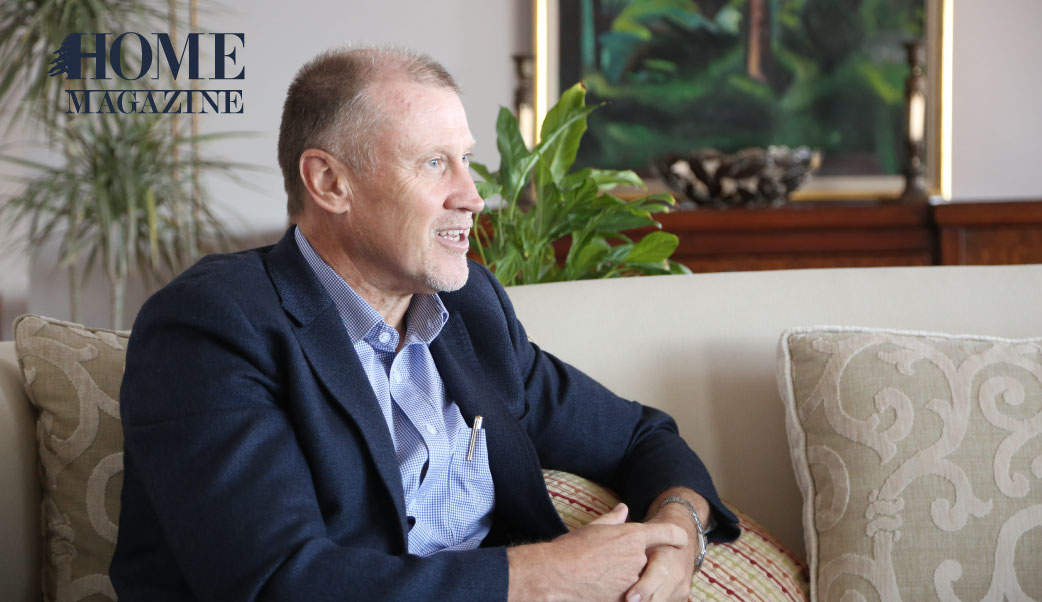
Glenn Miles, Ambassador of Australia to Lebanon, expresses his feeling about his two-year experience. He talks about the future plans to strengthen the relations between the two countries describing the strong ties they have built. He also conveys an advice to the Lebanese people through HOME.
What were your first impressions of Lebanon, and how have they changed since then?
My first impression was that the city of Beirut was alive and bustling, cosmopolitan and yet chaotic, with a vibrant music and art scene that rivals any city and all set against the backdrop of majestic snow-covered mountains. Dig a little deeper and you will find out that Lebanon is full of surprises, with a wonderful array
of museums, ancient monuments, mountain walks, wonderful views of the Mediterranean, and an eclectic mix of restaurants and bars. But what makes Lebanon unique is its people. It is the warmth and friendliness of everyone you meet. It quickly feels like HOME, which is so important when you are moving to a new country with your family.
“What makes Lebanon unique is its people”
What are the accomplishments you would like to mention?
Fortunately, Australia and Lebanon already have a strong relationship, and one that is deep and varied. At the embassy, we have sought to build on this by promoting what Australia has to offer. This includes working with business groups to encourage bilateral trade and investment. For instance, we held a successful seminar at the Lebanon Energy Conference earlier this year, where we promoted Australia as a business destination.
We have also brought out Australian artists to demonstrate Australia’s strong cultural and art scene, including the indigenous dance group Djuki Mala, and classical guitarists, the Grigoryan Brothers.
We are also raising the profile of Lebanon in Australia, particularly regarding the difficult challenges and the enormous price Lebanon is paying as a result of the ongoing humanitarian tragedy in Syria. And we are proud of the contribution Australia has been able to make in this regard.
In May, the Australian Government announced that it has offered $220 million-value packages over three years in response to the Syria crisis, of which a significant amount will be allocated to Lebanon. This is in addition to the $213 million already provided since 2011, of which over $30 million was allocated to Lebanon to help not only refugees, but also unprivileged Lebanese communities.
The assistance has delivered food, water, shelter, protection, health services, and education to communities here in need.
You were part of the announcement in the Lebanese Diaspora Energy (LDE) Forum. What are your hopes for this initiative?
The International Chamber House (ICH) is a positive initiative. It is based on a model used in Victoria and aims to encourage strong collaboration between government agencies and bilateral international chambers and business associations, to facilitate trade and investment opportunities for Lebanese Business with international markets. It will build on the annual Lebanon Diaspora Energy Conference to bring together business people with links to Lebanon from across the Globe. It has worked well in Victoria and I am confident it will work well here.
We continue to work with Australian-Lebanese Business Groups to promote bilateral trade and investment.
We regularly assist with visits of Australian trade delegations, led by the Chambers of Commerce in Australia, and assist in facilitating meetings. At the political level, there have been a number of visits over the years, both to and from Australia. Our foreign minister visited here in 2014, while our minister for immigration came out last year. We also see regular visits to Australia by Lebanese politicians, which assists in empowering bonds between the two peoples.
We also cooperate closely with Lebanon in other areas, including UN issues, sharing many common concerns, and of course in law enforcement, counter-terrorism and defense. Earlier this year, we provided $1.6 million in helicopter parts to the Lebanese Armed Forces, to assist the LAF in building capacity and contributing to peace and security in the country.
What are the key challenges for both countries?
The biggest issue in building the relationship is perceptions, most of which are driven by the media. On one hand, Australian business people tend to only look at the Gulf when they consider businesses in the Middle East. The Lebanese market looks such a hard one to penetrate, surrounded by instability. The media doesn’t report that Lebanon’s imports are worth around $24 billion – an obviously solid market in anyone’s terms.
It is good to point out that there are over 300 flights between Australia and UAE and Qatar per week, there are numerous connecting flights to all the major cities in Australia.
Despite the political difficulties, there are business opportunities here and several Australian companies are already taking advantage of this fact. Also, from a Lebanese point of view, Australia looks too far with little to offer.
Most Lebanese aren’t aware that Australia is a global leader in Agribusiness, Education, Tourism, Mining, as well as Wealth Management. We have had 24 years of uninterrupted growth and Australia is ranked 5th in the world for GDP per capita and has the 12th largest economy.
“In Australia, we have had 24 years of uninterrupted growth”
What are the demographics of Australians with Lebanese descendants in Australia, and their major groups, clubs, and NGOs?
Officially, there are well over 200 000 Australians of Lebanese descent in Australia, but the true figure is probably significantly greater. We also have around 20,000 Australians living here in Lebanon, a figure that grows considerably over the summer months as many Lebanese – Australians come back to visit family and friends. In July alone, around 11,000 Australians entered Lebanon, which obviously has a positive impact on tourism.
In Australia, Lebanese-Australians are represented in aspects of Australian life. From politics, to academics, from sport to science and medicine, Lebanese- Australians have made a positive and substantial contribution to Australia.

You served as an ambassador to Kuwait, a representative in Ramallah and had earlier postings in Amman and Riyadh. In your opinion what is the difference between these Arab countries? What are the similarities?
The biggest difference is the cosmopolitan feel of Beirut and Lebanon. It’s the variety in geography and climate, and the vibrant lifestyles of Lebanese people that make Lebanon so unique in comparison with other countries in the region. The Mediterranean influence is clear.
At the same time, there are also similarities. The language, the sayings, the music, and the general approach to life are common themes.
What do you think makes Lebanon so special?
The warmth of the Lebanese people is what makes Lebanon such a pleasant country to work and live in. In my time here, I have been invited to almost every village and my job has allowed me to visit much of this beautiful country.
In every place, I have been provided with guidance, advice, and most importantly friendship.
What advice do you have for the Lebanese people?
My one message is that, wherever you travel in Lebanon and whichever community you talk to, the issues, the desires, and the dreams for the country are all the same. Like all peoples of the world, Lebanese want peace, stability, and a strong economy so that their children can grow up in peace and prosperity. My message would be that what unites Lebanese is always going to be stronger than what divides them.
“What unites Lebanese is always going to be stronger than what divides them”

What will you be taking back with you to Australia?
At the physical level, I am carrying extra kilos I have gained from all the excellent food I have been fortunate enough to taste and savor. At the emotional level, it will be the friendships I have built and the good times I have enjoyed in this remarkable country.
The ambassador privileged HOME with some secrets of Australia and Lebanon. The Lebanese Rugby League Team, ‘The Cedars’ will play in the Rugby League World Cup to be held in late 2017 in Australia. The Ambassador also ran the 42-Km Beirut Marathon for the first time in 2016, and is also a keen surfer who has been able to keep his skills up in Lebanon. His ambition while here is to go skiing and surfing on the same day.
HOMEland
Coming Soon
HOMEland Events & Collaborations
Coming Soon
 Signature Boutique