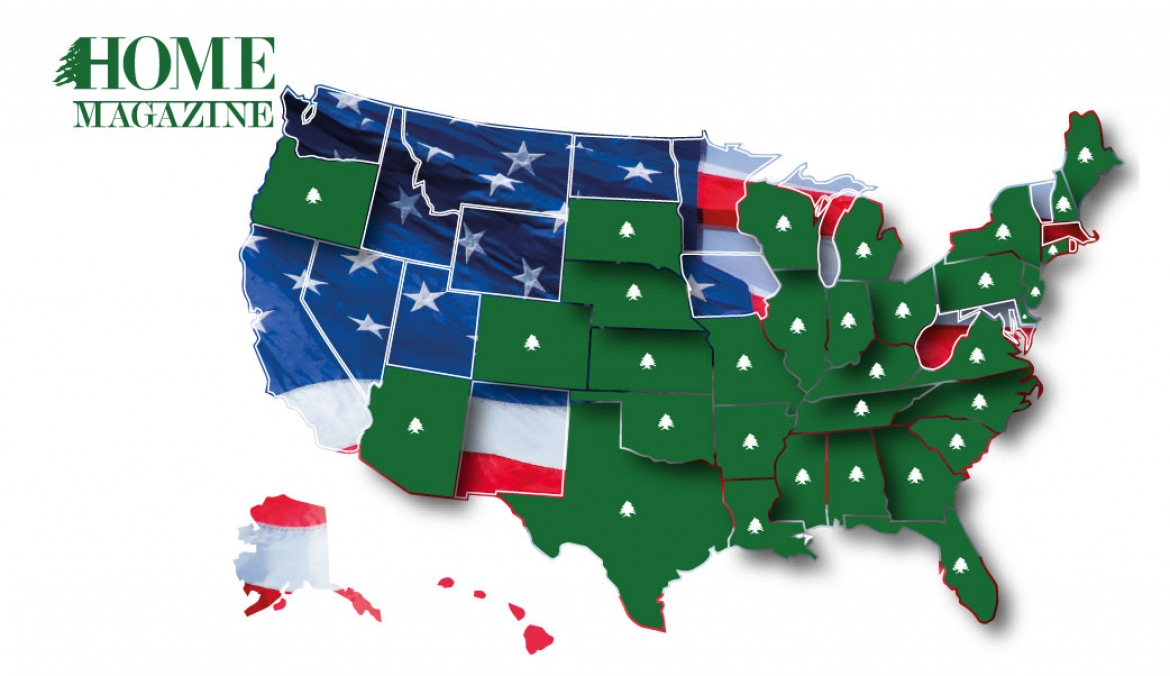
Almost anyone who has done an internet search for something in Lebanon has faced the problem that many of the resulting entries are for cities and towns in the US also called Lebanon.
Where are the Lebanons in America?
It is easier to list the 15 states that apparently never had a Lebanon: Alaska, California, Hawaii, Idaho, Massachusetts, Montana, Nevada, New Mexico, North Dakota, Rhode Island, Utah, Vermont, Washington, West Virginia, and Wyoming. There are records of 88 Lebanons in the other 35 states. While some have ceased to exist or have been incorporated into other towns, the remaining 53, use many variations of the name: Lebanon (22), Lebanon Township (7), Mount Lebanon and West Lebanon (4 each), South Lebanon (3), New Lebanon, Lebanon Heights, and Lebanon Junction (2 each) and Center Lebanon, East Lebanon, Lebanon Church, Lebanon Springs, Mount Lebanon Township, and Rising Sun-Lebanon (1 each).
Population of the Lebanons
According to their latest census information, the populations of these Lebanons range from 47 for Lebanon, South Dakota to 33,137 for Mt. Lebanon Township, Pennsylvania. Nine have populations of less than 1000, while another 9 have populations of over 10,000, and the total combined population of all these Lebanons is 230,959.

Reasons they were named Lebanon
Considering the number of emigrants from Lebanon to the US, one would think that some of them would have been named in honor of the homeland of those emigrants. But this does not seem to have been the case for any of them. The names of most of these Lebanons refer to nearby forests of cedars, hickory, juniper or other trees that reminded people of the cedars of Lebanon, mentioned many times in the Bible. A few were named after other Lebanons in America where many of their early settlers came from: The Lebanon of South Dakota was apparently named after the Lebanon of New York; Lebanon, New Hampshire after Lebanon, Connecticut; and both Lebanon, Missouri and Lebanon, Texas after Lebanon, Tennessee. The case of Illinois, however, is quite different. The southern third of Illinois is referred to as Little Egypt, and its towns not only include Lebanon, but also Cairo, Thebes, Palestine, and Karnak, as well as a number of Greek names.
Some of their Special Histories
The Lebanons of American have special histories totally disconnected from Lebanon the country. Lebanon, Connecticut is best known for its role in the American Revolution. Lebanon, Oregon is the home of the World’s Largest Strawberry Shortcake, which is part of the annual Strawberry Festival that began in 1909. New Lebanon, New York was the spiritual home of the Shakers, a religious sect that branched off from the Quakers. Lebanon, Oklahoma was settled in the late 19th century as part of the Chickasaw Indian Nation. And Lebanon, Kansas was the closest town to the geographical center of the US until Hawaii and Alaska became states.
Responses From Two Lebanons
Mayor Lyle Anderson of Lebanon, Missouri responded to an enquiry from HOME Magazine, noting that the town was settled by Scotch/Irish immigrants from Tennessee and Kentucky, that it was hotly contested during the Civil War, and that it is located in the Missouri Ozarks with the gentle beauty of dogwoods, red buds and oak forests. And Joe LePage, a municipal official of Lebanon, Indiana, responded as well, noting that the Boone County Courthouse, located in Lebanon, boasts its single-piece vertical Ionic order limestone columns that were at one time the largest single-piece limestone columns in the world.
A Lebanese-Australian-Lebanonian
Mr. LePage identified the one resident of the town of Lebanese heritage as Roye Gaha (Riyad Jeha) who moved to Lebanon, Indiana from Australia where his family had emigrated when he was 10. Mr. Gaha who is from Bishmizzine in Kourah, did not settle in Lebanon, Indiana because of its name, but because of a few very special coincidences during his family’s trip around the US in 1978. He did, however, create at least one connection between his two Lebanons by leading the effort for the Rotary Club of Lebanon, Indiana to support the sending of 32 dialysis machines to Lebanon. It would be wonderful if he and other Lebanese in America could help to establish further connections between the Lebanons of America and the country of Lebanon.
For more info:

HOMEland Magazine
We firmly believe that the internet should be available and accessible to anyone, and are committed to providing a website that is accessible to the widest possible audience, regardless of circumstance and ability.
To fulfill this, we aim to adhere as strictly as possible to the World Wide Web Consortium’s (W3C) Web Content Accessibility Guidelines 2.1 (WCAG 2.1) at the AA level. These guidelines explain how to make web content accessible to people with a wide array of disabilities. Complying with those guidelines helps us ensure that the website is accessible to all people: blind people, people with motor impairments, visual impairment, cognitive disabilities, and more.
This website utilizes various technologies that are meant to make it as accessible as possible at all times. We utilize an accessibility interface that allows persons with specific disabilities to adjust the website’s UI (user interface) and design it to their personal needs.
Additionally, the website utilizes an AI-based application that runs in the background and optimizes its accessibility level constantly. This application remediates the website’s HTML, adapts Its functionality and behavior for screen-readers used by the blind users, and for keyboard functions used by individuals with motor impairments.
If you’ve found a malfunction or have ideas for improvement, we’ll be happy to hear from you. You can reach out to the website’s operators by using the following email
Our website implements the ARIA attributes (Accessible Rich Internet Applications) technique, alongside various different behavioral changes, to ensure blind users visiting with screen-readers are able to read, comprehend, and enjoy the website’s functions. As soon as a user with a screen-reader enters your site, they immediately receive a prompt to enter the Screen-Reader Profile so they can browse and operate your site effectively. Here’s how our website covers some of the most important screen-reader requirements, alongside console screenshots of code examples:
Screen-reader optimization: we run a background process that learns the website’s components from top to bottom, to ensure ongoing compliance even when updating the website. In this process, we provide screen-readers with meaningful data using the ARIA set of attributes. For example, we provide accurate form labels; descriptions for actionable icons (social media icons, search icons, cart icons, etc.); validation guidance for form inputs; element roles such as buttons, menus, modal dialogues (popups), and others. Additionally, the background process scans all the website’s images and provides an accurate and meaningful image-object-recognition-based description as an ALT (alternate text) tag for images that are not described. It will also extract texts that are embedded within the image, using an OCR (optical character recognition) technology. To turn on screen-reader adjustments at any time, users need only to press the Alt+1 keyboard combination. Screen-reader users also get automatic announcements to turn the Screen-reader mode on as soon as they enter the website.
These adjustments are compatible with all popular screen readers, including JAWS and NVDA.
Keyboard navigation optimization: The background process also adjusts the website’s HTML, and adds various behaviors using JavaScript code to make the website operable by the keyboard. This includes the ability to navigate the website using the Tab and Shift+Tab keys, operate dropdowns with the arrow keys, close them with Esc, trigger buttons and links using the Enter key, navigate between radio and checkbox elements using the arrow keys, and fill them in with the Spacebar or Enter key.Additionally, keyboard users will find quick-navigation and content-skip menus, available at any time by clicking Alt+1, or as the first elements of the site while navigating with the keyboard. The background process also handles triggered popups by moving the keyboard focus towards them as soon as they appear, and not allow the focus drift outside it.
Users can also use shortcuts such as “M” (menus), “H” (headings), “F” (forms), “B” (buttons), and “G” (graphics) to jump to specific elements.
We aim to support the widest array of browsers and assistive technologies as possible, so our users can choose the best fitting tools for them, with as few limitations as possible. Therefore, we have worked very hard to be able to support all major systems that comprise over 95% of the user market share including Google Chrome, Mozilla Firefox, Apple Safari, Opera and Microsoft Edge, JAWS and NVDA (screen readers).
Despite our very best efforts to allow anybody to adjust the website to their needs. There may still be pages or sections that are not fully accessible, are in the process of becoming accessible, or are lacking an adequate technological solution to make them accessible. Still, we are continually improving our accessibility, adding, updating and improving its options and features, and developing and adopting new technologies. All this is meant to reach the optimal level of accessibility, following technological advancements. For any assistance, please reach out to