
The English-Speaking Union is celebrating 100 years of creating opportunities for students from around the world to meet and speak together. Lebanese students have been participating in its signature event, an international public speaking competition, for almost two decades.
And it turns out, Lebanese shine in this arena!
Since Lebanon first entered the English- Speaking Union’s (ESU) International Public Speaking Competition in 2000, our little country on the Mediterranean has performed exceptionally well.
This year, American University of Beirut sophomore Kamel Wehbe ranked third internationally at the ESU Public Speaking Competition in London in May. He competed in a series of public speaking competitions involving 600,000 students from more than 50 countries, all speaking on “Inventing Our Future.”
The economics and political science major won the trip to London and the honor to represent Lebanon at the ESU-Lebanon competition held at the Lebanese American University (LAU) in the spring. His speech, Defying Reality, described a mindset Lebanese university students need to overcome the challenging economic and political facts of life in Lebanon – the idea that people can “create their own reality.”
Our strong showing
While Wehbe made us proud to be Lebanese, he wasn’t the first. Lebanon boasts several finalists and one grand champion, an amazing record for a country of Lebanon’s size.
In 2010, University of Balamand pre-med student Moataz El Israwi won first place with a clever speech on overpopulation, titled, Oops, I’m Pregnant… Again! Like Wehbe, he participated in a series of competitions involving hundreds of thousands of students. In the final round, he competed against 80 participants from 45 countries.
As the first-place winner, El Israwi was the guest of honor at a special ceremony at Buckingham Place where Prince Philip awarded him the grand prize in person. El Israwi’s speech coach Ms. Nayiri Baboudjian, a lecturer of English language and literature at the University of Balamand and an ESU alumna herself, accompanied him to both the competition and the award ceremony.
“We were so super proud,” said Baboudjian, in a recent interview with HOME. “It was one of Prince Philip’s last public appearances. It was a special moment. The ESU committee members from Lebanon were so supportive. And when we returned to Lebanon, the English ambassador invited us to a reception.”
Said El Israwi: “Now, eight years after the competition, I realize that participating in a big gathering of educated youngsters from different origins, backgrounds and cultures in a friendly and educational environment was the most enriching experience of my life.” In fact, he is hosting one of the friends he made at the event in Lebanon this summer. And he will soon complete his master’s degree in international affairs at LAU.
In 2008, another Balamand student, Jad El Khoury, made it to the final round. The Francophone was surprised to win the national English-speaking contest. He attributes his success to lots of practice and excellent coaching. His speech, A Plea for Hope, reflected on human rights in Lebanon.
El Khoury, who today is finding success as a screenwriter for television and cinema, agreed with El Israwi that “meeting other students from so many different backgrounds was one of the best experiences of my life.” His enthusiasm was only slightly dampened by the fact that Beirut International Airport was closed due to political conflict when he was supposed to return. “I was actually worried about HOME, but I was well taken care of,” he said. He spent an additional week in London, hosted by Youmna Asseily, the founder of Lebanon’s ESU chapter.
And back in 2002, even before Lebanon’s ESU chapter launched, another Lebanese student, Pia Zeinoun, came in second in the finals in London.
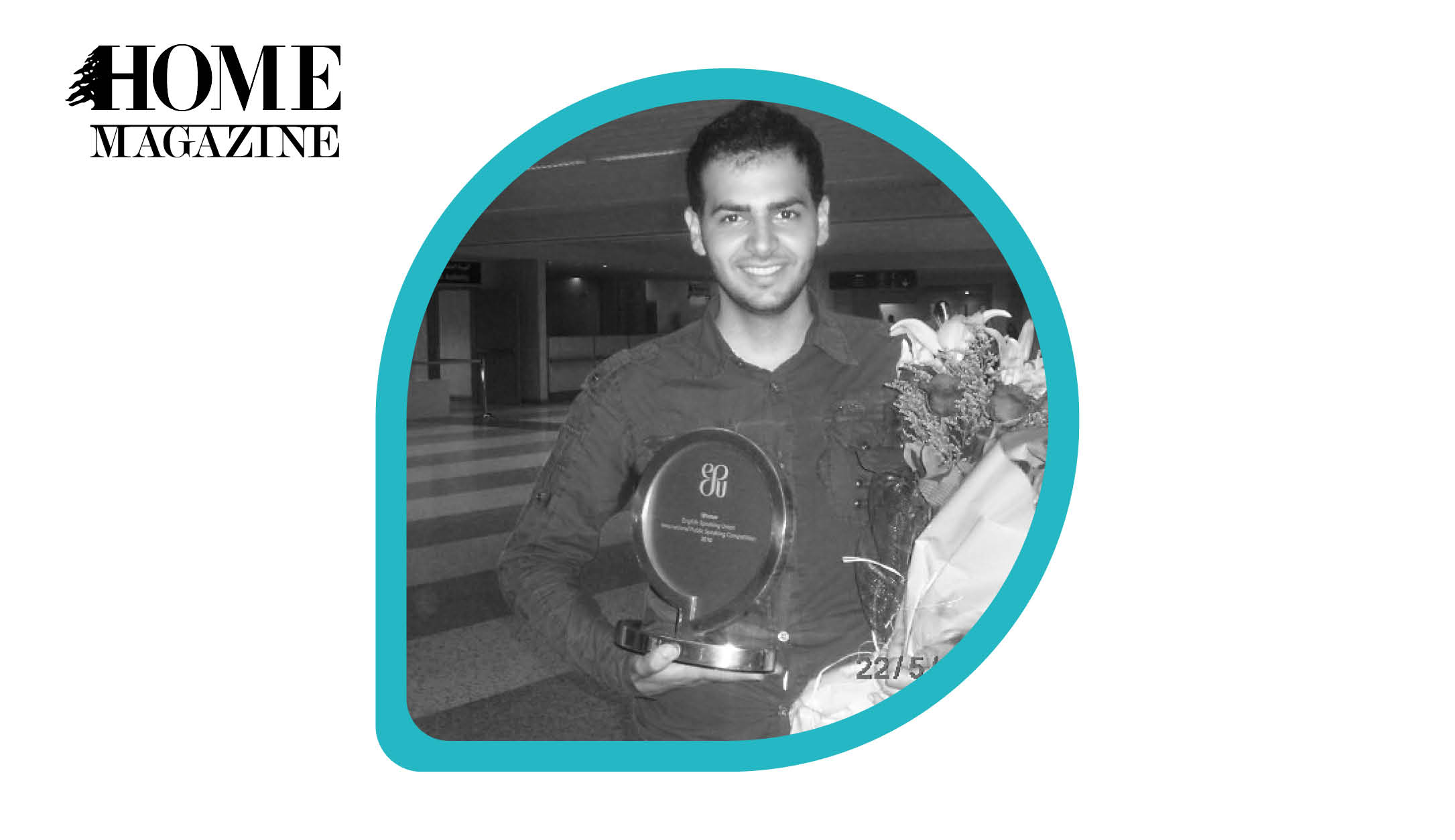
ESU 2010 International World Champion Moataz El Israwi
ESU in Lebanon
The London-based ESU is committed to giving encouragement and opportunity to young people to develop the ability to speak well in public, with the higher goal of nurturing international understanding and peace. “It’s not about promoting the language, but rather to foster the exchange of ideas among young people,” said then Chairman Lord Alan Watson at the founding ceremony for Lebanon’s chapter, the first in the Middle East, followed by Yemen and Turkey.
“There are four global languages: Arabic, Chinese, Hindi and English.
English, not because of the native speakers, but because of the amount of people who use it as a second language.
“Beirut itself is by instinct international and that is what we are trying to reestablish. In a way, it fits the traditional way of Beirut well, to be linked in with the international community.
“We are not trying to replace French. Beirut and Lebanon should certainly hold on to the French language. What we are arguing is that English is a language you add. You add it because it has become the language of the global village, and particularly for young people, English is a tremendous asset.”
“It’s not about promoting the language, but rather to foster the exchange of ideas among young people,” said then Chairman Lord Alan Watson at the founding ceremony for Lebanon’s chapter, the first in the Middle East.”
Asseily, who established an ESU chapter in Lebanon in 2003 and still serves as its president, said since its beginning, “Lebanon’s chapter has proven to be one of the most active worldwide.”
“In fact, in our early years, we were even more active and were pursuing international exchanges, debates and other activities, but the situation in Lebanon made people abroad fearful about coming to Lebanon,” she said. The ESU’s international council elected Asseily its president in 2006 because of “the dynamism of Lebanon’s branch,” she said. Asseily was the third president since the ESU was established in 1918 in the wake of World War I.
One popular program that expanded the horizons of Lebanese participants was scholarships given for a week-long cultural seminar and an international affairs conference at Oxford University. Baboudjian, one of the recipients, called the experience in Oxford “a dream come true.”
Nabelah A. Haraty, Ph.D., assistant professor of communication and English at LAU, and Mona Chahine, LAU senior instructor, both members of ESU’s executive council, have played key roles in running ESU’s National Public Speaking Competition for university students, now in its 18th year. Haraty recruited her friend Future Television personality Zaven Kouyoumdjian to serve as a celebrity judge and bring attention to the competition. “He does a lot for us to promote the competition,” she said.
“I love what I do for the ESU because it brings people together who otherwise would not have met,” said Haraty.
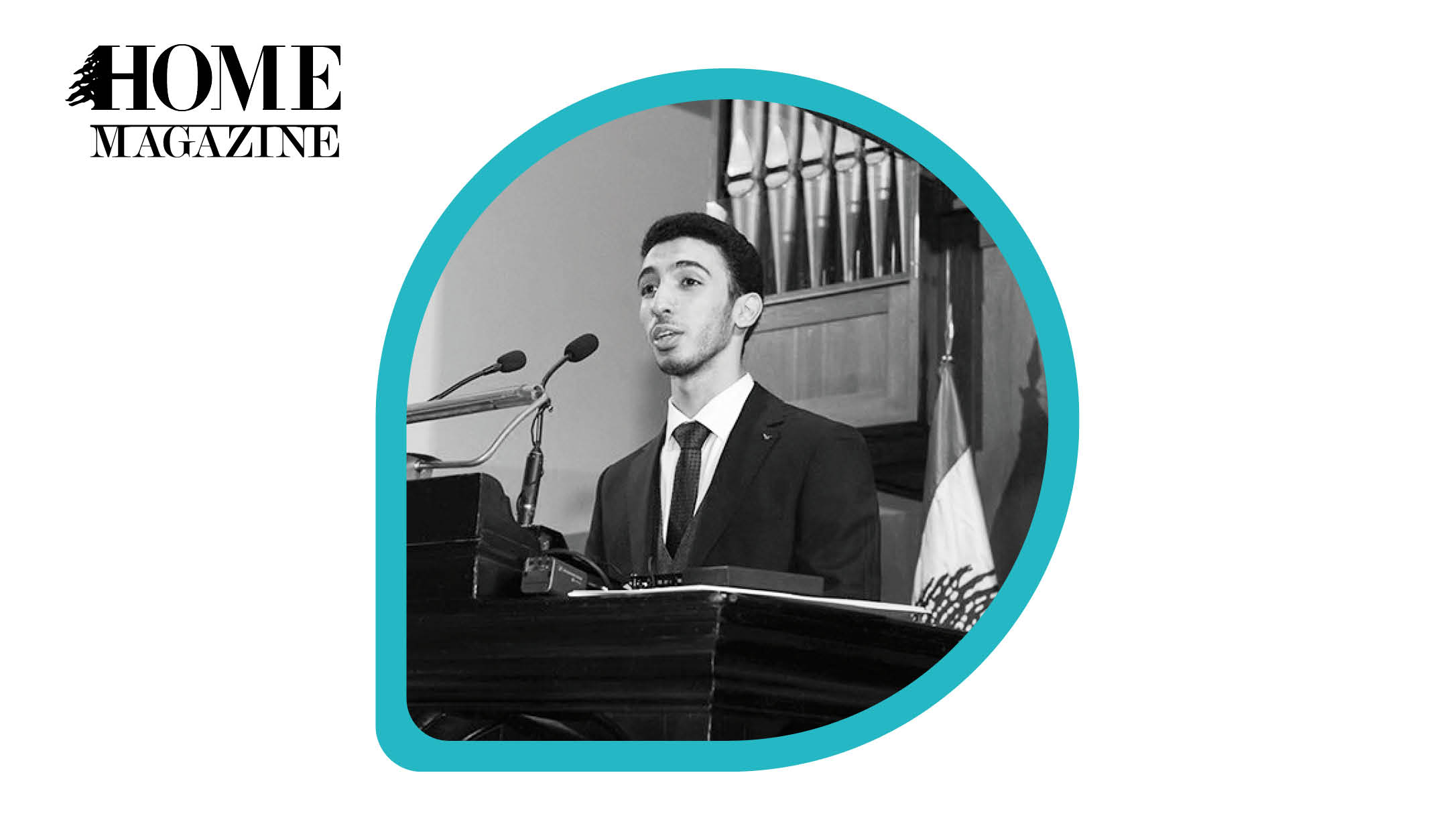
Kamel Wehbe placed third in the ESU 2018 International Competition
Excerpts from Kamel Wehbe’s awardwinning speech Defying Reality
We must invent the future … My father taught me that. In a tiny village called Mahrouna, he sold socks from the tender age of 8, until he scrapped enough money at 18 to travel to Bulgaria and start his own business. It took one small southern boy selling socks to invent my future and that of my family.
We must refuse to let our youth feel limited by predictions set for a country that may very well be small geographically, but is infinite in the resilience, potential and hard work of its people.
For more info:
https://100.esu.org/
https://www.facebook.com/the.esu/
Links to speeches:
https://youtu.be/BwAB8Kyp0hE
https://www.youtube.com/watch?v=m_PUs5qRcfA


HOMEland
Coming Soon
HOMEland Events & Collaborations
Coming Soon
 Signature Boutique