One summer afternoon in 2001, 11 years after the end of the Civil War, two women met over a cup of tea in a Lebanon still under Syrian occupation and divided along sectarian lines.
Article by: Yara Zgheib
One wore a hijab over her dark hair, the other a cross around her neck. Both had raised their children during the war. Marie Chaftari had been a communications officer for the Christian forces: “The other for me was the Muslim.” For Lina Hamade Charafeddine, who felt stigmatized for wearing her veil, “There was no place for the other in my daily life.”
They met through Initiatives of Change, a global organization headquartered in Switzerland, whose mission is to “build trust across the world’s divides.” It brought people together from all over the world, from either side of many conflicts, to address and heal wounds and work toward reconciliation and a future together. That cup of tea launched the first of many conversations, and curiosity gradually replaced fear.
“And curiosity gradually replaced fear.”
In 2005, they formed a group of women who began meeting regularly. “We spoke about the veil and the nikab, about marriage and divorce, even about Christ and religious beliefs and about everything that (we) had heard about each other,” says Marie.

They discovered that there was no other, just another way of seeing the same thing. So while the country and region around them faced repeated, divisive outbreaks of social and political unrest, Lina and Marie founded Linaltaki, an organization whose name means “let’s meet.”
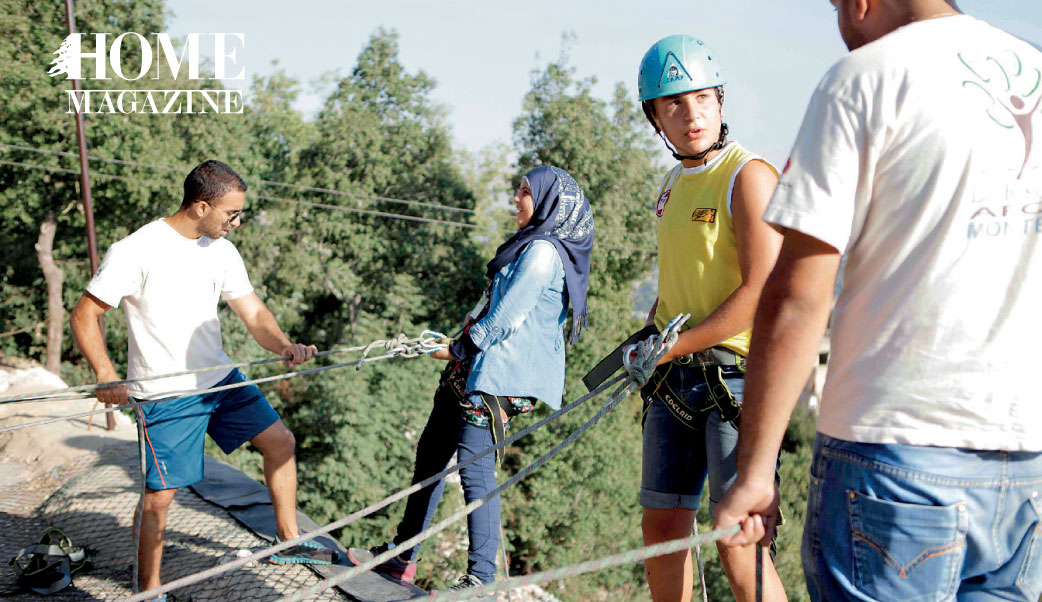
Linaltaki brings Muslim and Christian women together to organize a five-day summer camp for 60 children from all over Lebanon every year. The 13-year-olds take part in workshops, creative activities and games around the themes of conflict resolution, communication, emotional intelligence and challenging prejudice.
The children play, eat, and live together. They attend the workshops and ateliers. They ask questions, they share stories, they sing. They put a show together for their parents and friends on the final day of the camp, then return to their communities having made wonderful friends and memories.
Ongoing since 2010, these camps have had a profound impact on the children, who are exposed, often for the first time, to beliefs and ways of life different from their own. Acceptance, respect, shared values. One of the participants, Nour Banna, said: “I learned that God is one and he has no religion… we are all children of God.” Many maintain the new friendships they have formed for years after the summer camp.

The impact is felt by the organizers as well, and even the families to which the children return. Year after year siblings and classmates of former participants ask to take part in the camp themselves. The premise of Linaltaki’s mission is Pope John Paul II’s message to Lebanon: “Lebanon is more than a country. It is a message of freedom and an example of pluralism for East and West.”
That Lebanon exists, and within it so many beliefs and cultures, stories and traditions, is a powerful message to the world: The Other is just Another. Another learning experience, another perspective, another friend perhaps?
“When we love each other as mothers, our children will end up loving each other as not make war again.”
It takes courage to let go of the fear and prejudices one has been building for years, to dare to say: “let’s meet.” But “by not reaching out to the other,” says Lina, “I missed not only the beauty of the other but of myself.” Marie adds: “And when we love each other as mothers, our children will end up loving each other and not make war again.”
Neither Lina nor Marie could have envisioned the friendship or extraordinary project their first cup of tea would launch. Since then, over campfire conversations, games, and songs, they have been breaking barriers, challenging stereotypes. They have shared their story and led workshops on conflict resolution and reconciliation, both in Lebanon and at Initiatives of Change conferences in Caux, Switzerland.
The greatest challenge they still face is bringing this message of friendship HOME; in the hearts and minds of many Lebanese in their respective communities, the wounds of the past are still fresh. These ladies do not believe in ignoring differences, but “we believe that what unites us is far greater and more sacred than what separates us”… and that is a future for their children. And by meeting, talking, and organizing this summer camp, they hope to raise a generation that will truly be a message of freedom and pluralism for the East and the West.
FB: Linaltaki
For more info: www.linaltaki.org
HOMEland Magazine
We firmly believe that the internet should be available and accessible to anyone, and are committed to providing a website that is accessible to the widest possible audience, regardless of circumstance and ability.
To fulfill this, we aim to adhere as strictly as possible to the World Wide Web Consortium’s (W3C) Web Content Accessibility Guidelines 2.1 (WCAG 2.1) at the AA level. These guidelines explain how to make web content accessible to people with a wide array of disabilities. Complying with those guidelines helps us ensure that the website is accessible to all people: blind people, people with motor impairments, visual impairment, cognitive disabilities, and more.
This website utilizes various technologies that are meant to make it as accessible as possible at all times. We utilize an accessibility interface that allows persons with specific disabilities to adjust the website’s UI (user interface) and design it to their personal needs.
Additionally, the website utilizes an AI-based application that runs in the background and optimizes its accessibility level constantly. This application remediates the website’s HTML, adapts Its functionality and behavior for screen-readers used by the blind users, and for keyboard functions used by individuals with motor impairments.
If you’ve found a malfunction or have ideas for improvement, we’ll be happy to hear from you. You can reach out to the website’s operators by using the following email
Our website implements the ARIA attributes (Accessible Rich Internet Applications) technique, alongside various different behavioral changes, to ensure blind users visiting with screen-readers are able to read, comprehend, and enjoy the website’s functions. As soon as a user with a screen-reader enters your site, they immediately receive a prompt to enter the Screen-Reader Profile so they can browse and operate your site effectively. Here’s how our website covers some of the most important screen-reader requirements, alongside console screenshots of code examples:
Screen-reader optimization: we run a background process that learns the website’s components from top to bottom, to ensure ongoing compliance even when updating the website. In this process, we provide screen-readers with meaningful data using the ARIA set of attributes. For example, we provide accurate form labels; descriptions for actionable icons (social media icons, search icons, cart icons, etc.); validation guidance for form inputs; element roles such as buttons, menus, modal dialogues (popups), and others. Additionally, the background process scans all the website’s images and provides an accurate and meaningful image-object-recognition-based description as an ALT (alternate text) tag for images that are not described. It will also extract texts that are embedded within the image, using an OCR (optical character recognition) technology. To turn on screen-reader adjustments at any time, users need only to press the Alt+1 keyboard combination. Screen-reader users also get automatic announcements to turn the Screen-reader mode on as soon as they enter the website.
These adjustments are compatible with all popular screen readers, including JAWS and NVDA.
Keyboard navigation optimization: The background process also adjusts the website’s HTML, and adds various behaviors using JavaScript code to make the website operable by the keyboard. This includes the ability to navigate the website using the Tab and Shift+Tab keys, operate dropdowns with the arrow keys, close them with Esc, trigger buttons and links using the Enter key, navigate between radio and checkbox elements using the arrow keys, and fill them in with the Spacebar or Enter key.Additionally, keyboard users will find quick-navigation and content-skip menus, available at any time by clicking Alt+1, or as the first elements of the site while navigating with the keyboard. The background process also handles triggered popups by moving the keyboard focus towards them as soon as they appear, and not allow the focus drift outside it.
Users can also use shortcuts such as “M” (menus), “H” (headings), “F” (forms), “B” (buttons), and “G” (graphics) to jump to specific elements.
We aim to support the widest array of browsers and assistive technologies as possible, so our users can choose the best fitting tools for them, with as few limitations as possible. Therefore, we have worked very hard to be able to support all major systems that comprise over 95% of the user market share including Google Chrome, Mozilla Firefox, Apple Safari, Opera and Microsoft Edge, JAWS and NVDA (screen readers).
Despite our very best efforts to allow anybody to adjust the website to their needs. There may still be pages or sections that are not fully accessible, are in the process of becoming accessible, or are lacking an adequate technological solution to make them accessible. Still, we are continually improving our accessibility, adding, updating and improving its options and features, and developing and adopting new technologies. All this is meant to reach the optimal level of accessibility, following technological advancements. For any assistance, please reach out to