
HOMEland
Coming Soon
HOMEland Events & Collaborations
Coming Soon
 Signature Boutique


An unlikely tale of two towns, on either side of the world, with a strong relationship and shared culture and customs.
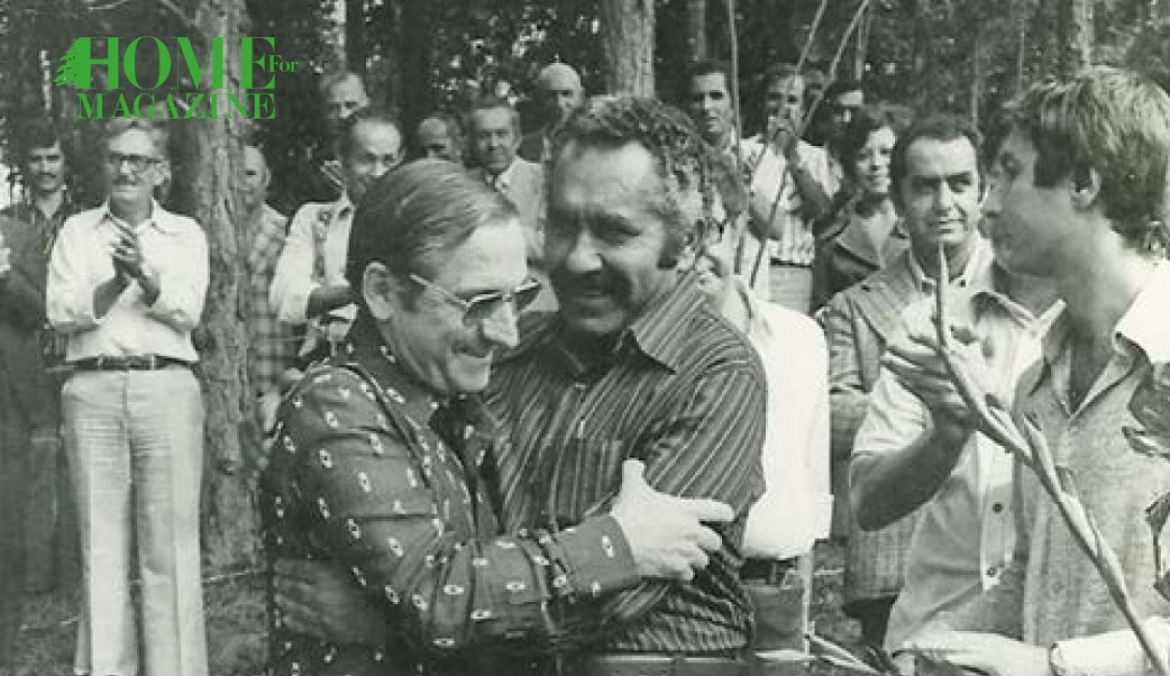
Lebanon, one of the smallest countries in Asia, is located thousands of miles away from Brazil, the largest country in Latin America, but the geographical distance has not prevented the two nations forming a close fraternal bond that grows stronger year after year. The town of Lucy is an example of this. According to the only historical book of Lebanon written in Portuguese, by historian Roberto Khatlab called “Lebanon, an Oasis in the Middle East,” Lucy was built on the city Sultan Yaacub al-Fauka located on the mountain by the Bekaa Valley, 1,250 meters above sea level.
Lucy is a Brazilian town on Lebanese soil. Ninety percent of its population speak the Brazilian Portugese dialect. In addition to this, Brazilian cuisine can be found here including feijoa, feijoada, pastel, cheese bread and drinks such as guarana. Lucy is the reflection of Brazil in Lebanon, or “mini Brazil” as the senator and former Brazilian President Jose Sarnet referred to it during his visit in 1999. This impact goes back to the flood of Lebanese emigrants to Brazil in the 1960s where large families, such as the Barakat, Orra, Jarouche and many others, moved in search of a better future.
To help trace the Lebanese diaspora in Brazil, which total about 10 million Lebanese and is the largest Lebanese diaspora in the world, we interviewed Dalila Barakat, whose father, Mohamad Barakat, was a Lebanese emigrant who left Lebanon in 1952 and came back to visit his relatives and friends and enjoy the summer right up until this year of 2015, just before his death, in 29th September in Brazil on the diaspora day (Allah Yerhamo).
Setting out for a new land
Dalila’s father was 16 when he left Lebanon heading to Brazil. He and his friend, Abou Sleiman Jarouche, travelled to Brazil by cargo ship with only $2 in their pockets. Even though it was a hectic and long journey, nothing could stop him.
“Mr. Barakat and his friend, Abou Sleiman Jarouche, travelled to Brazil by cargo ship with only $2 in their pockets”
He arrived at the port of Santos, in the State of São Paulo, where he was well received and helped to settle by two “brimos” or cousins (the word is “primos” in Portuguese but in Arabic there is no “b”). Mr. Ali Barakat started working for a company selling tissues and then later sold mattresses. As he wanted totalindependence he started to buy products to sell himself.
Through his entrepreneurial character, a Phoenician trait, he started trading and managed to get him name around the markets. After, he headed to St. Andrew, in São Paulo, where he bought leather for shoes, which added to his repertoire.
After establishing himself, he brought his brothers and then their parents and sisters to Brazil, so that everyone could contribute to his evolving business. His hard work paid off and he made enough money to begin constructing buildings.
He was grateful to Brazil for the opportunities this country offered, a land he chose for his new life, a country that welcomed him and pushed him toward success.
Coming home in search of love
The story of Mr. Barakat is just one of several cases of Lebanese who left Lebanon in search of new horizons and who would return to their land and invest in it. The vast majority of Lucy is Lebanese who went to Brazil and worked in the furniture and mattress industry. Currently some work in the timber industry.
The first generation worked hard and had to learn Portuguese, totally depending on themselves. But all that was worth it to provide a better life and education for the next generation. A good example of the success of the second generation is the son of Mr. Barakat, Dr. Mohamad Ali Barakat, an endocrinologist recognized in Brazil, better known as Dr. Barakat. He was a partner at Aviccena Hospital, where he became president.
His father, at the beginning of the 1960s, returned to Lebanon in search of love. Mrs. Zaher Barakat Saker was the one, known within the Lebanese community in Brazil as “Dona Rosa,” an important figure in the social life of the community. Dona Rosa was from the city of Baloul, also in the Bekaa Valley. A portion of Baloul’s population emigrated to Panama, Central America, and so as people in Lucy speak fluent Portuguese, many from Baloul speak Spanish. Mrs. Zaher Barakat and her husband founded the Sultan Sports Club, in São Bernardo do Campo in Brazil, in honor of the city of Sultan Yaacub Tahta. The club played host to various events, traditional Brazilian parties, Lebanese parties, meetings and weddings, all of which strengthened the bonds of friendship and unity of the Lebanese community. Brazilian Lebanese descendants from Lucy live a typical life of São Paulo. However, the Lebanese tradition predominates in their daily lives and can be seen in the gastronomy, religion and customs. Every summer, Lucy’s descendants return to Lebanon to visit their parents and grandparents. Because of this Lucy has a strong family ethic, due to joy of families reunited and peaceful country life. They also worked at Mesquita do Brazil, one of the firsts Muslim Mosques in Latin America, as presidents and vice presidents in the 90’s.
“Brazilian Lebanese descendants from Lucy live a typical life of São Paulo”
Leaving a legacy
In the end, Mr. Barakat built a dynasty in Brazil over his 60 years there. He was owner of multiple businesses including the furniture store Olido, Furniture Elite. Mr. Bakarat owned a franchise in São Paulo, and built several buildings. He was an entrepreneur in the truest sense. A young man, who came to Brazil with $2, made a new life for himself and raised three successful sons. Dalila Barakat, a Brazilian, but in love with the Lebanese culture whose vocation lay in the field of communication and advertising, worked in the Future magazine in Brazil, for Tayyar Al Mustaqbal despite her training in law. She currently publishes the Lebanese culture through her blog 1001viagens, which has the support of the Brazilian Embassy in Beirut on social networks. So the invitation is there to visit a little piece of Brazil in Lebanon, on your next visit to the Bekaa, meet Lucy, and start the dialogue already in Portuguese, “Oi, tudo bem?” Meaning: “Hi, how are you?”
Signature Boutique
Lebanon, in your inbox


HOMEland Magazine
We firmly believe that the internet should be available and accessible to anyone, and are committed to providing a website that is accessible to the widest possible audience, regardless of circumstance and ability.
To fulfill this, we aim to adhere as strictly as possible to the World Wide Web Consortium’s (W3C) Web Content Accessibility Guidelines 2.1 (WCAG 2.1) at the AA level. These guidelines explain how to make web content accessible to people with a wide array of disabilities. Complying with those guidelines helps us ensure that the website is accessible to all people: blind people, people with motor impairments, visual impairment, cognitive disabilities, and more.
This website utilizes various technologies that are meant to make it as accessible as possible at all times. We utilize an accessibility interface that allows persons with specific disabilities to adjust the website’s UI (user interface) and design it to their personal needs.
Additionally, the website utilizes an AI-based application that runs in the background and optimizes its accessibility level constantly. This application remediates the website’s HTML, adapts Its functionality and behavior for screen-readers used by the blind users, and for keyboard functions used by individuals with motor impairments.
If you’ve found a malfunction or have ideas for improvement, we’ll be happy to hear from you. You can reach out to the website’s operators by using the following email
Our website implements the ARIA attributes (Accessible Rich Internet Applications) technique, alongside various different behavioral changes, to ensure blind users visiting with screen-readers are able to read, comprehend, and enjoy the website’s functions. As soon as a user with a screen-reader enters your site, they immediately receive a prompt to enter the Screen-Reader Profile so they can browse and operate your site effectively. Here’s how our website covers some of the most important screen-reader requirements, alongside console screenshots of code examples:
Screen-reader optimization: we run a background process that learns the website’s components from top to bottom, to ensure ongoing compliance even when updating the website. In this process, we provide screen-readers with meaningful data using the ARIA set of attributes. For example, we provide accurate form labels; descriptions for actionable icons (social media icons, search icons, cart icons, etc.); validation guidance for form inputs; element roles such as buttons, menus, modal dialogues (popups), and others. Additionally, the background process scans all the website’s images and provides an accurate and meaningful image-object-recognition-based description as an ALT (alternate text) tag for images that are not described. It will also extract texts that are embedded within the image, using an OCR (optical character recognition) technology. To turn on screen-reader adjustments at any time, users need only to press the Alt+1 keyboard combination. Screen-reader users also get automatic announcements to turn the Screen-reader mode on as soon as they enter the website.
These adjustments are compatible with all popular screen readers, including JAWS and NVDA.
Keyboard navigation optimization: The background process also adjusts the website’s HTML, and adds various behaviors using JavaScript code to make the website operable by the keyboard. This includes the ability to navigate the website using the Tab and Shift+Tab keys, operate dropdowns with the arrow keys, close them with Esc, trigger buttons and links using the Enter key, navigate between radio and checkbox elements using the arrow keys, and fill them in with the Spacebar or Enter key.Additionally, keyboard users will find quick-navigation and content-skip menus, available at any time by clicking Alt+1, or as the first elements of the site while navigating with the keyboard. The background process also handles triggered popups by moving the keyboard focus towards them as soon as they appear, and not allow the focus drift outside it.
Users can also use shortcuts such as “M” (menus), “H” (headings), “F” (forms), “B” (buttons), and “G” (graphics) to jump to specific elements.
We aim to support the widest array of browsers and assistive technologies as possible, so our users can choose the best fitting tools for them, with as few limitations as possible. Therefore, we have worked very hard to be able to support all major systems that comprise over 95% of the user market share including Google Chrome, Mozilla Firefox, Apple Safari, Opera and Microsoft Edge, JAWS and NVDA (screen readers).
Despite our very best efforts to allow anybody to adjust the website to their needs. There may still be pages or sections that are not fully accessible, are in the process of becoming accessible, or are lacking an adequate technological solution to make them accessible. Still, we are continually improving our accessibility, adding, updating and improving its options and features, and developing and adopting new technologies. All this is meant to reach the optimal level of accessibility, following technological advancements. For any assistance, please reach out to